
Who did the Welsh Government (WG) commission to undertake the evaluation of WG EHE guidance?
A commercial company, seemingly run by and employing mainly ex-WG staff. The key authors appear to be a former WG policy advisor and a former WG project manager.
How much this company were paid by WG conduct this evaluation has not been disclosed, nor has the exact source of this funding. The company website suggests that WG are one of their main commercial clients, if not the main one. This could imply that WG are a major source of income for this commercial company.
Evaluation of the Methodology
How do the evaluation authors try to justify their recommendations?
Based on assumptions or reasoned evidence?
Is there a reliable and representative approach to methodology?
Based on interviews solely with council staff (plus some input from schoolteachers or headteachers)
An evaluation of guidance on elective home education with the complete absence of input from home educators, from those with lived experience or those with differing perspectives.
No-one with differing views or experiences interviewed or used.
Only selections of responses used, full array of responses not available for evaluation and comparison.
Reliance on second and third hand data
No explorations of the instructions and briefing given by WG when commissioning, including what expected or desired aims, intentions or outcomes may have been conveyed.
No reference to who made the decision about the study design, particularly the decision to only include council staff or those from a school background, and not those impacted by present practice or with concerns about the kinds of recommendations made.
No explanation was given of the use of schoolteachers in an evaluation about guidance relating to children who do not use that form of institution. Could this reflect a school-centric institutionalised bias?
The evaluation starts with the premise that the desires expressed by council staff are needed, it gives no reasons for providing these powers other than saying staff want them, even though the evaluation also repeatedly describes attempts to overstep and misuse existing powers as if this is appropriate and to be commended.
The data given in Table 3.1 is somewhat confusing, as 4475 considered to be receiving a suitable education, plus 288 considered to be potentially missing this, does not equal the total number of learners given of 7146. If there is a reason for the discrepancy in the figures cited in this table, this is not stated.
Very limited external sources to evaluate the issues or their recommendations are used. These are not evaluated or critiqued. The main reliance would seem to be on those of Sally Holland’s previous reviews and communications with WG, without critiquing these. For example, there is no note, or even seemingly any awareness that a legal rebuttal of her use of the UNCRC in attempting to justify her recommendations was given to WG in 2022, a rebuttal that WG did not acknowledge, respond to, or publish.
Only sources that would support their recommendations are used, not, as one would expect in an “evaluation”, comparison and exploration alongside those that would raise alternative perspectives or outcomes.
The evaluation therefore seems to be based on very questionable methodology
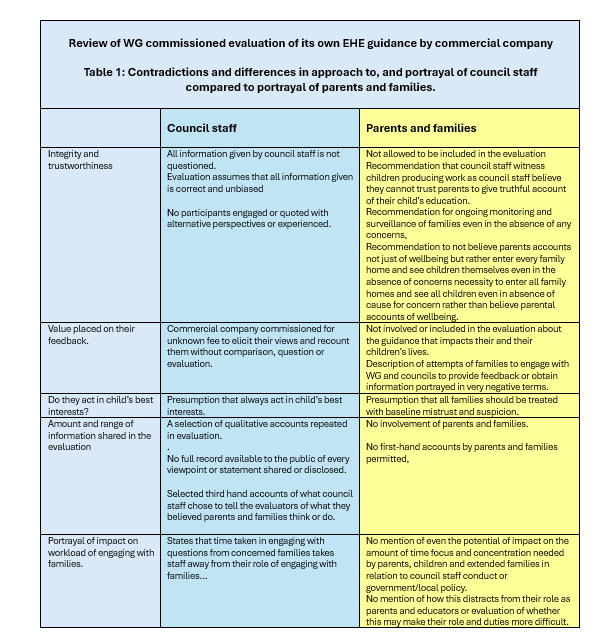
Do they portray a negative concept of home educators?
Seeks and promotes “power to compel parents”
Treats all parents with same suspicion, seeks same powers over all home educating families, not seeking powers to just target families where reasonable concerns.
Presumption that parents cannot be assumed to be acting in their children’s “best interests”, but that council staff who do not know the child will always do so and are in a better position to do so.
Conflation of “support” with providing approbation, perpetuating a paternalistic view of “oversight”.
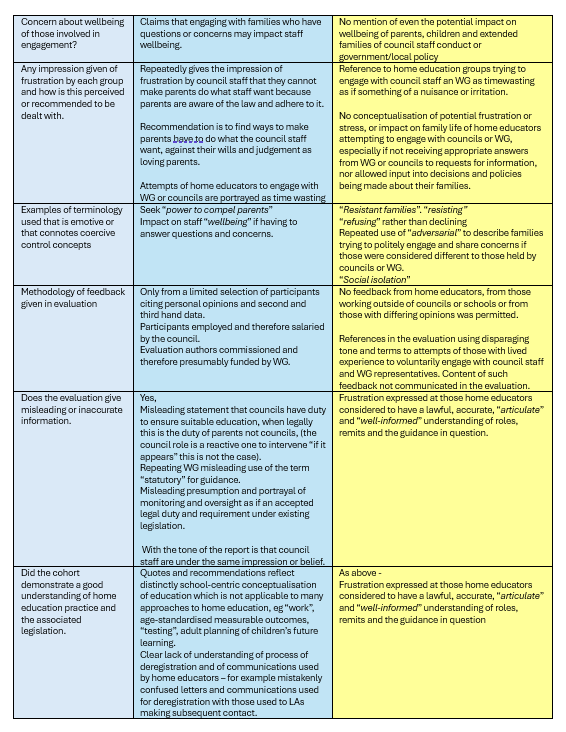
Repeatedly negative tone and terminology for home educators who show empowered or independent thinking, such as being aware of their lawful duties and responsibilities as well as those of the council, or who show an accurate and lawful understanding of the guidance.
Groups or events organised by the council portrayed in very positive tones, giving an impression to a reader without experience of home education as if these are the only groups and events of such types, giving an impression that these would not be likely to occur otherwise. However elsewhere, negative terminology and tone towards home education peer led community groups, conveying the impression that these are seen as something of a nuisance and irritation, especially if they try to engage with the council or WG.
Frustration expressed at time and effort taken to engage with families with concerns or questions, when employed and paid to engage with families.
If home educators maintain relationships based on lawful remits, then they are repeatedly termed “resistant” or said to be “resisting”. If home educators choose to communicate in writing when cooperating with informal enquiries from the council, they are wrongly described as “refusing” to “cooperate” or engage. Cooperating with enquiries by written means is not refusing to cooperate or engage. Likewise, families are portrayed as “refusing” to “cooperate” if they choose not to take up offers of what is meant to be “voluntary support”, which is something of a contradiction of the words “voluntary” and “support”.
Repeated use of the derogatory and discrediting term “adversarial”, without evidence to back up this claim, to describe families trying to engage about processes and policies being implemented on their families.
Concept of home education advocacy and support groups being “well-resourced” with a tone that could connote this would be an unfair or suspicious situation, when in fact such groups are simply families expressing concerns. Even if such peer-led home education support groups were “resourced” in some way, the councils and WG who they are trying to engage with are clearly far more “resourced”, including ready access to legal representation if that were necessary. So, if WG or councils choose to perceive such groups’ attempts to engage and communicate as being “adversarial”, and choose to treat them as such, the playing field they create is then hardly a level one.
There is no evaluation or reflection on these negative terms and concepts towards home educators, but just a seeming presumption that they must be justified if said by council staff.
Thus, there is no reflection on the potential of misuse of existing powers, or of any potential of institutionalised bias or discriminatory or paternalistic attitudes, let alone how these would impact the use of markedly increased powers by council staff.
Templates produced by WG or council staff are considered to be extremely helpful, without reference to feedback from home educators explaining inappropriate use of these including how some can risk encouraging unlawful actions.
Templates produced by home education groups to help other home educators treated with a tone of suspicion and distain. This is even though the evaluation reports such groups to be “articulate” and when there is a seemingly grudging acknowledgment that home educators’ understanding of lawful boundaries is correct.
The report therefore appears to perpetuate a negative, paternalistic and authoritarian attitude of suspicion towards home educators.
Do any statements appear to be misrepresentative or inaccurate?
The evaluation misrepresents lawful duties by repeating a previously used claim that councils have a legal “duty to ensure every child has a suitable education”. This legal duty lies with the parent, not councils, who would rapidly be bankrupted if it did, because they would then be liable for every time they do not provide a suitable equation for a child. The council’s remit is a reactive one to intervene “if it appears” a parent is not fulfilling their duty.
The evaluation reflects WG’s misleading use of terminology in referring to the present guidance as “statutory”. The 2023 guidance was given the term statutory, compared to the title of “non-statutory” for the previous guidance. There is a contradiction in the depiction of calling the present guidance “statutory” and the subsequent complaints that councils cannot force parents do what they want because of their understanding of lawful remits but that they want to be able to have more “power to compel parents”
However, there were no new “statutory” elements to the 2023 guidance, no new mandatory requirements. Most of the 2023 guidance, including the new preferences for parental behaviour, are non-statutory.
The evaluation repeatedly perpetuates the misleading presumption and portrayal of monitoring and oversight as if an accepted legal duty and requirement under existing legislation, when this is not correct. WG CME statutory guidance, the former Welsh EHE guidance and the present English EHE guidance, all of which are based on same legislation, confirm any such portrayal to be false. The impression given is that monitoring and oversight of EHE families are the remit of the council and that staff just wish for more powers to enact a remit that they do not have lawful basis for.
Lack of balancing evaluation of statements made perpetuates any biases and beliefs expressed as if these are impartial, accurate and fully reflective.
Do the authors, or those they have interviewed, appear to understand home education?
The quotes used and recommendations given reflect a distinctly school-centric conceptualisation of education which is not applicable to many approaches to home education, e.g., “work”, age-standardised measurable outcomes, “testing”, adult planning of children’s future learning.
Clear lack of understanding of process of deregistration and of communications used by home educators – for example mistakenly confusing letters and communications submitted to school on deregistration with those used with council staff if and when they subsequently make contact.
Belief repeated expressed that unsolicited and unexpected phone calls or visits to house (a practice known as “doorstepping”) are beneficial, engaging and welcome by home educators, even with the admission that as well as being unsolicited that these are done to try to see children or obtain information about them while parents are not expecting such encounters. This is very different to how home educators generally perceive such unsolicited practices; these are often considered unprofessional and intrusive.
Indeed, ironically this is just the kind of issue that home educators often seek to try to provide constructive feedback on, so it would appear that such feedback from home educators isn’t just considered a nuisance but it is also not heard, understood or appreciated.
We can of course provide examples of such attempts at constructive feedback.
Focus on goals such as “data capture” and a one size fits all approach, both of which are rather incongruent to most home education philosophies.
Repeated statement that home education groups that attempt to engage with WG or councils on policy or practice issues are “adversarial”, as well as believing they are “well-resourced” – as mentioned above.
Again, there seems to be no evaluation or reflection on whether these beliefs and understandings are appropriate or of other perspectives.
Why did WG commission and publish such an evaluation?
Such an evaluation was mentioned in documentation relating to the CME database consultation. Those extensive pilots involving non-consensual datasharing of identifying data from primary healthcare sources on all children of CSA in the seven LAs involved. Evaluation of those extensive pilots seems to have been commissioned by the same commercial company that conducted this evaluation.
Will this evaluation of EHE guidance be used, alongside evaluation of those extensive “CME database” pilots to justify extending those pilots to be permanent and cover all of Wales?
Inadvertently leaked comments on the WG website regarding publication of this evaluation revealed that the timing was intended to use this evaluation to “inform” the Vote at Plenary on the Legislative Consent Motion (LCM) to apply key clauses of Westminster’s CWS Bill to Wales. That process has been termed “piggybacking” onto what was designed and drafted as an England-only bill and put through the House of Commons as such.
It would also appear that this evaluation is intended to influence new guidance on EHE in Wales, especially if the Senedd did decide to use Westminster’s CWS Bill rather than using devolved powers on a devolved issue.
So, these motivations for publication of such an evaluation could raise the question: is this what some might consider a “propaganda piece” to promote political agendas or ambitions?
Or is in an informed and independent evaluation to open up discussion and engagement?
What does this “evaluation” want and recommend?
If the recommendations were adopted, then the requirements would be the following mandatory enforcements against all EHE families, not only to selected families with reasonable basis for concerns.
Mandatory meetings on deregistration whether the parents and children feel it is appropriate or wise to attend these or not.
This includes children already unable to attend school due to school-trauma and other such issues.
The evaluation does not mention let alone explore the impact on children of this recommendation.
Asking council staff to determine what is in the child’s “best interests” when the parents and family have already done so.
How the opinions of council staff would then be applied is not expressly considered in the evaluation, but the overriding tone gives the impression of intention to influence parental decisions and choices to align with the opinions of council staff.
Appearing to interview the child not just the parent.
Again, the impact of this on children is not explored or mentioned in this evaluation.
Does this include attempts to influence family choice and persuade the child and/or the parent to change their minds on the decision they have made? to prefer to stay in school?
This is not directly addressed in the evaluation, but the overriding tone is that school is better than home education.
Does this risk the state trying to come between the parent and child in some way? To seek to influence children against family-based preferences, choices, decisions and beliefs?
does this reflect innate institutionalised discrimination of a belief that school is preferable to home education?
This prosect is not addressed in the evaluation.
What safeguards would be in place to ensure there is no coercion or institutionalised discrimination regarding families’ decisions and beliefs? This is not addressed in the evaluation.
At such “deregistration meetings”, parents would have to provide future plans for the education. this would undermine many child-led approaches to home education. provision of future plans at deregistration would mean only adult-led approaches would be allowed. That would be both discriminatory and damaging to the child’s education especially as children are so often deregister because adult-led approaches have failed to provide a suitable education. it would inhibit the ability of families to explore a wide range of educational pedagogy.
These negative impacts are not addressed in the evaluation including by council staff
There is no mention of consequences for families if they do not “adhere” to the plans they have provided. However, the definition of an efficient education is that which achieves what it sets out to achieve. So the risk is that education would subsequently be deemed inefficient and therefore unsuitable if and when families find that they need to change their initial plans and concepts of home education to be more appropriate to the child’s needs. Thus the provision of future plans would be inhibitory to parents being able to fulfil their lawful duty to ensure that a child receives an education that is suitable for each child’s age aptitude and ability.
Again, these issues are not addressed in this evaluation.
Regular mandatory meetings as monitoring and oversight of family life.
Following such a meeting, the recommendation is for, more regular mandatory meetings as monitoring and oversight of family life. These would be to not only see the child but witness them producing work because of the repeated message that it should be assumed that all EHE parents cannot be trusted including cannot and must not be trusted to tell the truth. you’re sure there’s a fair chance parents will be lying to you too.
This is contrary to the principles of innocent until proven guilty.
This is contrary to the principles of empowerment and promotion of unity in family life.
The evaluation safely perpetuates the myth that if a child’s name is not on a register and if they are not “seen” annually by a council employee then there are somehow “invisible” to society as if under some sort of “invisibility cloak”- whereas such a visit makes them somehow “visible”.
The evaluation pays no regard to parental information of how their child is active and engaged in society, but would appear to dismiss this as irrelevant or not to be believed.
The evaluation pays no regard to the negative impact on children and families of such negative beliefs and stereotypes.
The evaluation pays no regard to the negative impacts of being under such suspicion or surveillance, or of visits, especially when entering into the child’s own safe space of home.
The evaluation pays no regard to the potential of conscious and unconscious bias in council employee perception of home and family life, including the home environment.
The evaluation speaks of measuring the child’s “progression”, including having professional assessors prepare templates and approaches to compare home educated children to standardised expectations for their age.
No evaluation of costing and source of funding for all these measures including this aspect.
No evaluation of the conflict of this approach with the variety of pedagogy commonly used by home educators that are based
See our article on the conflict of using measures of progression in the educational approaches often used by home educators
Providing “events” with the intention of using these to surveil and monitor loving families.
including opportunities to speak to children without their parents, again based on the principle of not trusting parents.
No evaluation of negative impact of potentially paternalistic or suspicion-based approaches on the wellbeing of families.
No reference to how many such events and learning or social experiences have been arranged by home educators themselves within the community for decades. The impression is given that children would be socially “isolated” or lacking contact with peers unless the council were to do this. the impression is given of lack of such opportunities if it wasn’t for the action of council staff, which is not reflective of the true situation.
This is, of course, only a selection of the issues of concern in this “evaluation”.
To appreciate the limited perspective of this WG commissioned evaluation further, please do engage with us here, or with home educators in your area.
A copy of this WG commissioned evaluation of their EHE guidance can be found here
 Wellbeing in Education Wales
3 responses to “An “Evaluation” of the Welsh Government Commissioned “Evaluation” of their 2023 EHE guidance.”
[…] for visits/meetings are not engaging was recently repeated in the Welsh Government commissioned evaluation of their present EHE guidance. That evaluation was completed by former Welsh Government staff based […]
LikeLike
[…] be asked to participate in the evaluation, as occurred with the Welsh Government commissioned evaluation of the effectiveness of their EHE […]
LikeLike
[…] Welsh government commissioned evaluation of EHE guidance spoke of the desire for “powers to compel” […]
LikeLike