This survey was designed to evaluate measures proposed or considered in the Children Not in School clauses of the Children’s Wellbeing and Schools (CWS) Bill, alongside consideration of some of those suggested in the Welsh Government commissioned evaluation of its 2023 guidance on elective home education (EHE), publication of which was timed to “inform” voting in the Senedd on that Bill.
The approach of the survey was twofold:
- To assess the views of home educators on such potential future measures in relation to EHE, particularly as there has been no engagement with home educators on either
- To evaluate home educators’ present experiences of LA conduct, including overstepping or lawful or respectful remits or inappropriate practices, as part of evaluation of whether it is safe or wise to consider markedly extending powers and remits of LAs, especially in the absence of any independent complaints, appeals, mediation, advocacy or tribunal services or systems.
Overview of Key Results of the Survey
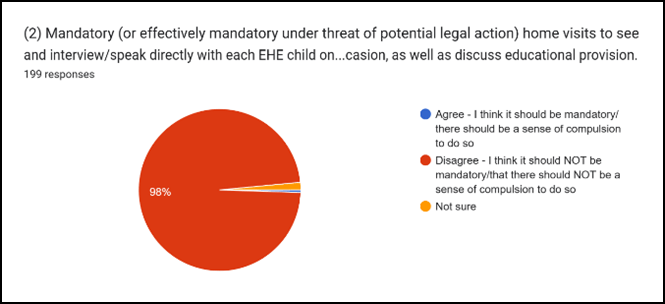
- Mandatory (or effectively mandatory) measures such as those contained in the CWS Bill, or mentioned in the WG-commissioned evaluation of their EHE guidance, were almost universally rejected as being considered suitable or acceptable.
- No respondent believed that the CNIS clauses of the CWS Bill should apply to Wales.
- Reasons given for this clear stance included
- not only disagreement with the content, the lack of sufficient scrutiny and understanding of impacts, and the presence of sufficient existing legislation that needs to be used correctly,
- but with nearly two-thirds of respondents indicating that they “disagree with Westminster passing laws on a devolved issue”.
- Likewise, the intrinsic premise within the CWS Bill that councils can always be guaranteed to act in the “best interest” of children and therefore it is safe to not have any independent appeals, complaints, mediation, advocacy or tribunal systems was also almost universally rejected.
- The responses to many of the proposals and ideas in the CWS Bill and the WG-commissioned evaluation of its guidance were most concisely summarised as:
“Tell me you don’t understand home education,
without telling me you don’t understand home education”.
- A range of ways in which overstepping of respectful or lawful boundaries in LA conduct impact home educators in Wales were highlighted and explored, raising questions on the wisdom and safety of any considerations of increasing council powers and remits.
- The wide range of responses gave significant insights into the concept of home education, as well as the difficulties and challenges that can already be faced by a number of Welsh home educators in relation to LA conduct, and reading these would be a vital step before any consideration of development of policy or legislation.
- These are summarised in the main survey report in section A and B, with more extensive ranges of examples given in Sections C and D.
- Some initial insight into the experiences of home educators can be gleaned from consideration of the semantic fields given in questions such as Question A.12 and Question B.3.4.3
- A range of safeguarding risks from various measures within the CWS Bill were highlighted in number of sections of the survey.
- These include risks of self-harm and suicide of children in direct relation to impacts of proposed measures in the CWS Bill.
- The data shows a distinct contrast to views and opinions given in the WG-commissioned evaluation of their EHE guidance, including marked discrepancy between how council staff portrayed normal conduct and experiences of home educators and accounts and information given by home educators in this survey.
- The inherent conflict of interests was highlighted of the same person or department being expected to enact lawful remits in screening for whether legal action is required against families, to also being in a non-lawfully binding potential role of “support” (or to offer “advice and information” as the CWS Bill puts it), and furthermore to deal with any complaints or attempts to appeal misunderstandings or decisions.
The survey generated a wide range of quantitative data, demonstrated in a series of graphs and tables within the main survey report. These need to be considered in the context of each question for the significance to be fully appreciated.
Key findings from quantitative data include:
Over two-thirds of respondents (68.8%) indicated an awareness of potential discrimination or bias of council staff as a potential influencing factor of how they or their educational provision would be viewed,
with nearly two-thirds indicating that feeling treated with suspicion impacted how they chose to engage with council staff.
- Nearly one-third of respondents had experienced cold-calling by council staff to make enquiries about their children and educational provision, with only 3% finding this helpful, pleasant or positive.
Over two-thirds of respondents were unable to clearly identify the person visiting or calling despite information about children or access into family homes often being sought, highlighting one of a range of safeguarding concerns. - Reasons for declining visits, unsolicited or prearranged, focused on concerns on parents safeguarding the wellbeing and education of children, as well as protection from bias and production of “paper trail” as evidence of engagements.
Over two thirds of respondents indicated that they had received misleading communications from council staff giving the impression or stating that home visits or meetings with council staff were a requirement (when they are not),
with less than one-third of such communications enabled respondents to exercise informed consent in relation to meetings.
- Less than 45% of those who agreed to home visits or meetings did so with fully informed consent, knowing these were not a requirement.
- Of the respondents who declined requests or LA-scheduled appointments for home visits or meetings,
only 12.5% were able to do so because the council had provided sufficiently clear and appropriate information for them to know this was an option.
Just over one-fifth of respondents who exercised their lawful rights to decline a home visit or meeting, indicated that they had meet some form of difficulties from their LA for declining a visit/meeting, with the range of these experiences explored within the survey report.
Further indication of the extent of misleading, inappropriate or unclear communications from the council is indicated in the finding that in only 25% of cases where “samples of work” were obtained was this with fully informed consent.
No respondent believed that council staff personally witnessing children producing samples of work would be beneficial to children’s wellbeing and education, with over 90% deeming this to be detrimental to the wellbeing and education of children.
12.5% of the total number of respondents to this survey indicated that they had tried to make an internal complaint about the conduct of LA staff or about LA policy and practice in relation to EHE,
- with only 12% of these having found the process to be to any extent easy or straightforward,
- and only 8% being in any way satisfied with the outcome or considering the issue to have been resolved.
Nearly one-quarter of respondents reported they felt they had wanted to make a complaint about LA conduct, or that they had grounds to, but did not.
- Reasons included being concerned about potential or perceived negative personal consequences of putting in a complaint or raising concerns (66%)
- or feeling it would not be worth the effort/would not be listened to (66%).
- Difficulties in the process were also given as reasons.
The findings correlate with the conclusions of a recently published research report by the charity Educational Freedom, where highly disproportionate use of legal action by LAs against home educating families was demonstrated. Two Welsh LAs appeared in the “worst ten” of the country for the UK, despite Wales only having 22 LAs out of some 500 in the UK, and the average rate of instigation of legal action against families was markedly higher in Wales than England, despite no evidence of increased need.
The survey highlighted the mixed nature of experiences of home educators in Wales in relation to local authority conduct, some positive, some negative.
The information in the survey strongly suggests the risks and concerns that an introduction of the CWS Bill would cause deterioration in all areas,
- with previously positive engagement becoming negative
- and with negative engagement becoming worse without any checks and balances or means of redress
It is beyond the scope of this study to determine the reasons for the apparent persistence of suboptimal conduct by some, such as misleading and inappropriate communications from councils.
- This study is not able to evaluate or establish whether this could be the results of, for example, intentional practice, repeated oversights or a commonly occurring lack of understanding.
- It is relevant to note that home educators as individuals and as groups have sought to engage with local authorities in Wales to provide constructive feedback and attempt to improve practice by ensuring correct information is provided to council staff.
- Likewise, relevant information on commonly experienced issues that home educators can experience in engagement with the council is readily available in the public domain on websites of home education groups and charities.
- However the only CNIS related clause or amendment of the CWS Bill that the Welsh Government have NOT requested apply to Wales is the one that would allow a duty on councils to at least listen to concerns of families, even though there would be no duty to act on concerns expressed and this clearly would not be independent or enable concerns to be raised anonymously.
It is hoped that attitudes conveyed in the WG-commissioned evaluation of their guidance of council staff towards home educators who seek to constructively engage are not factors in the lack of progress in such areas.
Key take home messages include:
(1) It is inconceivable to consider such an unprecedented increase in powers and remits to council staff when there is consistent evidence of misuse of existing ones,
(2) It is even more inconceivable to consider doing so without independent accountability or redress for overstepping or inevitable mistakes even under existing powers.
It would be ridiculous to believe that any internal complaints or accountability mechanisms to those who advocate for or devised the policies leading to such problems would be impartial or appropriate.
(3) The 2023 Welsh Government guidance has been problematic and generally felt to have worsened the experience of home educators in Wales, not because of a need for more “powers to compel”, but because of encouraging conduct towards pressurising, misleading or compelling families to comply with measures without lawful remit and without need.
It has been ineffective because the premise of suspicion of parents and an authoritarian approach, as so concerningly demonstrated in the WG-evaluation of their guidance, are counterproductive.
(4) The various measures under consideration were not requested or wanted by home educating families in Wales.
To consider a consultation on how to implement such measures after bringing them into legislation would be a classic example of closing the stable door after the horse has bolted, as well as dismissing grave warnings of safeguarding risks and harm to the wellbeing and education of children.
These families, who have not been consulted or engaged with by the Welsh government or LAs on such measures, were able to articulately express in this survey why a range of such measures would be damaging, counterproductive and bring safeguarding risks.
The only safe option can be to abandon the concept of “piggybacking”, as the Attorney General has phrased this, onto what was designed as an England-only Bill from Westminster,
to allow the people of Wales and their elected representatives time and scope for appropriate evaluation, consideration and reflection on policy development and use of limited resources, based on the needs and experiences of the people of Wales.
Wellbeing in Education Wales
8th March 2026.
Links:
Survey report can be found here:
Further information can be found here on the impact of varous measures proposed, the lack of scrutiny or impact assessments, legal challenges and other related issues.
For example: “Evaluation” of the WG-commissioned “evaluation” of their guidance can be found here:
Educational Freedom report “Local Authority Enforcement – LAs still abusing their powers” – original report here, as applies to Wales here:
Helpful further information can be found here:
- The approach of the survey was twofold:
- Overview of Key Results of the Survey
- Key findings from quantitative data include:
- Key take home messages include:
- Links:
A PDF Version of this summary can be downloaded from below:
 Wellbeing in Education Wales