Part A – Information Available in the Public Domain via Council Websites
March 2026
It is hoped that this initial evaluation of the reliability of information provided by LAs about EHE will be of use in informing the debate of consideration of application of Children Not in School (CNIS) sections of Westminster’s Children’s Wellbeing and Schools (CWS Bill) to Wales
Methodology
This report is based on evaluation of the information that was available on the websites of each county or city council in Wales, as of 10th March 2026.
Whilst there are 22 LAs in Wales in total, Gwynedd and Isle of Anglesey function as one department in relation to home education, and therefore are treated as a single LA for the purposes of this analysis.
No information page on EHE could be found on the websites of two LAs, two had simply an email address and links to WG guidance, another had two sentences and address/phone number, another had seven sentences. None of the LAs with minimal information gave links to local policy as a separate document. Thus, it is extremely difficult to gain any impression of the understanding of these councils from the information in the public domain on their websites.
Further searching could reveal scrutiny committee meeting minutes for some, which often contained very concerning and misleading comments, but analysis of scrutiny committee meetings is a topic for a separate survey.
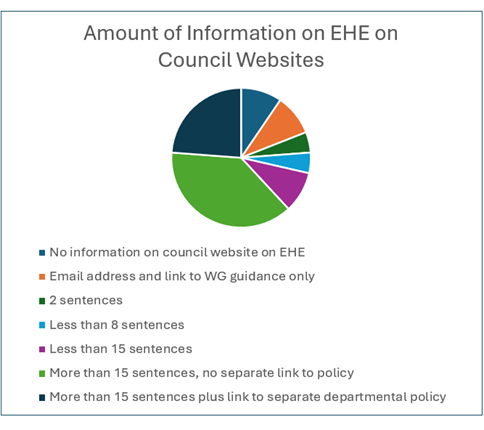
Out of the 21 LAs, 5 had a link to their local policy on their website. A further three had more extensive information directly on their webpages that may or may not be the same as their local policy but was not identified as local policy.
So local policy on EHE was only clearly identifiable and accessible in 5/21 of LAs.
13 councils, including the 5 who provided links to documents containing local policies, had more than 15 sentences about EHE on their website (in addition to the content of such links).
These councils had variable and sometimes more extensive amounts of information directly on their websites (i.e. separately to any linked documents), either as a designed page on EHE or in relation to other educational issues such as ALNs, enabling some degree of analysis of the accuracy of the information and approach to EHE.
As departmental policies will be the subject of a follow up survey when sufficient LAs have responded to FoIs to provide these, the content of the linked policies was not generally included in this analysis other than comparison on the few points explored below.
Given limitations both in time and the amount of information available in the public domain, the evaluation particularly focuses on the most obvious areas of concern in terms of reliability of information or misrepresentations, rather than being able to take a more global assessment.
However, a report with thorough evaluation of each local policy will follow when access to these policies is possible.
LAs are not directly identified in this evaluation, as the aim is not to criticise individuals, but to be constructive and provide a general overview of problems in order to illustrate why measures in the CWS Bill are not appropriate or safe.
The main observations of this evaluation included:
Contact details for individuals or departments relating to EHE were noted to only available on council websites for 5 out of the total 21, with an email link to a 6th LA not functioning.
Of the 13 councils where there was sufficient information on their website for a degree of analysis, all had information that was either incorrect or was misleading.
(1) 6 claimed that the LA has a “duty to ensure” every child has a suitable education. 5 stated this on website, 1 not stating this on website but did in policy. Of the 5 councils who provided links to their policy as a document, 2 had stated this on their websites but not in their policy documents.
(2) 4 claimed they had a duty to determine or check suitability/duty to ensure parents are providing suitable education, that “must check home educated children are receiving a suitable education”, or that council staff are responsible for “making sure the home education is efficient, suitable, and appropriate”
(3) Further conflation of S436A and S437 of the Education Act 1996 was seen by the explicitly expressed expectation by 8 councils that they needed to be “satisfied” as part of initial informal enquiries. This was stated on 7 websites, with a further 1 of the 5 LAs who provided policy as a linked document demonstrating this in that policy but not on their website.
Explanation of these errors, misrepresentations and misunderstandings:
- Parents are the ones that are responsible for ensuring that children receive a suitable education. This is why parents cannot sue a school or LA when it fails to do so, as it was always the parents’ duty to ensure suitability of education, not the school or council.
- This is why any moves to obstructing, delay or prevent deregistration, as found in the CWS Bill would not only be immoral, but would also be of highly questionable lawfulness. If the council were truly responsible for ensuring each child had a suitable education, they would rapidly be bankrupted not only from all the measures they would have to put in place to ensure education was truly suitable for each individual child’s age, aptitude, ability and any ALNs they may have, but also from subsequent legal action from families for all the times that this is not the case.
- Councils do not have a lawful “duty to ensure every child has a suitable education, a duty to check suitability of every child’s education, or be the determiners of what constitutes “suitable”. Those are all the lawful duty of the parents. The lawful duty of the council is a reactive one, to act “if it appears” a child is not receiving a suitable education (S437 of the Education Act 1991), and prior to this their duty is to take measures, “so far as is possible to do so”, to establish the identities of children who are not in receipt of a suitable education (S436A).
- Understanding the significance of the phrase “so far as is possible to do so” is crucial here, as it means that councils should not breach any other laws, rights or ethical principles in attempts to establish such identities. The significance of this phrase is explored further here. https://he-byte.uk/england/so-far-as-it-is-possible-to-do-so/.
- Alongside this is the “Golden Rule” of British justice of the presumption of innocence. Because of the principle of presumption of innocence, police and social services are not allowed information or access to details about family life just because of the families’ lawful life choices, justifiable and reasonable grounds are required for police or social services to make enquiries, with a system of checks and balances including accountability measures for how such enquiries are then made.
- Should there be a disagreement between families and council staff as to whether a child’s education is considered “suitable” under S437 of the Education Act 1996, it is the courts not the councils who become the determiners of suitability. However, that can only be achieved should parents allow themselves to be taken to court for non-compliance with any SAOs, allowing them to then put their case to a magistrate (who may or may not be experienced in educational law or alternative educational approaches and pedagogy). Parents in such situations, who often have to self-represent when in court, therefore have to risk a criminal record, fines and their child being constrained to attend school provision they believe is not suitable if they fail to adequately put their case. This is because there are no independent appeals, complaints, mediation, advocacy or tribunal system for how councils handle existing remits, duty and powers. This is problematic enough in relation to use of existing powers, as the recently published survey on the experiences of Welsh home educators has demonstrated, let alone if the Senedd were to allow unprecedented increases in remits and powers by giving assent to the CWS Bill.
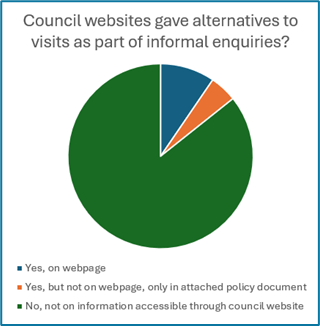
(4) All those 13 council webpages analysed further (those that provided more than 15 sentences of information) gave misleading info about visits and meetings.
- Only 2 websites clearly stated there were alternative ways to respond to informal enquiries, such as a written “report”, with a 3rd council stating this in the attached policy document but not the website.
- 12 out of those 13 councils used the term “will” in direct reference to aspects of home visits or meetings, conveying connotations of these being a foregone conclusion.
- For example, “will be an annual visit” or “the parent will be contacted by email / phone to arrange a meeting for this purpose”, or when referring to what “will” be discussed in such visits. 7 of these used such terminology on the website, 5 in their attached policy documents.
- 2 councils also used the term “should” on their websites in relation to home visits or meetings. This may be a reflection of the confusing nature of the WG guidance on EHE but is contrary to the previously obtained legal opinion of David Wolfe KC that “should” is an incorrect term to use in such circumstances as it carries the impression of something being a requirement when it is not.
- 10 of these 13 council webpages on EHE used the term “offer” in relation to meetings and visits. However, this does not clearly connote voluntary. “Offering” an appointment does not make it clear that the visit or meeting itself is an “offer”, it can equally be read that the date and time given are the offer of when such a meeting or visit could take place.
- Likewise, on the two occasions where it was stated that parents are able to decline such a meeting, this was immediately followed by reference to perceived duties of councils in a manner that risks readily connoting the parents are at risk of significant repercussions if they do not accept these.
- As with all other points of comparison, it is vital to note that, given the limited amount of info provided by many councils on their website, that several of the websites do not even mention meetings to be able to consider their approaches to them.
(5) 7 out of these 13 council websites explicitly stated a duty, remit or intention to “monitor” each family’s home education provision. All 5 attached policies also explicitly referred to the council having a role in “monitoring” home education, with each having separate headed sections in their policy containing the term “monitoring”.
Examples of quotes from webpages include:
“Annual monitoring visit”,
“In preparation for a monitoring visit”,
“A further monitoring visit may take place following this”,
“We will meet with you to discuss our role in monitoring your child’s education”,
“The initial meeting will clarify the local authority’s role in monitoring the provision”.:
Significance of this misinformation:
- There is however no lawful basis to monitor home education. The Welsh CME guidance clearly states that there is no lawful remit or basis for monitoring elective home education, as does guidance on EHE in England is based on the same primary legislation that applies to Wales.
- So, try to enforce this as if there were a lawful remit to do so would be to cause council staff to act unlawfully.
- No website or policy clarified that there is no lawful basis for monitoring EHE, therefore any such attempt at monitoring is conducted without informed consent if on the basis of this level of information alone.
- This is thus a very concerning level of misinformation not only for home educating families but also for staff employed and instructed by the council.
- However, all of the 13 council webpages analysed implied this to be a requirement in their use of follow up meetings/visits/assessments of suitability. For example, “need to provide information about the education you provide” as if this is a lawful requirement when it is not, it has rather become common practice to do so to avoid the risk of councils escalating enquiries. The concept of monitoring was often linked to a perceived “duty to ensure” regarding education.
(6) Deregistration was generally something that was discouraged rather than home education being portrayed as something to embrace.
Home education was usually portrayed as an option of last resort, especially if the child was already registered in a school, with parents usually urged to take measures to try to keep children on the school roll when deregistration was addressed on websites. This risks conveying what would be biased attitudes of “school is best”.
A somewhat school-centric concept of education was also conveyed in the choice of terminology used on a range of websites, such as planning, “homeschooling”, “good curriculum”, “teaching”, “what is taught” or “specialist teacher” (for council workers who contact families).
(7) One website gave inaccurate information in relation to parental responsibility and deregistration in stating, “Both parents with parental responsibility need to agree to the decision to home educate. Schools should not accept an instruction to deregister if it is clear parents are not in agreement”.
This is not correct and would cause staff to behave unlawfully if followed. It could also create dangerous safeguarding issues in cases of domestic abuse.
(8) 11 websites contained information for parents of children who had never been to school. 5 correctly stated that there was no “need” to notify the council, 5 websites asked parents to do this so the council could offer “support”, and 1 so that they could “exercise their duty”.
However, no council clarified directly alongside such request to notify them that, as a result of doing so the family would then be subject to “monitoring” by the council. The only outcomes given to the decision to notify the council that were home educating were of “support”, other than the one ambiguous reference to “exercise duty”.
Concerningly, 1 LA stated on their website that “For children not previously enrolled in school or who have moved into the area, parents should notify the local authority directly of their intention to home educate”, Again, as demonstrated in the counsel given by David Wolfe KC, “should” is a strong term that indicates a requirement, and there is no such requirement here. Another council’s website contained the incorrect statement, “If your child has never been to school, you do not need to give notice to the school, only the Elective Home Education Team”.
(9) Councils invariably portrayed home education as a right of parents rather than a right of children, and/or depicted it to be decision of “parents” rather than a choice of children or a family unit. For example, websites frequently contained phrases such as, “council respects and accepts the right of parents to educate their children at home” and “parents have a right to educate their children at home and we recognise that elective home education can be a valid choice”.
However, the appropriate perspective would be that it is children who have the right to be home educated rather than just parents having the right to home educate them. As children have a right to suitable education, not specifically to “school” education, then they have just as much right to home education as to attend a school. The decision to home educate, or to continue home education, is generally child focused or child led. Such portrayals of home education being the choice and right of parents rather than of children risks intimating that home education is not something that children choose, desire or wish to continue with. Such a concept that can fuel drives to elicit the voice of the child if the presumption is that it is a parental not family choice and as if it were somehow against the will of the child. This is of course somewhat ironic, as children are rarely asked if they wish to be registered at school or to continue attending one, outside of when the decision is made to deregister.
(10) Further examples of incorrect and misleading information were also noted with concerning frequency.
- While the limited information available does not specify an expectation of provision of samples of work or future plans as if these are definitely considered by the LA to be requirements, there was reference to expectations to, for example, “review evidence of progress” during meetings, or “outline their long-term goals and the strategies they will use to achieve them”.
- The problems relating to any expectations for provision of “samples of work” or “future plans”, which are not lawful requirements, are explored elsewhere, including in the recently published survey of Welsh home educators’ experiences, or articles such as here:
- Some websites refer to the “process” of becoming home educated, which is misleading. Children are automatically home educated unless parents choose to register them for alternative educational provision such as schools. If children are deregistered from schools, this is an instruction with immediate effect. Councils and schools may then have processes that they follow, but those are processes for those organisations, the child already is home educated. There is a risk of conferring or propagating a viewpoint without lawful basis that children are only home educated if there is approval by councils by if considering “becoming” home educated to be a “process” that involves councils.
- Several websites contained comments such as parents “taking responsibility” or “you will become responsible for ensuring that your child receives a broad and balanced education” which highlights two fundamental errors and misunderstandings.
- This communicates a lack of understanding of lawful duties and remits. Parents are always the ones that are responsible for ensuring that children receive a suitable education, as explained above. Therefore, they do not “become” responsible on deregistration, they are simply more involved in the actual provision then when that was delegated to a school.
- This is why parents cannot sue a school or LA when it fails to do so, as it was always the parents’ duty to ensure suitability of education, not the school or council. This is why any moves to obstructing, delay or prevent deregistration, as found in the CWS Bill would not only be immoral, they would also be of highly questionable lawfulness. If the council were truly responsible for ensuring each child had a suitable education, they would rapidly be bankrupted not only from all the measures they would have to put in place to ensure education was truly suitable for each individual child’s age, aptitude, ability and any ALNs they may have, but also from subsequent legal action from families for all the times that this is not the case.
- Whilst it is correct to confirm that parents are financially responsible for how they enact their duty to ensure their child has a suitable education should they decline the offer of using free state-funded schools, there could potentially be some confusion on what is considered necessary in terms of costs. For example, a statement such as “You will also be liable for any costs involved in providing books, equipment, educational visits and tutors” could be read to imply those to be requirements or likely to be needed. Tutors, for example, whilst some parents may choose to access these, are certainly not a requirement or necessary, and many home educators do not use these, or adopt a more school-like approach to education that tutor-based practices may tend to connote. Home education is often very different to school-based learning and is traditionally often based on parents and children co-learning and using a range of self-sourced initiatives as part of their learning journey together.
- Reasonable access to examination centres that offer the appropriate range of examination boards and relevant access arrangements is often a source of concern for home educating families who wish to sit external examinations. Information on access to external examinations was generally very limited on websites, with none providing contact details for external examination centres. The lack of provision of information on websites is not an issue in and of itself, as local home education groups are frequently a source of communication of such information. This corroborates the findings of the recent survey of Welsh home educators experiences of LA conduct and WG policy, where it was noted that home educators most frequently find other home educators and home education groups their most useful source of information and support, for example, Question B.1.2 in this survey report :
- However, some misleading information was noted on websites, for example “You will need to contact the EHE Officer who should provide you with the relevant information”. Whist this phrasing may refer to the information not being readily provided on the website, the phrasing is ambiguous and potentially misleading, as there is no “need” as in requirement to contact the department either to find such information or to access external examinations.
- The lack and limitations of access to appropriate examination centres is a significant issue for many home educators in Wales, despite such access being a fundamental promise of the 2023 Welsh Government guidance package.
(11) Misunderstanding of the WG guidance on EHE was frequently noted. Many continue to use the misleading term “statutory” that WG itself uses to refer to its guidance, when this term is incorrect to apply to most of the contents of that guidance. There are no new “statutory” measures in the 2023 guidance compared to WG’s previous guidance which was correctly termed “non-statutory”. Most of the measures, and all of the newer measures in the 2023 guidance, are “non-statutory”, they are “coulds”, “mays” and “shoulds” and cannot be called “musts”. Furthermore, David Wolfe in his 2019 report and opinion on the draft WG guidance confirmed that even the use of the word “should” is incorrect as it can confer such measures to be a requirement, when they are not.
- Therefore, this is just one example of how errors in the WG guidance can subsequently be perpetuated by councils.
- Further example of misunderstanding of the remit of the 2023 guidance was noted in the comment “As well as providing clarification on the characteristics of a suitable education”.
- Any such list of characteristics of “suitable education” is not a “clarification” of requirements, but simply a list of personal opinions of what may or may not be relevant or appropriate for individual children.
- Some websites state that educational provision has to be “broad and balanced”, whereas, whilst this may initially seem an appealing concept, this is not the appropriate requirement, not only legally but also in terms of individual suitability.
- Education has to be geared towards each individual child’s age, aptitude and ability, including any ALNs they may have, and “broad and balanced” may not dovetail into that individualised legal requirement. Education has to be individualised, tailored to age, aptitude, ability and ALNs, and also according to family cultural identity, language and values, allowing freedom of expression and respecting the views and choices of the child, rather than according to such potential checklists.
(12) One website referred to S175 of the Education Act 2002 is sometimes used to try to convey a routine and automatic duty towards home educated children. This states “A [F2local authority] shall make arrangements for ensuring that [F3their education functions] are exercised with a view to safeguarding and promoting the welfare of children”.
- It is therefore important to appreciate that this states “with a view to”, i.e. be mindful of this in what you do. It does not say or mean “must ensure”, nor does it say, “all children” or “all areas of their life”. Furthermore, in that Act, the concept of having “a view to safeguarding and wellbeing” is inextricably linked to the council’s educational duty. The only legal educational duty that intersects with elective home education is any confirmation that a child is EHE rather than CME.
(13) The concept or belief of home education being a “partnership” between parents and councils or to be achieved by “working together” was demonstrated in several websites, whereas this is not a legal requirement, with education being the responsibility of parents not the state or council. One website unsettlingly used the possessive pronoun “our” when referring to home educating families as “our families”.
(13) One LA gave confusing advice to professionals on their website. It included the statement
- “As a professional working with children, you must notify us if you’re aware of a child who is missing education” but this was immediately under a heading “Notify us of a child being educated at home”, thus conflating the two. There is no lawful requirement to “notify” or “report” families who exercise a lawful choice to home educate. Causing families exercising lawful and beneficial choices about how they raise their children to feel under suspicion and at risk of being “reported” to authorities for doing so is counterproductive. It risks causing families to feel less confident to openly and freely engage with services they wish to access. The dangers of causing professionals to breach confidentiality are addressed as part of the research report Confidentiality and Respect which can be found here:
- The same website also gave information for home educators on how access to school nurse services, being the only council website to do so. Whilst such information can be very useful, there was no associated information confirming if this would be a confidential and separate service, or if data would be shared with the education department of the LA. Indeed, in the absence of such information and reassurance, there is the significant risk of causing doubt about confidentiality of access. IF confidentiality is respected by the school nursing team in question, then inclusion of confirmation of confidentiality of access alongside information about their contact details would seem particularly important to give confidence in access of such services.
Conclusions
This analysis is inevitably limited for two reasons.
- Lack of ready access to information in the public domain on policy and practice
- How written policy does not necessarily correlate to practice on the ground, either by given departments or even within each department by differing members of staff. Such discrepancies between written policies and actual conduct are highlighted and notable by comparison with the recently published survey of Welsh home educators’ experiences of LA conduct and WG policy.
Many of the websites evaluated did not mention key issues to be able to consider the councils’ interpretation and understanding of these.
We have been able to separately source several further documented policies from work that Home Ed Cymru has previously conducted in reviewing these individually. Each of these contains very concerning levels of misinformation of confusion about lawful roles and remits.
Further comparative analysis of each LA policy will follow when each council policy is obtainable to allow fuller evaluation, but these have not been possible to source prior to the vote in the Senedd on the 17th March 2026 regarding potential application of key clauses of the CWS Bill to Wales.
However, when analysing the information that is accessible to the public via council websites,
the frequency of information that is either incorrect or misleading calls into question the wisdom of entrusting significantly increased powers, such as those given in the CWS Bill
There is no accountability for such mistakes, errors, oversights or overstepping of lawful remits in written information and policy, as well as in conduct.
There is no means of redress for families if and when staff act on such mistaken understandings or incorrect beliefs of duties, remits and responsibilities. There are no independent complaints, appeals, mediation, advocacy or tribunal services of systems regarding council conduct towards home educating families. This is despite the former CCfW highlighting to the Welsh Government the need for such mechanisms.
Whether or not one believes the kinds of measures such as attempts at “monitoring” should be a requirement is not the issue here.
The issue is whether councils abide by existing lawful remits and provide information that is not misleading, information that would cause families to act without informed consent or council staff to overstep existing lawful remits.
This is key if considering whether or not to entrust with the remarkably increased powers and remits depicted in the CWS Bill.
This is just one of many facets and concerns that should have been considered in terms of impacts of the Bill,
but there is still no impact assessment regarding potential application of these clauses to children and families in Wales.
Thus, it cannot be considered safe to vote to apply the CNIS clauses of the CWS Bill to Wales.
Wellbeing in Education Wales
March 2026
 Wellbeing in Education Wales