
An initial consideration:
The Welsh Government today published their commissioned evaluation of their “CME database” pilot studies.
An evaluation conducted by the same commercial company as their commissioned evaluation of their EHE guidance last month.
More can be read on that previous evaluation here.
The Welsh government have not stated the reason for bringing forward the publication of this evaluation. We gather the pilots were or are due to run for one year until the end of April.
We are still considering the contents and implications of this evaluation,
But here is a summary of a few initial observations.
- The “evaluation” gives no consideration of the risks or impacts of the measures.
- The evaluation does not include input from anyone who was impacted by the pilots, by the datasharing or by being “identified”.
- It involves no input from those with lived experience.
- The evaluation does not include any input from clinicians, despite advocating for increased datasharing from healthcare sources, and despite warnings being raised during the consultation phase by professional medical bodies.
- The pilots were based on inaccurate and unreliable source information, and said to be time consuming and resource intensive, however there is no information about cost, including of the commissioned evaluation itself.
- The evaluation of the “CME database” pilots was unable to demonstrate that the pilots has achieved what was claimed they were designed to achieve, namely- identity children who are actually missing education
To explore slightly further:
The evaluation was:
- Not able to say if the pilots identified any children who were truly CME,
- let alone whether intervention as a result of being identified by these measures has been productive or counterproductive.
- Not able to say how many children were placed onto “CME databases” that include all the information prescribed in the Schedule of the consultation documents. It is very unclear what information was and wasn’t recorded about each of these children.
- Not able to say how many children were identified that were actually EHE and not CME. This should be an important part of the evaluation, as these pilots were first introduced to the Senedd in relation to identifying home educated children, despite the Welsh Government’s claims that these measures would not affect home educated children and families.
The figures given of “CME” and “potential CME” in Table 6.1 are rather misleading and at the very least lacks clarification and explanation.
Elsewhere the evaluation refers to number of potential CME being “over 5,000 across the 5 local authorities that provided data” (Para 8.5) but then admits that these are mainly school children who, by WG definition, cannot be considered CME.
There is no indication if home educated children were also included in these numbers, and if so, why and how many.
The evaluation gives a different definition of CME (Para 3.1) to the meaning given in consultation documents and the one stated by Lynne Neagle and her aide to CYPEC , which wrongly classified a home educated child to be considered CME until LAs confirmed education suitable.
Notably – there is absolutely no evaluation of impacts or risks,
With only one sentence making any reference to the potential of these, than one sentence stating schools had commented that “Parents seeking to avoid CME oversight may also avoid healthcare registration, posing a safeguarding risk to the child”.
Given the lack of consideration of impacts and risks in this evaluation, as in the DPIA for the pilots that was not released until after the consultation had closed, it is therefore not surprising that there is no consideration that the impact in relation to healthcare is much more nuanced and widespread than this.
Risks include impacting the trust based clinician patient relationship when accessing healthcare well as potentially impacting registration for healthcare in accessible locations within participating LAs, alongside the financial pressures of feeling forced to access private instead of NHS healthcare.
These issues were addressed further in the research report Confidentiality and Respect, although the Welsh Government has not responded to this.
The evaluation misrepresents the consultation on these pilots, which is rather ironic, given previous comments on the floor of the Senedd by the present Cabinet Secretary for Education that “You cannot have a consultation and then just ignore that consultation“
For example, the evaluation states that “health stakeholder organisations were broadly supportive”. Yet the GMC, BMA and Med Confidential alongside other professionals, including through submitted research, all raised serious and significant concerns of risks and negative consequences and impacts. Other organisations such as Royal College of GPs were not engaged with.
The evaluation omits to mention how the consultation phase raised concerns of many safeguarding and counterproductive impacts by respondents.
When referring to the consultation, the evaluation refers to “organisations with responsibility for children and children’s rights”, a phrase that many may feel rather galling and misleading phrase as the “responsibility for children and children’s rights” lies with parents, and their advocacy for the children’s rights to home education and private life are complementary not counter to that responsibility.
Lawful positions and duties were also incorrectly stated by the evaluation in the claim that LAs have a statutory duty to ensure every child receives an education. Why this statement is misleading and incorrect is explored in other articles.
Interestingly, seven LAs took part in the pilot, but only five provided data, with no clear reason for this discrepancy, and without identifying which LAs these were.
The evaluation indicates that the quality of the data used by council staff was highly questionable. The evaluation omits to mention however that council staff were provided with no information or training by the Welsh Government about how to conduct these pilots. (The Welsh Government have confirmed elsewhere in writing that they did not provide any such training or information for council staff on how to conduct these pilot trials).
Some may wonder if reference to unique property reference number UPRN (page 36) be a potential nudge towards any possible WG intentions or considerations for alternatives to the Unique Identifier Numbers found in the England only sections of the CWS Bill.
The evaluation does not mention of the cost to the taxpayer of the pilot exercise, including the cost of commissioning this evaluation or of running consultations.
There is no cost-benefit analysis of the measures,
although comments such as “time-consuming”, “labour intensive”, “very heavy administrative burden” and “disproportionate effort relative to the value of the results obtained” indicate a considerable diversion of resources without benefit.
So – it would seem that the Welsh Government and their paid evaluators have started to realise that the CME databases are ineffective and overly complicated. If only they had listened to all the information given to them in the consultations, including to the voices of those with lived experience.
In terms of the impacts, we will be publishing independent research of the experiences of those impacted by these “CME database” pilots very soon, research complied in anticipation of the likelihood that those with lived experience would not have been permitted to be involved in this WG-commissioned evaluation of the impacts of their measures.
Take home messages from this WG-commissioned evaluation include that there seem already be sufficiently good ways to identify CME if councils use these appropriately.
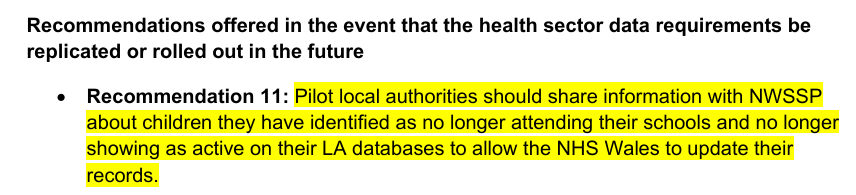
However it would appear that the Welsh Government do want more datasharing between NHS sources and councils – see Recommendation 12 for example.
Interestingly, Recommendation 11 was highlighted in yellow in the originally published PDF of the commissioned evaluation.
This would appear to be an editorial error in not removing the highlighting before publication, but it is interesting to speculate on the reasons why it was felt important to single out this particular point by highlighting…
This has been a suspicion of some who could clearly see that these database mechanisms would be ineffective and counterproductive, and who also noted that the Welsh Government repeatedly did not heed these warnings-
that the intent of these pilots was not so much to find an effective method that sensitively and productively helped any children who were missing education but rather to introduce and normalise datasharing from the NHS for non-healthcare purposes.
So, moving forwards into the Seventh Senedd after the next election,
will the next Welsh Government, and Members of the Senedd who have the role of holding the Welsh Government to account, consider the risks and impacts of non-consensual datasharing, including from the experiences of those impacted and from those involved in the ethics and practice of clinical confidentiality?
Moving forwards, will the next Welsh Government base policy and practice on the input of those with lived experience?
This article contains some initial reflections and will be updated with further consideration and discussion of this “evaluation”
 Wellbeing in Education Wales