Contents
- Contents
- Introduction & Method
- Results
- Demographics
- Section A -views and opinions on future measures
- Section B – Current experience
- Summary of Sections C & D
- Conclusions
- Section C
- Section D
Introduction & Method
In March 2025, the Welsh Government (WG) announced their desire for the Children Not in School (CNIS) clauses of Westminster’s Children’s Wellbeing and Schools (CWS) Bill to apply to Wales.
In February 2026, the WG published a commissioned evaluation of their 2023 guidance on EHE which was based on the views of council staff but did not include the experiences and views of home educators in Wales. That publication was said to be timed to inform voting at the Senedd on the CWS Bill and referenced desires for measures in addition to those of the CWS Bill.
More information on the attempt to apply the CNIS clauses of the CWS Bill to Wales can be found here.
https://wellbeingineducationwales.co.uk/
More information on the commissioned evaluation of their EHE guidance can be found here
As there has been no engagement with or involvement of those in Wales with lived experience in the above processes or policy developments, this survey was conducted by volunteer Welsh home educators, in the hope of facilitating engagement by Senedd Members and Members of Parliament, to allow a fuller evaluation both of the impact of the CWS Bill and of various claims within the commissioned report on EHE guidance.
A survey including multiple choice questions and numerous opportunities for free text written responses was developed, to allow production of quantitative and qualitative data. The range of questions were drawn from a spectrum of suggestions and concerns expressed in a variety of home education groups. The questions were designed with the opportunity of cross-referencing response from various points of the survey to confirm if respondents had understood each question and to identify if there were any mistaken entries, being mindful of the potential of errors when using tick boxes on smaller digital devices. The survey used Google Forms and was circulated via a range of Welsh national and local home education groups.
Due to time limitations, the survey was run for 12 days, from 13th February 2026, to enable the findings to be reviewed and the resulting report circulated before the planned vote in the Senedd.
Responses were fully anonymised, with no collection of email or IP addresses.
Responses were gathered from every local authority area in Wales.
Due to time constraints in view of the rapid timescale at the Senedd, the survey was limited to the first 200 usable responses to the quantitative sections. Each response was screened to ensure that the views of each home educator were reflected as clearly and appropriately as possible. Five responses were removed from the survey where there were indications of likely errors, for example where there was discrepancy between a box ticked and subsequent comments or other answers. In each of these cases the written comments were noted to be reflected in other written comments used in the survey. One response which was written in abstract, third person terminology that directly mirrored particularly unusual facets recently expressed by a council manager in that area, and which lacked any reference to personal experience or family was excluded, as the anonymous nature of this survey meant that it could not be confirmed that these were the views of a home educator. Copies of such responses were kept to enable evaluation if required.
Results
Demographics
Responses were received from home educators in every local authority area in Wales, and reflected a wide range of experience as home educators, as show below.
Demographics – Duration of respondents’ experience of home education.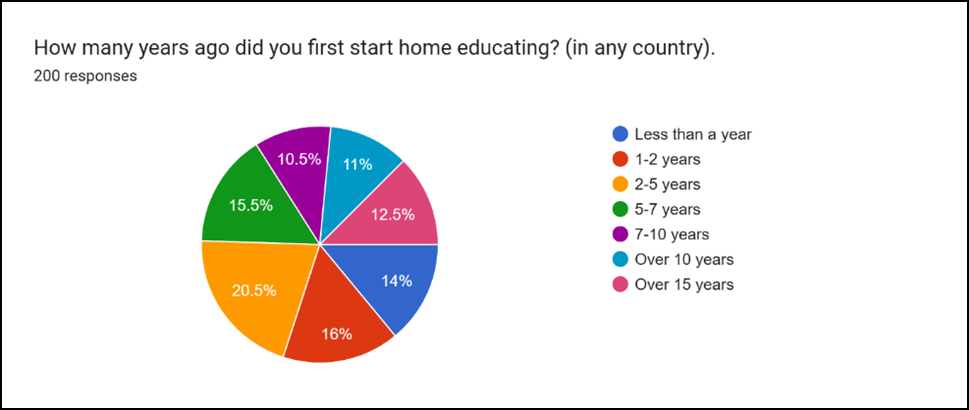
Section A -views and opinions on future measures
Quantitative data to explore views and opinions on a range of potential future measures in relation to EHE
Some of the measures considered relate to those proposed in the CWS Bill, others to potentials raised in the Welsh Government commissioned evaluation of their guidance.
Section A.1 potential mandatory measures in relation to EHE
Quantitative data demonstrates an extremely clear and persistent trend of objection to a range of proposed or potential measures being made mandatory, as seen in Figures A.1-A.6.
Question A.1 – Figure A.1.
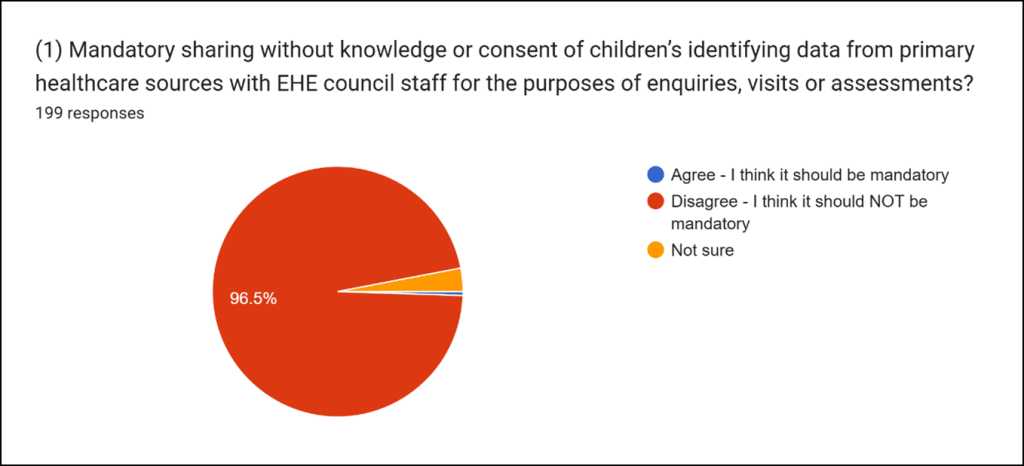
Qualitative data from the opportunity for respondents to explore or explain their answers further can be summarised under the following general categories:
- Present current practice and ability of medical staff being able to share data if a child is considered to be at risk was acknowledged and agreed with.
- The prospect of this measure making families feel less confident in engaging with health care professionals knowing that data was not confidential was raised by a number of responders.
- Confidentiality of access to healthcare was considered to be paramount by many, with respondents considering breaches of confidentiality to undermine trust.
- Consent – or the lack of this- was a very frequent recurring concern in responses, alongside the use of datasharing as part of a non-focused widespread data sweep.
- Use of data for purposes other than the one it was provided for was another frequently commented on concern.
- Risks inherent in data sweeps and sharing were often raised.
- Concerns were raised on ethics, lawfulness, the role of state vs parent, and the relation to right to private family life.
- Motivations for such actions and datasharing were questioned by some, including influence of institutionalised bias that “school is best”
- Some shared negative personal experiences of their data having been shared in this way as part of the extensive pilots of so-called CME databases.
- Other concerning accounts of negative personal experiences were provided
- Concerns were often raised on the inappropriateness of using EHE-related council staff as some form of “safeguarding officers”
Question A.2 – Figure A.2
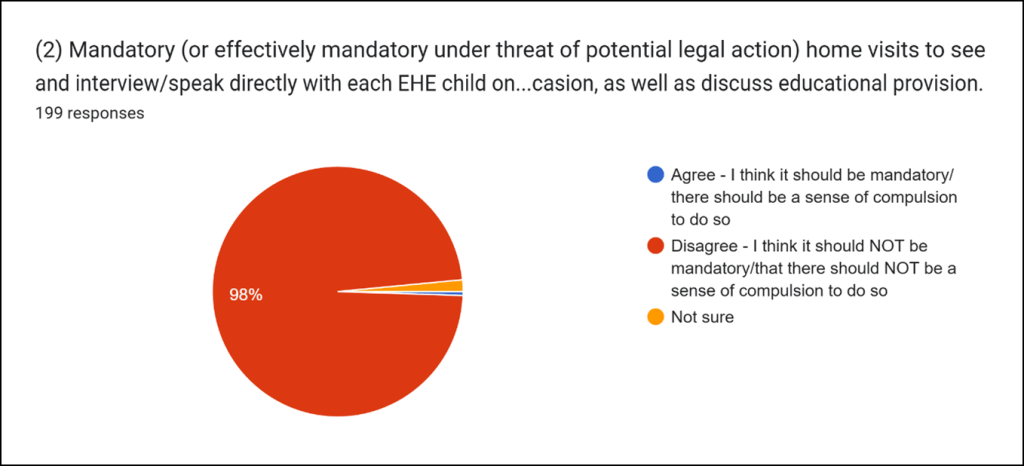
Qualitative data from the opportunity for respondents to explore or explain their answers further can be summarised under the following general categories:
- A number of responses indicated such a measure is not required or acceptable, considering it “intrusive”, “invasive”, “unnecessary”, “without consent”, “violating”, “compromised sense of safe space”, “presumptive”, “against human rights”, “breach of rights to privacy of family life”, “disregarding children’s autonomy”.
- Many responses highlighted the consequences of unnecessary and damaging anxiety and stress to families and children, including discussing what was seen as profoundly damaging impact on neurodivergent children and parents and on those suffering from school-trauma. For example:
- Would be a disaster for a child like mine who we have had to home educate due to significant school-based anxiety. This could tip her over the edge
- This would be extremely stressful for my child whose home needs to be a safe space where she is not subjected to interview. If education is seen as a demand or expectation, it would impact her ability to engage. Such a visit could damage our successful learning process where she feels in control.
- Many responses indicated how such a measure is considered both ineffective and unsafe for a range of reasons, which are best explored by reading the words of respondents here.
- Many responses addressed concerns of overstepping of respectful and lawful remits
Question A.3 – Figure A.3
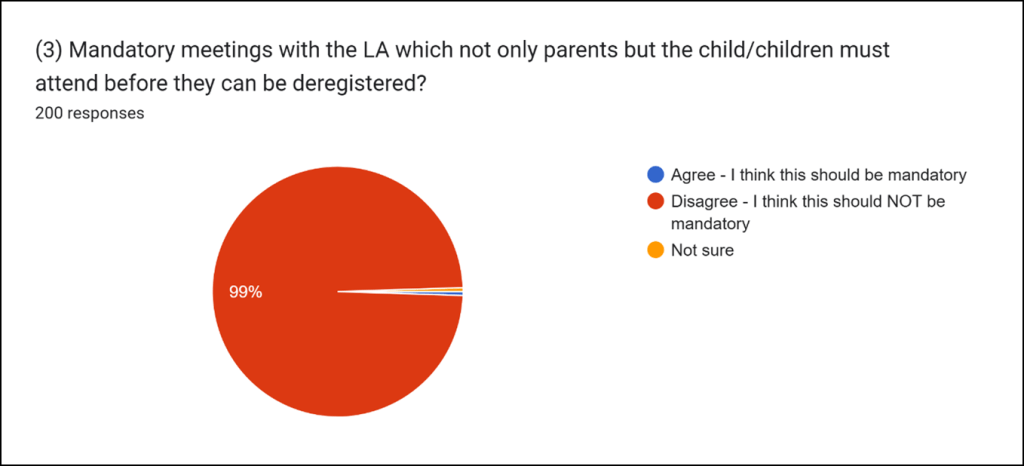
Using the opportunity to provide free text exploration or explanation of their answers, respondents raised a number of issues, which included:
- A number of responses deemed such a measure inappropriate when school is an opt in service and questioned the motivation behind such a measure, including influence of institutionalised biases such as a belief that “school is best”.
- The distress, anxiety, trauma and harm to children caused by such meetings was a common theme in responses.
- Concerns were raised that such meetings, with the delays and potential obstructions to deregistration would be dangerous, risking suicide and self-harm, damaging to children’s wellbeing, and counterproductive.
- Concerns were raised at attempts of interference with family choice and overstepping of the role of the state.
- The overwhelming consensus of opinion was that any such meetings should be optional and without coercion or suspicion.
Question A.4 – Figure A.4
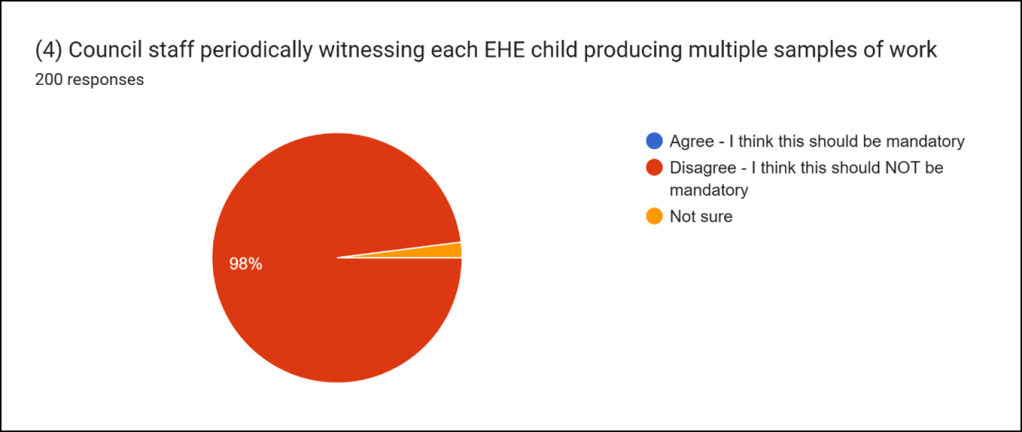
Points and experiences raised in the opportunity to provide further information on this question included the following:
- The overriding message of the responses from 110 respondents into this point considered the concept would demonstrate a lack of understanding of pedagogy and educational philosophies and approaches often utilised by home educators.
- Respondents demonstrated how such a measure would not reflect children’s normal modes of education and learning and would be based on presumptions of a more linear concept of learning than is often beneficially experienced by home educated young people.
- Many responses addressed how this would be traumatising and harmful to children, counterproductive in terms of educational progress and capacity to continue learning as well as to wellbeing.
- Many responses raised concepts of infringement of rights, questions of lawfulness and issues relating to lack of consent.
- Lack of appropriate training, skills and resources to be able to undertake suitably individualised assessments even if these were acceptable, were often highlighted.
Although not mentioned in survey responses, it is also worth noting the risks of infringement of copyright law if “work” is shared without consent, according to the Copyright, Designs and Patents act of 1988 https://www.legislation.gov.uk/ukpga/1988/48/contents
An appreciation of children’s ownership of their intellectual property can be found here:
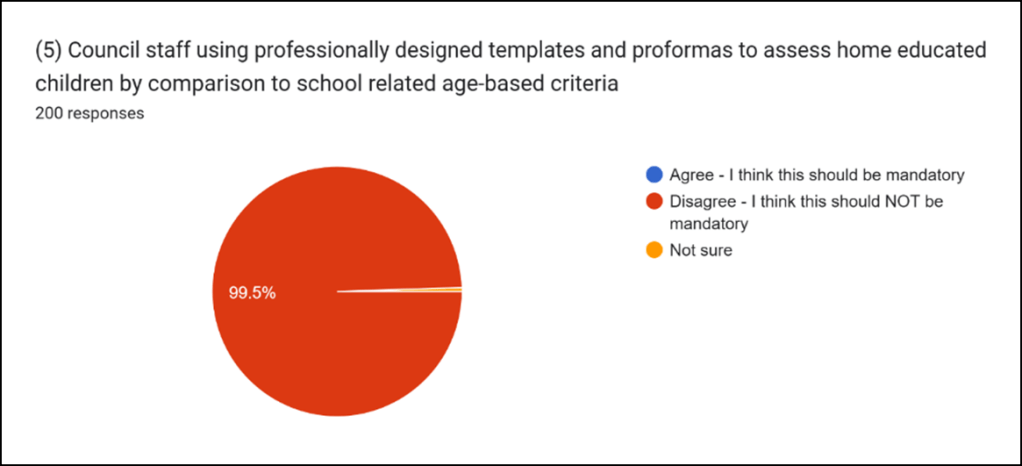
Question A.5 – Figure A.5
Question A.6 – Figure A.6
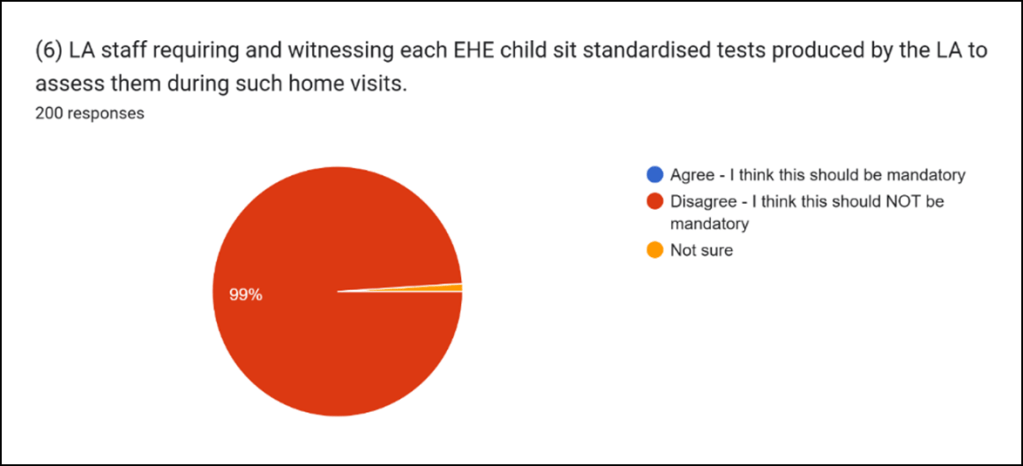
The survey generated 332 written responses to Questions A.5, A.6 and A.7 alone,
which can probably best be summarised with the quote from one of these of:
Tell me you don’t understand home education
without telling me you don’t understand home education.
This is somewhat ironic, as these 3 questions and figures relate to concepts claimed in the WG commissioned evaluation of their EHE guidance to be advocated and favoured by council staff employed to engage with home educators.
The source of these concepts was purposefully not mentioned in the survey to allow exploration of each concept in its own right.
The responses to these questions provide a remarkably helpful and informed insight into the concept of home education for those who do not have lived experience of this.
A wide selection of these responses will be provided in Section C of this survey report to allow opportunity for the voices of those with lived experience to be heard, and
in the hope that these will enable non-home educators to glean fuller understanding of home education.
We strongly encourage the reader to explore this range of these responses, which will be found here:
Question A.7 – Figure A.7 – Children must be “seen” by council staff to be believed safe
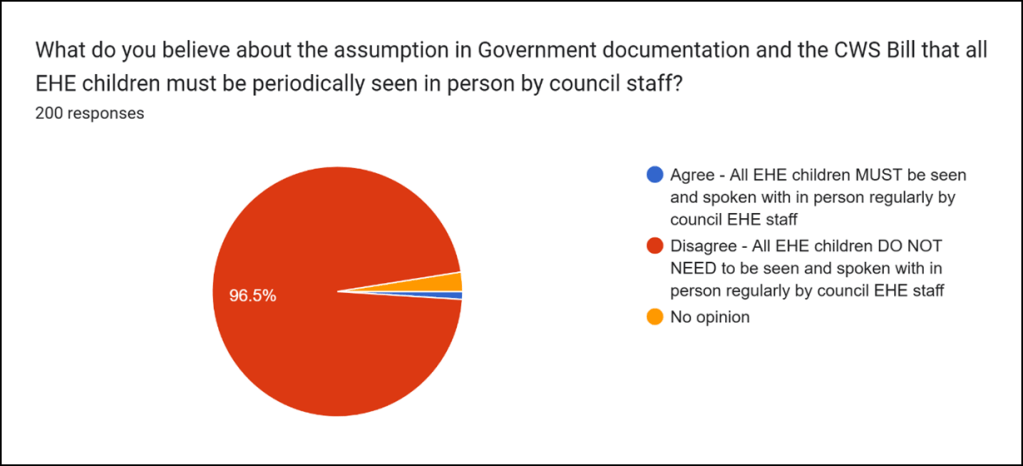
Responses expressed can be found here and summarised as:
- Very ineffective “tick-box” method or attempt at safeguarding, with a range of reasons given why it would be ineffective or counterproductive
- Assumes children are “not seen” unless seen by a member of council staff, respondents report this mistakenly presumes an element of social isolation.
- Double standards of not “seeing” children who are pre-CSA, who are at significantly higher risk statistically speaking, and of not “seeing” school children during school holidays
- Double standards according to those who feel their children were let down or not safeguarded in school.
- Intrusion into family life,
- Parents safeguard their children against intrusion or speaking to strangers
- Treating parents and families with mistrust, as if guilty until proven innocent,
- Taking council time and resources away from families who need them, wherever they may be educated,
- Lack of evidence of benefit or need
- Damage and stress to children of such meetings and encounters,
- How the perceived need for such meetings or encounters damagers and undermines the trust-based parent-child relationship.
- Lack of understanding of council staff of home education
- Option of flexible voluntary contact with genuine support available if requested more beneficial
- Conflict of interests of staff who are employed to take measures for children to attend school, with some LAs having targets for this.
Some examples of responses include:
A universal requirement for periodic in-person meetings is neither proportionate nor evidence-based. Contact should only take place where there are specific, evidenced safeguarding concerns, not as a default for all families, particularly where compulsory meetings can cause distress and negatively impact a child’s wellbeing.
A lot of home educated children are home educated due to system failures. Putting them in such a position in front of those responsible is unethical
After birth, there is no mandatory monitoring of parents or babies/young children (health visitors etc are optional). Parents are not usually assumed to be incompetent but are free to reach out for help if they feel the need. The same should be true of children aged 5+.
Respondents were invited to respond to the following statement and question in free text responses.
In a recent Welsh Government report surveying the opinions of LA staff,
it is repeatedly stated that they believe council staff should not just undertake home visits,
but during those home visits witness each home educated child producing “”work”,
not only to evaluate the child
but also to be sure that the work was produced by that child and no one else.
What are your thoughts and feelings on this assumption and recommendation? “
This was the first reference in questions to a “WG report” or opinions of council staff,
This question mirrors one earlier and allows verification of responses and exclusion of ones containing errors. However, it is repeated to specifically allow parents to consider the concept of verification of the source of their children’s “work” being considered to be necessary.
Alongside the wide range of concerns already expressed in response to previous questions, the prevailing message of responses related to the “insulting”, “offensive”, “demeaning” and “counterproductive” concept of routinely considering parents to be “liars” and “untrustworthy”.
Responses indicated how such measures would decrease any productive engagement rather than enhance it, and that such measures reflected double standards.
Significant safeguarding and wellbeing issues for all involved in the concept of strangers entering private family homes and placing children into stressful situations were also addressed in responses.
A thorough and representative collation of responses can be found in Section C.:
Question A.9 – Figure A.8 – CWS Bill and Welsh Home Educators.
In relation to CWS Bill, the views were very clear.

No respondent believed that the CNIS clauses of the CWS Bill should apply to Wales.
This included the very few respondents who were in favour of any of the above measures being mandatory (and incidentally was also the unanimous opinion in the few removed responses).
Every respondent answered this question.
Disagreement with the content of the Bill, lack of proper scrutiny or appreciation of the impacts scored highly, alongside consideration that existing legislation if used correctly is sufficient.
Nearly two-thirds of respondents also considered devolution and the use of devolved powers to be a significant factor in their consideration that the CWS Bill should not be applied to Wales, stating that they “disagree with Westminster passing laws on a devolved issue”.
The data from Figure A.8 is also produced in table format to allow each reason to be clearly appreciated.
| Data from Figure A.8 Do you believe that the clauses of Westminster’s Children’s Wellbeing and Support (CWS) Bill that relate to home education should apply to Wales? | Number | Percentage of those responding who considered this to be a key factor |
| No, because I disagree with the content and measures | 162 | 81 |
| No because I do not believe the Bill has been properly scrutinised or the impacts understood. | 162 | 81 |
| No because we already have sufficient legislation if used correctly | 148 | 74 |
| No because I disagree with Westminster passing laws on a devolved issue | 119 | 59 |
| Other | 12 | 6 |
| Yes, the CNIS clauses of the CWS Bill should apply to Wales | 0 | 0 |
Free text responses allowed reiteration and deeper exploration of these.
Reasons given to objecting to the concept of the CWS Bill applying to Wales can be summarised as:
- Failure to respect devolution and lack of use of devolved powers
“But it’s not suitable and shouldn’t be adopted just to save the bother of doing something ourselves when it is so fundamentally flawed”
- Misuse /overstepping of existing powers by LAs
- Failure to use existing powers by appropriate agencies if safeguarding measures were needed, “Scapegoating” of home education when problems and failings identified as lying elsewhere.
- Inappropriate influence of media reports in ways that are felt to be “propaganda” and “scaremongering”.
- Mistaken belief that schools is required for “socialisation”.
- Misuse of limited resources on ineffective or counterproductive tick-box measures on families who do not need intervention of monitoring, diverting these from children who do.
- Bill being “rushed” or “pushed” through at Westminster and/or Senedd, including for party political purposes
- Infringement of rights
- Present state education system considered “not fit for purpose” as an alternative to home education.
- Discriminatory against those with additional learning needs or disabilities
- Imparting of unprecedented powers without detail of how would be enacted
- Lack of safeguarding of independent complaints or appeals processes
- Disproportionate and lacking in evidence base.
- Inappropriate use of taxpayer’s money
- Interference in how families choose to raise and educate their children.
However, we strongly encourage the reader to explore these reasons as expressed directly in the collation of representative responses,
which can be found in Section C.
Questions A.10 and A.11. (Figures A.9 and A.10)
These address the presumption in the CWS Bill and in the WG-commission evaluation of their guidance that LAs will always act in a child’s best interests, with no provision made for independent appeals, complaints, advocacy, mediation or tribunal systems in relation to LA decisions or opinions.
Note that all respondents to the survey answered both questions.
Question A.10 – Figure A.9
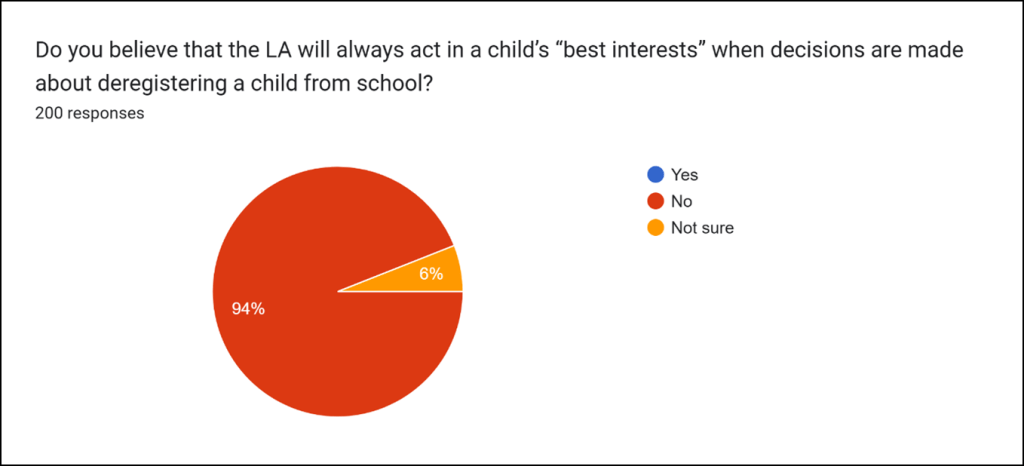
Comments were provided in relation to the question “Do you believe the LA will always act in a child’s ‘best interests’ when decisions are made about deregistering a child from school?”
When exploring concerns about this concept further, respondents repeatedly questioned the capacity of council staff to be able to make such significant decisions about a child’s wellbeing, as well as their right to do so.
These comments can be generally categorised as indicating concerns and beliefs that:
- Parents are in the best position to determine what is in a child’s best interests. Parents understand their children in ways others cannot and advocate for them when they cannot.
- Misuse of existing powers by LAs, either by not using appropriate powers when required or by inappropriately overstepping and abusing these.
- Institutionalised bias and discrimination against home education by council staff /belief amongst LAs that “school is best”.
- Lack of capacity of council staff to make such decisions, not an appropriate role for them.
The depth of these concerns and issues is best appreciated from voices of respondents, found in the collation of responses in Section C, which we strongly encourage the reader to consider.
Question A.11 – Figure A.10
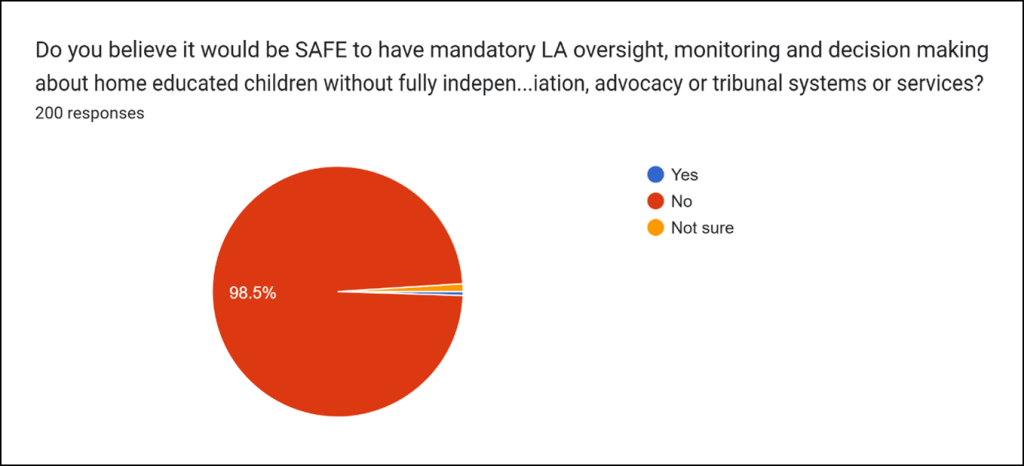
Respondents were able to add comments to the question, “Do you believe it would be SAFE to have mandatory LA oversight, monitoring and decision making about home educated children without fully independent complaints, mediation, advocacy or tribunal systems or services?”
Comments reflected overwhelming incredulity at any belief it would be safe to allow LAs to operate in relation to EHE families without such systems and services, let alone if LA powers were considerably increased.
The dangers to the wellbeing of parents and children were also referenced, including the risk of harm and suicide as a result.
The responses identified the lack of such independent complaints, mediation, advocacy or tribunal systems or services as a considerable safeguarding risk.
Question A.12.
This was the most frequently commented on question in the survey, with 178 comments. This is particularly noteworthy given how relatively time-restricted many respondents would be and the position of this question towards the end of section A rather than at the beginning.
This question asked respondents to comment on:
The CWS Bill does not say that LA staff meeting and seeing the child once they have been deregistered is mandatory,
it says that if parents decline home visits, then the LA MUST consider this to be a factor in deciding whether to issue School Attendance Orders.
How would you describe such a policy and approach?”
The semantic field used by respondents to describe this measure included terms such as:
“bullying”
“coercive”, “coercion”, “coercive control”
“manipulative”,
“intimidation”
“Coercive and undermining of parents with a side order of gaslighting”
“blackmail”
“unnecessary”
“abusive behaviour”
“Clear attempt at social engineering and behavioural modification”
“deliberately confusing”
“entrapment”, “sly”, “underhand”
“frightening”
discriminatory, “cruel”,
“creating anger, distrust and distress”,
“traumatising”, “breach of human rights, “breach of children’s rights”,
“absurd”, “ridiculous”, “farcical”, “disgrace”
“Criminalising, suspicious approach”,
“controlling and demoralising”,
“Heavy handed- combative”,
“tantamount to child abuse”
“Inflammatory and insensitive” “punishment”,
“sinister”, “unfair”, “wrong”
“undermines trust”, “scaremongering”,
“bias”, “power overstep”, “subjective”
“misguided”, “punitive”,
“Orwellian”, “draconian”,
“extremely hostile”
“will be misused”.
“Coercive”, “coercion”, “bullying , “threat” and “criminalising” were the most commonly used descriptive terms.
The many points raised in the response included:
- identifying further safeguarding issues with this measure in the CWS Bill of an attempt to prevent or inhibit the capacity of families to safeguard their children’s wellbeing in their own homes.
- “Suicide” risks.
- That the potential, presence or use of such “threat”, “coercion or inducement” would mean that informed consent was not obtained or possible.
- Not acting in best interests of children, counterproductive and damaging.
- Irony and double standards of such “threats” and enforcement on the occasions where the family are home educating due to “failings” of the council, or being “let down” by the council.
- Against children’s rights
- Open to abuse or confused interpretation and application by LAs
- Obstructing parent’s abilities to ensure their children thrive
- That firm boundaries are needed for LAs rather than families
- Double standard of not threatening or enforcing home education as a measure for school children, with the underlying bias of “school is best”.
- Deflection of blame from failures of councils and statutory services
We again very strongly encourage the reader to explore the full spectrum of responses in Section C to best appreciate both the experiences and concerns of home educators in Wales. This is particularly essential for elected representatives considering voting on the imposition of such measures on the people of Wales.
Section B – Current experience
This section explores current experiences of home educators in Wales in relation to WG EHE policy and LA conduct.
Section B.1
Views on present guidance and most useful sources of support and information
Question B.1.1 – Figure B.1.1
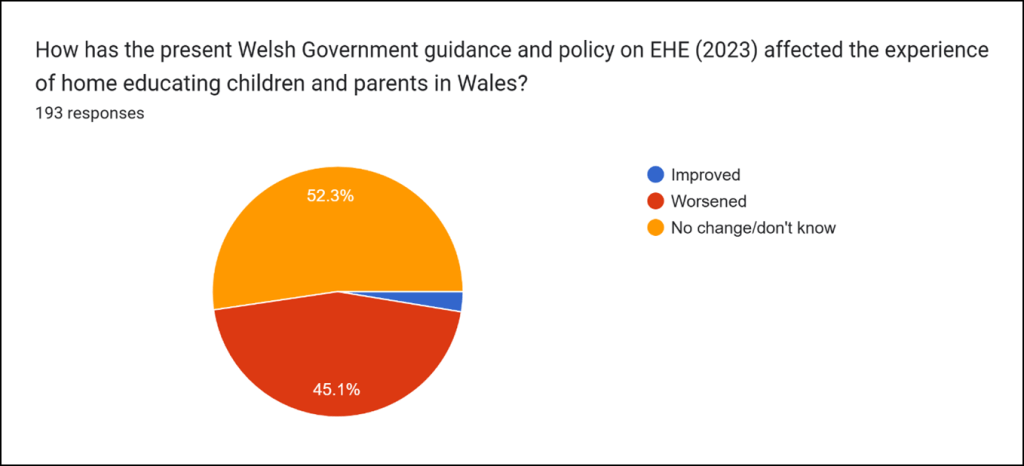
On giving their views of whether the present WG guidance on EHE had improved or worsened the experience of home educating children and parents in Wales, respondents were given the opportunity to comment further on their answer.
Responses tended to fall into categories of
- Those who were aware of the guidance itself
- Those who were judging by recent experience of la conduct rather than the guidance as written
- General comments relating to previous questions and issues rather than directly in relation to the guidance.
These comments highlight that there can be two key issues –
- What guidance (or legislation) may contain
- And the differing ways various LAs may or may not apply this.
Terms and phrases used in relation to the guidance itself included:
“coercive”, “bullying”, “intimidating”, “controlling”
“deliberately misleading”
“treats families with contempt and suspicion”, insulting”
“Tries to trick people into compliance”,
“causes/adds more pressure and stress”
“already interfering in family life , values & rights”
Some commented that there had been no change, others observed negative outcomes in direct relation to the 2023 guidance, such as
- “Marked negative shift in our local authority’s attitude toward EHE when the new guidelines were published”
- “More issues with LA’s overstepping, pushing boundaries”
- “More likely to disengage with the LA even when they had good relationships before”.
- “It has increased uncertainty and anxiety for families, shifting the tone from supportive engagement to monitoring. This erodes trust and makes collaborative relationships harder to sustain”
- “The LA is using the guidance to justify overreach”.
- “Uses bribery to try to get their “eyes” on children. That’s plain creepy as well as manipulative”.
Reference was made to the parallel pilot of “CME” databases:
“Deliberately misleading and openly misusing law when they claim that children who are not known to the local authorities are CME – they are not missing education, they are home educated, they just aren’t on some list at the council. “
Occasional comments describe it as “sufficient”, seemingly meaning no further measures are required when taken in context of other answers by these respondents.
Comment was made on lack of substance to offers of support:
- It suggests the Welsh Government have a great support package for home education, which they do not (including some issues with exam centre access).
Lack of engagement by the Welsh Government in drafting and administrating the present guidance was also noted.
So many of us tried to engage with the Welsh Government when they were drafting this, but we just, as always, met with stonewalling and gaslighting.
Reference was made to guidance being considered to reflect political views rather than evidence-based need
“It isn’t just their guidance that is poor, it is their policies on EHE – policies based on suspicion, mistrust, state control over families, state knows better than people approaches”.
Comments included consideration that
“guidance doesn’t really correlate with legislation in places”,
with a number or respondents raising criticisms such as:
- Misuse of the term “statutory” when there are no new statutory elements in the 2023 guidance compared to the non-statutory 2017 guidance:
- “They use that term “”statutory”” as a further attempt to intimidate, control and manipulate people.”
- Gives the impression that personal preferences are requirements when they are not, in the views expressed in the guidance alongside the use of “should”.
- (The 2019 report and opinion by David Wolfe KC on what he considered inappropriate use of the word “should” in the 2023 WG guidance on EHE was not cited in the survey but is a useful reference point on this)
- “Suggests the LAs duty is proactive and not reactive”
- “It conflates s437 and s436A of the Education Act 1996”.
The responses that related to LA conduct rather than directly to the guidance reflected the very mixed range of experiences of home educators in Wales.
The general trend and message observed in these responses is that
- Voluntary, flexible, respectful, minimal or absence of engagement by LAs is experienced as positive,
- Involuntary or “overstepping” attempts at engagement by LAs, for example using “threats and intimidation tactics” is experienced as negative and “detrimental”.
In relation to potential positives of funding, negative impacts were also noted,
“Opportunities that, when previously organised by parents, were open to all…
have now become, when taken over by LAs, exclusive to children within each county only. Living on the borders makes this extremely upsetting.
Also, families who do not wish to be on a register have had their opportunities actively reduced by the threat of venues and hosts sharing their data with the LA when they previously didn’t.
This is an insightful point when much is made of provision of activities and events in the WG-commissioned evaluation of their 2023 guidance, portraying these as extremely positive.
Question B.1.2 – Figure B.1.2
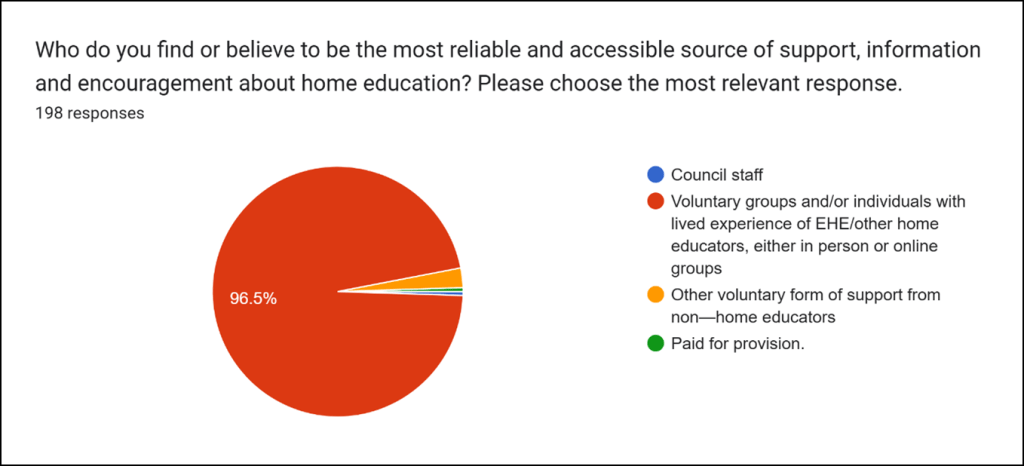
The findings of this question – that LAs are NOT generally or frequently considered a reliable source of support, information and encouragement – run in stark contrast to the portrayal of the role of council staff as the core providers of these in the WG-commissioned evaluation of their 2023 guidance.
The very negative view of home education groups that are not organised by them that was expressed by such council staff in that WG-commissioned report is of note by comparison.
It is worth reading the comparison and an “evaluation” of that “evaluation” here:
Question B.2.1 – Figure B.2.1.
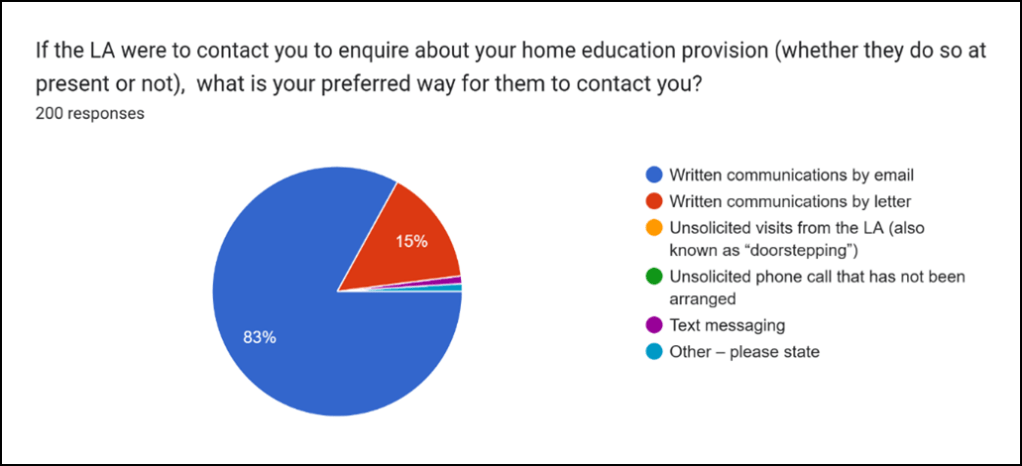
Question B.2.2 – Figure B.2.2.
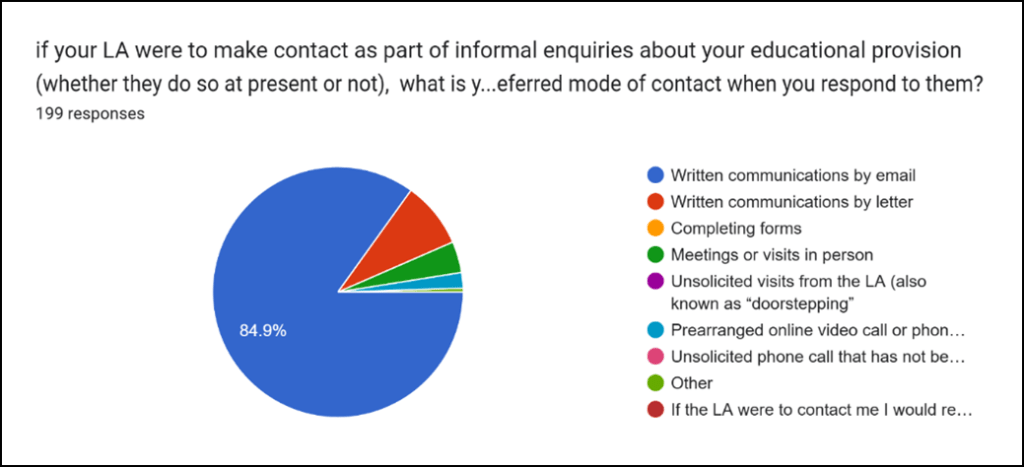
Home educators in Wales demonstrate a clearly marked preference for communication from and in response to LAs to be in writing, be that by email, or sometimes preferably by letter.
Cold-calling by phone or “doorstopping” are clearly not preferrable for home educators.
This contrasts markedly to the WG-commissioned evaluation of their EHE guidance, which repeatedly expresses a belief by council staff employed to contact home educators that unsolicited and unexpected phone calls or visits to house (“doorstepping”) are beneficial, engaging and welcome by home educators.
The contrast in awareness or consideration of cold-calling as expressed in that WG-commissioned evaluation of their guidance will be explored further in consideration of subsequent questions.
Section B.3 – Areas of suboptimal practice or potential overstepping by LAs
The data in this section relates to concerns frequently expressed by home educators on various common forms of overstepping of LAs
Section B.3.1
Data to establish the baseline of preferred ways of communication with the LA.
Question B.3.1. – Figure B.3.1..
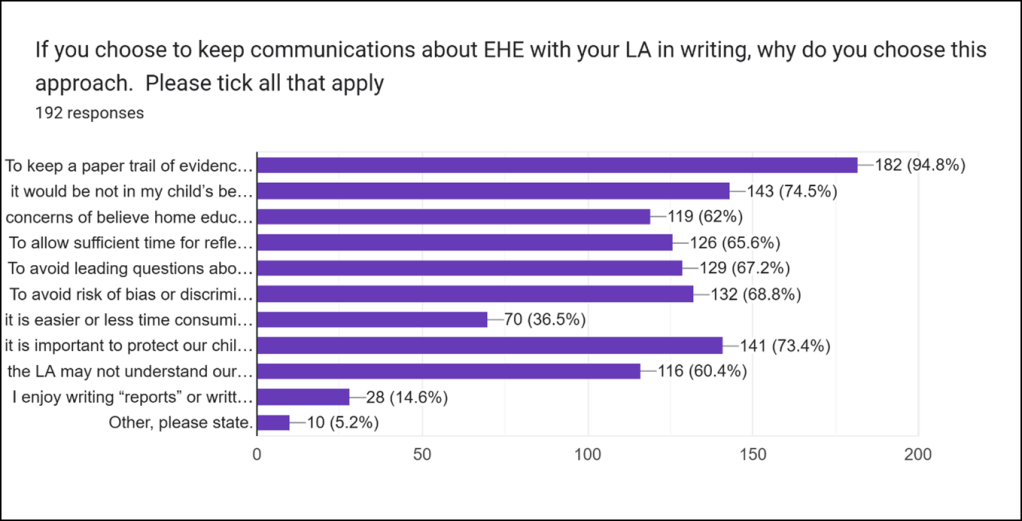
Data from Figure B.3.1.1 is also demonstrated in the table below to allow each reason to be clearly appreciated
| Data from Figure B.3.1.1 Reasons given for keeping communications with LA in writing | Numbers | Percentage of total survey respondents |
| To keep a paper trail of evidence of what has been said by each party | 182 | 94 |
| It would be not in my child’s best interests to meet or be interviewed by the LA in person | 143 | 74.5 |
| It is important to protect our children’s rights by ensuring conduct is according to lawful remits | 141 | 73.4 |
| To avoid risk of bias or discrimination influencing views | 132 | 68.8 |
| To avoid leading questions about information that may consider inappropriate or unnecessary | 129 | 67.2 |
| To allow sufficient time for reflection on what said | 126 | 65.5 |
| Concerns of believe home educators being treated with suspicion or mistrust | 119 | 62 |
| The LA may not understand our approach to education unless explained in writing | 116 | 60.4 |
| It is easier or less time consuming | 70 | 36.5 |
| I enjoy writing “reports” or written responses | 28 | 14.6 |
| Other | 10 | 5.2 |
An awareness of a need to keep a “paper trail” as evidence of outcomes of engagement with council staff is the main motivating factor given, with 94% of the 192 respondents to this question citing this reason.
Protection and safeguarding of their children are the common factor in the next two most frequently cited reasons.
Acting in children’s best interests is a strongly motivating factor influencing family choices.
Strikingly, over two-thirds of respondents (68.8%) indicate an awareness of discrimination or bias of council staff as a potential influencing factor of how they or their educational provision would be viewed.
This is relevant when one considers there is presently no independent appeals, complaints, tribunal, mediation or advocacy service or system for home educating families in relation to conduct or decisions on EHE related matters by council staff, nor are there any plans for such under markedly increased powers and remits in the CWS Bill. Likewise, the WG-commissioned evaluation of their guidance makes no consideration of a potential need for such mechanisms.
Even if there is no possibility of bias or discrimination affecting conduct or decisions of council staff in relation to EHE, the fact that over two-thirds of families surveyed considered there to be so would alone indicate a need for independent mediation, advocacy, complaints, appeals and tribunal services.
The perception of being treated with suspicion by council staff influencing engagement with the LA (indicated by 62% of respondents) is another factor that must be of note for those considering any policy development in this area.
This is mirrored over two-thirds of respondents (67.2%) citing a need to avoid leading questions as a reason to keep communications in writing.
It could be argued that, as the lawful remit of council staff employed for such engagement is to identify children not in receipt of suitable education and take legal measures enforcing school attendance against will if they consider that is the case, that such suspicion is not unfounded and could be considered sensible and prudent.
If families are aware that the person is there to see if there are grounds to suspect them of evidence of educational neglect, or other forms of neglect or abuse, it is quite understandable that they would “suspect” the person in return.
There is an inherent conflict of interests of the same person or department being expected to both enact such lawful remits in screening for whether SAOs should be issued and also being in a non-lawfully binding potential role of “support”, to offer “advice and information” as the CWS Bill puts it.
Likewise, an awareness that council staff may or may not understand home educating families’ approaches to education is a fundamental issue that must be appreciated by any considering developing policy or legislation in relation to EHE.
The potential for considerable lack of understanding or appreciation of such approaches to education:
The awareness of home educators that council staff may not understand or appreciate approaches to education is both echoed and verified in the concepts and proposals advocated by council staff in the WG-commissioned evaluation of its EHE guidance. This was demonstrated in so many of the qualitative response to even Questions A.5, A.6 and A.7 alone, available in Section C, and earlier summarised as:
“Tell me you don’t understand home education
without telling me you don’t understand home education“
Indeed, the responses to such proposals and ideas for regulation of home education indicate that even the consideration of these has a counterproductive effect of increasing suspicion and mistrust, let alone any attempts at enactment or enforcement of these.
Use of forms by LAs for completion by parents/children as part of informal enquiries about educational provision.
It is a common complaint of home educators in Wales that the council send forms as if completion of these is a requirement and/or that these forms overstep by asking for more information than is required.
The following questions were to evaluate the extent and range of experience of this.
Question B.3.2. – Figure B.3.2.
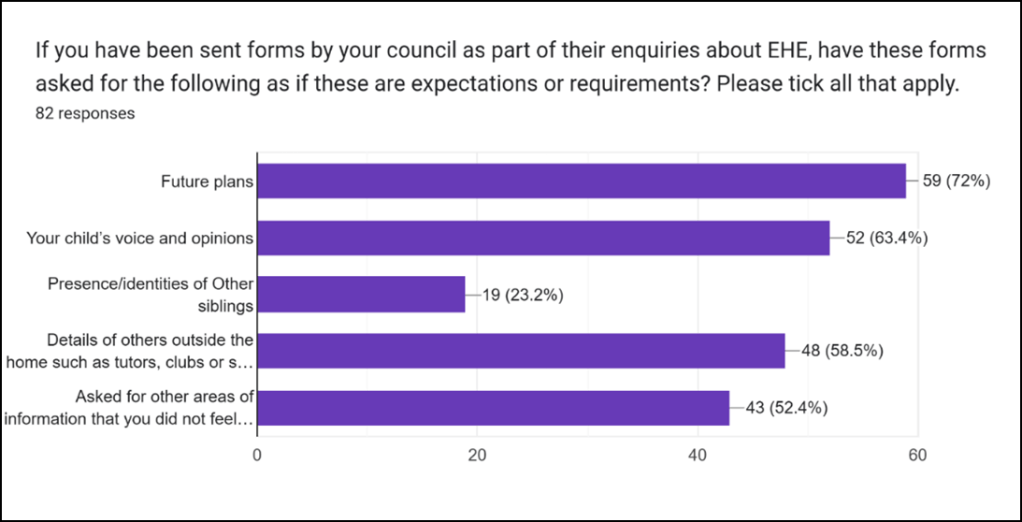
Data from Figure B.3.2 is also demonstrated in tabulated form to allow each reason to be clearly appreciated
| Data from Figure B.3.2: Information requested on council form as if providing the information is a requirement. | Number of respondents | Percentage of total survey respondents |
| Future plans | 59 | 72 |
| Your child’s voice and opinions | 52 | 63.4 |
| Details of others outside the home such as tutors, clubs or social contacts | 48 | 58.5 |
| Asked for other areas of information that you did not feel comfortable providing or did not feel necessary | 43 | 52.4 |
| Presence or identities of other siblings | 19 | 23.2 |
The issues and problems with considering a requirement for the provision of “future plans” are addressed as part of this article, in the final section.
https://wellbeingineducationwales.co.uk/2026/02/10/cws-pilots-of-mandatory-meetings-to-deregister-a-child-from-school/
An appreciation of the problems with what may appear to the onlooker seem a simple and reasonable matter is vital for those considering developing policy and especially for those passing legislation on home education related matters.
Whilst parents may or may not choose to make “plans”, a requirement or expectation to make or provide the LA with such future plans discriminates against child-led and child focused pedagogy and approaches.
It inevitably enforces a degree of a more limited, adult-led, school-like concept of education that may well have already failed the child or that families have already decided is not the optimal approach.
Any plans that home educators make can and should change with time, as the education received by home educated children has to be suitable to “age aptitude and ability”, all of which also inevitably change with time. Likewise, one of the strengths of home education is the ability to explore differing educational approaches, and which approaches suit each child best are likely to change with the development of the child too.
However, education has to be not just “suitable” but “efficient”, to achieve that which it sets out to achieve.
This is a key area where concepts, such as plans, that may relate to school-based education for large groups of children, diverge considerably from home education, which is focused on each individual child.
So if parents are required, or expected, to provide future plans, then as and when these plans inevitably change and are not fulfilled or “achieved”, the risk is of education then not being considered “efficient” and therefore deemed not suitable, especially if the council member of staff as particularly biases or views of how education should look, or acts out of other influences or motivations that may encourage a less flexible understanding.
Future plans are not a requirement for council staff to fulfil their duty of identifying those who are not in receipt of suitable education (that education being past or present, not future). The issue of any expectations of the provision of such plans becomes particularly problematic if and when council staff convey the impression that these are a requirement and not simply a voluntary option.
Then, the issues relating to making future plans are compounded by being misled into providing, without informed consent, information that could be used as legal evidence against oneself. Even if the information is not used in such a way, an awareness of staff giving, or having given such a misleading impression increases mistrust and suspicion further.
Respondents also reported that such forms frequently request the “voice of the child” as if this were a requirement to provide.
The whole point of the “voice” of children being respected is that there should be respect for their right to say “No“.
Problems related to information about contacts of children
There are of course a wide range of issues in requesting information about contacts such as tutors, clubs and other sources of educationally enriching experiences, including
– consent of those involved,
– potential of bias in interpretation of choices of these,
– and the fact that provision of these is not necessary as parental word, which is sufficient in a court of law, should be sufficient to confirm that a child is home educated.
Data leaks and hacking would not only compromise the data of the adults involved,
but leave children at a considerable safeguarding risk with their likely locations being identifiable and traceable at given periods of time.
Cold-calling by the LA – Unsolicited communications
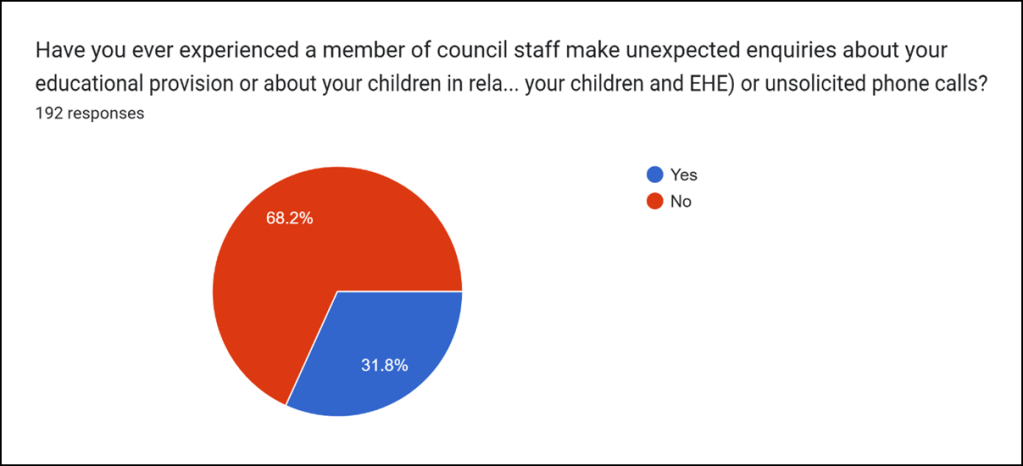
Unsolicited communications from the LA, for example unannounced home visits (“doorstopping”) or unexpected phone calls, are frequently cited as sources of concern and problem by home educators.
The following questions were to objectively evaluate the extent and range of experience of this.
Question B.3.3.1 – Figure B.3.3.1
Question B.3.3.2 – Figure B.3.3.2
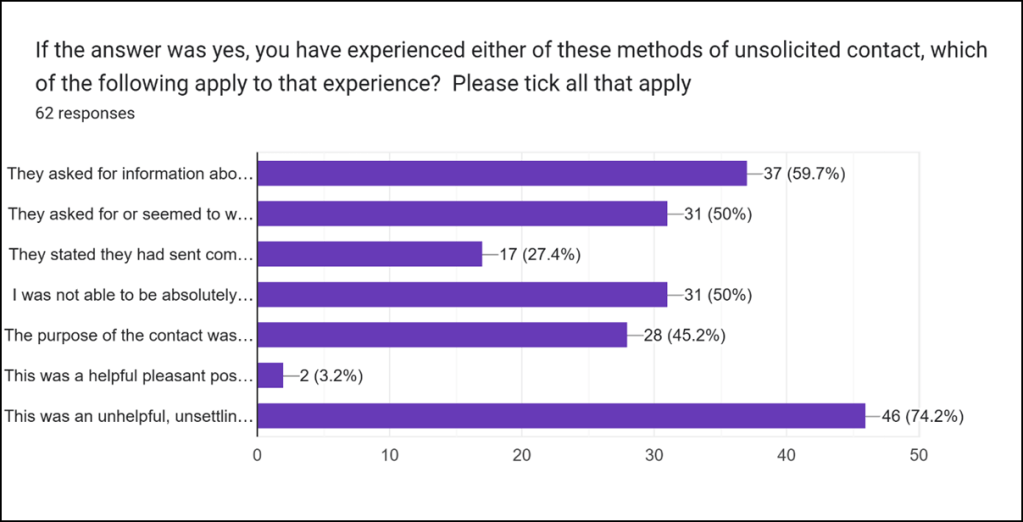
Data from Figure B.3.3.2 is also demonstrated in table format to allow each reason to be clearly appreciated
| Data from Figure B.3.3.2: Experience and impact of unexpected/unsolicited contact from LA staff on parents and children. | Numbers | Percentage |
| This was an unhelpful, unsettling or anxiety-causing experience for myself or my children | 46 | 74.2 |
| This was a helpful pleasant positive experience for myself and my children | 2 | 3.2 |
| They asked for information about my children/the children in my care | 37 | 59.7 |
| They asked for or seemed to want access into my home | 31 | 50 |
| I was not able to be absolutely sure who I was speaking to | 31 | 50 |
| The purpose of the contact was not completely clear | 28 | 45.2 |
| They stated they had sent communications announcing a meeting/visit but we had not received any such emails or letter. | 17 | 27.4 |
74% of respondents who had experienced cold-calling from the LA (“doorstopping” or unsolicited, unexpected phone calls) considered this to be:
“an unhelpful, unsettling or anxiety-causing experience for myself or my children”.
Whereas only 3.2%of respondents considered it to be a “helpful pleasant positive experience”.
This strongly echoes the results and observations from Questions B.2.1 and B.2.2 of preferred modes of communication, where a clearly marked preference for communications from and in response to LAs to be in writing (email or sometimes letter).
The combination of clear preferences in modes of communications, and how frequently any attempts at cold-calling are considered to be an “unhelpful, unsettling or anxiety-causing experience for myself or my children” contrasts markedly to the WG-commissioned evaluation of their EHE guidance.
That “evaluation” repeatedly expresses beliefs by council staff employed to contact home educators that unsolicited and unexpected phone calls or visits to house (“doorstepping”) are beneficial, engaging and welcome by home educators, even with the admission that as well as being unsolicited that these methods are chosen to try to see children or obtain information about them while parents are not expecting such encounters.
This strongly suggest that the council staff involved in that WG evaluation of their guidance are not very in tune with the experiences of home educators, the impacts of their conduct in relation to them, or the perception of their actions.
If the staff involved in that “evaluation” are aware of the preferences of home educators, then their comments in that evaluation risk strongly indicating a deliberate choice to discount or override the experience and choices of families.
Question B.3.3.3 – Figure B.3.3.3.
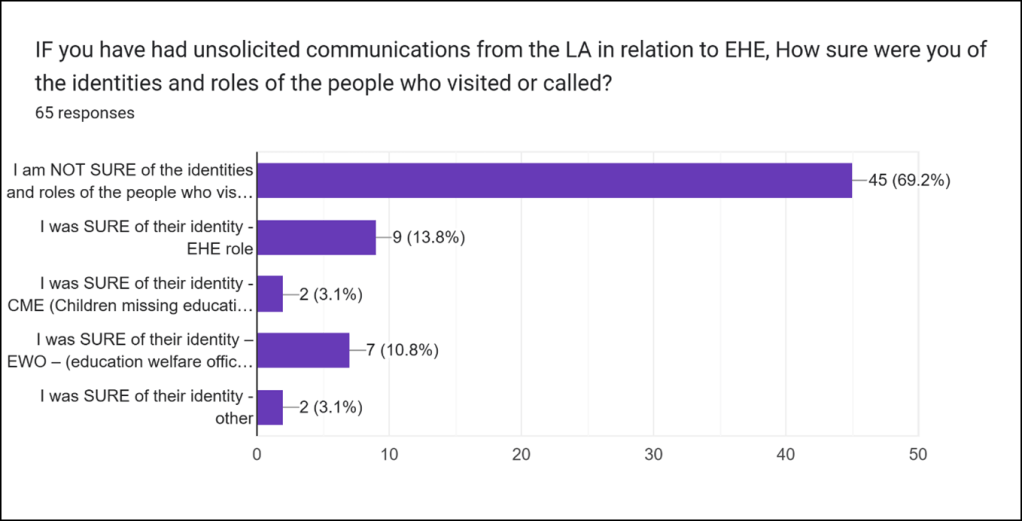
Very concerningly, given the information sought and expectations of those making such cold-calls,
Over two-thirds (69.2%) of respondents said they were not able to be sure of the identities of those calling.
This identifies a clear safeguarding issue, especially when such callers are seeking information about children and entrance into family homes,
And further brings into question the wisdom or not of considering these to be an acceptable form of practice, let alone one to be advocated and promoted.
Question B.3.3.4 – Figure B.3.3.4
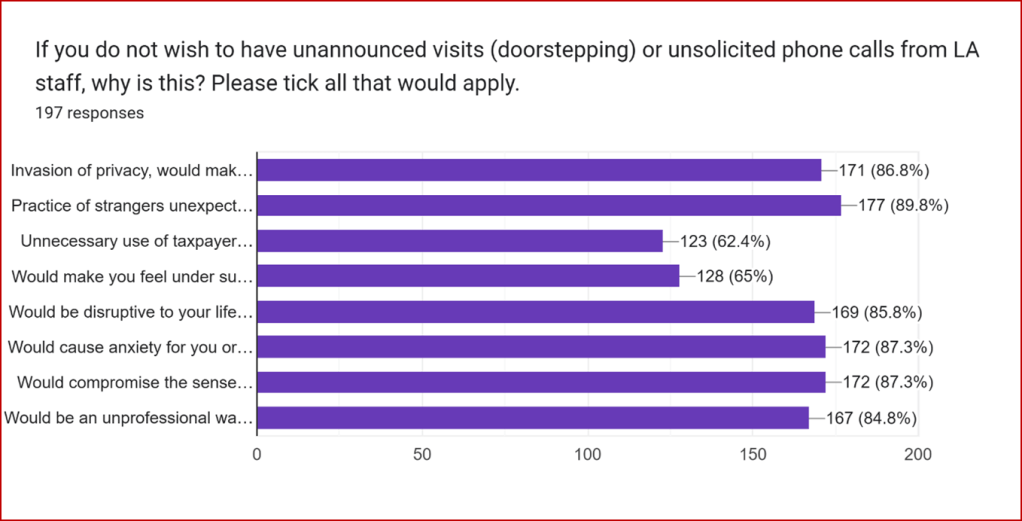
Data from Figure B.3.3.4 is also demonstrated in table format to allow each reason to be clearly appreciated
| Data from Figure B.3.3.4: Reasons given for not wanting unannounced visits or unsolicited phone calls from council staff | Number | Percentage |
| Practice of strangers unexpectedly asking for information about children can be a safeguarding risk | 177 | 89.8 |
| Would cause anxiety for you or your children | 172 | 87.3 |
| Would compromise the sense of home as a safe space | 172 | 87.3 |
| Invasion of privacy, would make you feel under suspicion | 171 | 86.8 |
| Would be disruptive to your life and/or home education at the time | 169 | 85.8 |
| Would be an unprofessional way to try to engage/or unproductive way to exchange information | 167 | 84.8 |
| Would make you feel under suspicion | 128 | 65 |
| Unnecessary use of taxpayer money | 123 | 62.4 |
89.8% of respondents also identified the practice of cold-calling to be a safeguarding risk, despite it being one commonly utilised by council staff in the claim of being a safeguarding practice.
Respondents also frequently cited a wide range of problems with the practice of cold-calling, with the most commonly ones relating to harm to a child’s wellbeing and education.
For example:
- Would cause anxiety for you or your children – 87.3%
- Would compromise the sense of home as a safe space – 87.3%
- Invasion of privacy, would make you feel under suspicion – 86.8%
- Would be disruptive to your life and/or home education at the time – 85.8%
This demonstrates the prioritisation of the best interests of children by families.
It also demonstrates a full contradiction to the presumption in the CWS Bill that councils will always act in a child’s “best interests”.
Section B.3.4
Pre-arranged home visits or meetings.
Question B.3.4.1 – Figure B.3.4.1
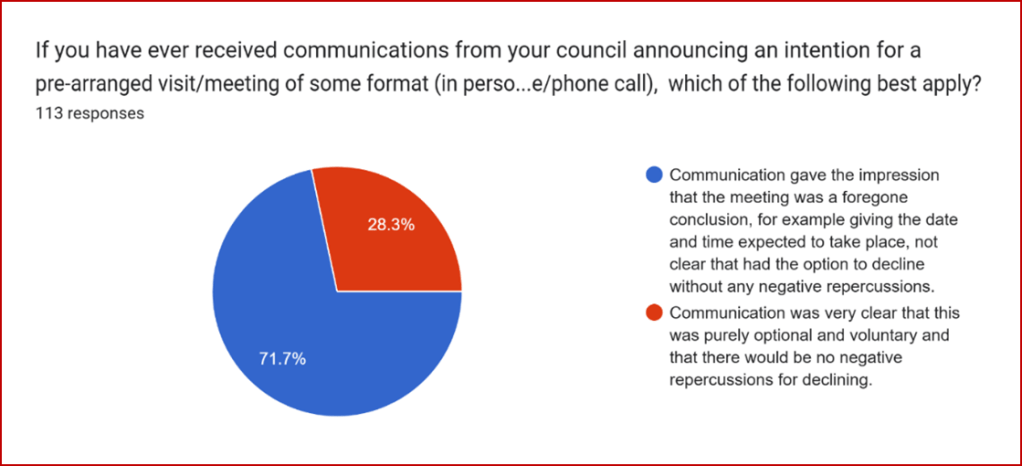
When asked about communications from council staff to pre-arrange home visits or meetings,
over two thirds (71.7%) of respondents to this question indicated that they had received communications from council staff that gave the appearance that such meetings or visits were not optional.
Less than one-third (28.3%) of communications from the council enabled respondents to exercise informed consent in relation to such meetings.
Question B.3.4.2 – Figure B.3.4.2

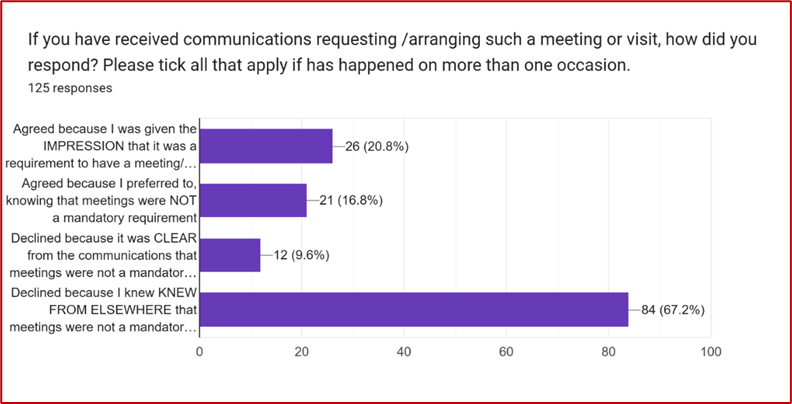
Data from Figure B.3.4.2 is also demonstrated in table format to allow each reason to be clearly appreciated
| Data from Figure B.3.4.2: Responses to communications specifying home visits or meetings | Number | Percentage |
| Declined because I knew from elsewhere that meetings were not a mandatory requirement | 84 | 67.2 |
| Agreed because I was given the impression that it was a requirement to have a meeting/visit | 26 | 20.8 |
| Agreed because I preferred to, knowing that meetings were not a mandatory requirement | 21 | 16.8 |
| Declined because it was clear from the communications that meetings were not a mandatory requirement | 12 | 9.6 |
Concerningly, 20.8% of respondents to this question had only agreed to home visits or meetings because they were given the impression by the LA that these were a requirement.
This is particularly problematic and concerning when one considers that information gathered on such a visit could be used as part of legal proceedings if the council were to proceed to SAOs, with this information having been gathered by misleading the family in question and without fully informed consent.
Crucially, less than 45% of those who agreed to home visits or meetings did so with fully informed consent, knowing these were not a requirement. (21/ 26 + 21)
Over 55% of respondents who agreed to home visits or meetings did so because of misleading information or communications from the council rather than through informed consent and free choice.
Of the 96 respondents to this question who were able to decline what should have been an open and unconditional voluntary offer of a home visit or meeting,
only 12.5% were able to do so because the council had given them this option by providing clear and appropriate information. (12 / 12+84).
87.5% of those who were able to exercise lawful rights were only able to do so because of having obtained accurate and lawful information from elsewhere.
82.2% (67.2 + 21) of respondents to this question indicated they were only able to make informed decisions about how to engage because of accurate and reliable information that was available from elsewhere, where this information was not conveyed by local authorities.
The data drawn from this question corroborates data earlier in this survey (in relation to Question B.1.2) that demonstrated fellow home educators and home education groups are felt to be the most reliable source of information for home educators
This data also stands in very stark contrast to the information and impressions conveyed in the WG-commissioned evaluation of their EHE guidance.
If accurate and lawful information had not been available to home educators from other sources,
it would be reasonable to assume that the rates of families agreeing to home visits and meetings because of misleading communications from the council, without informed consent, would be significantly higher.
Question B.3.4.3 – Figure B.3.4.3.
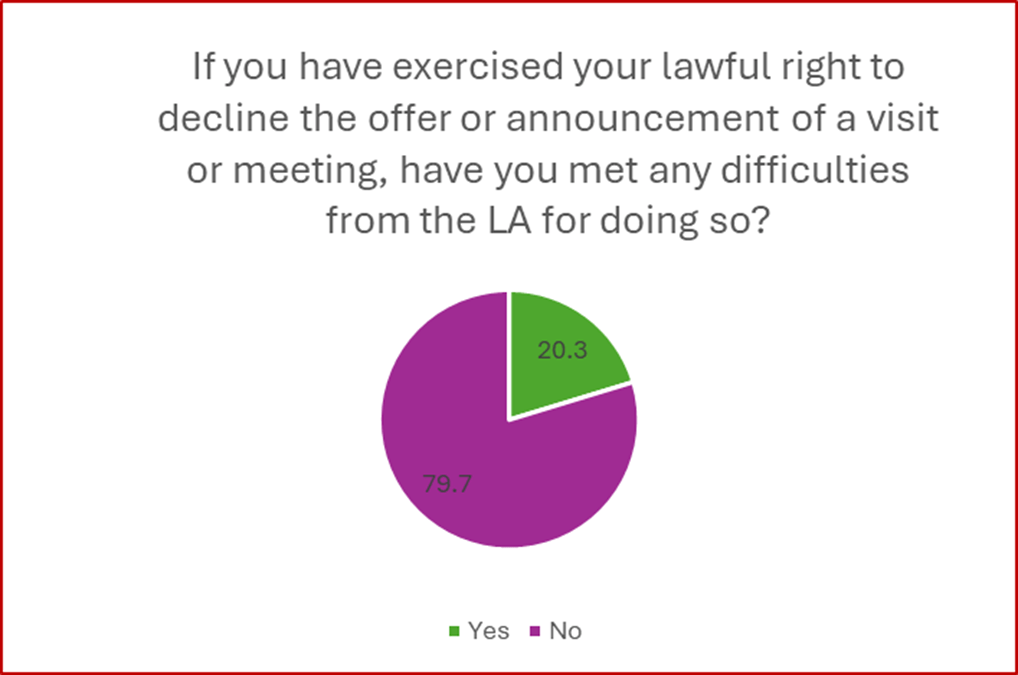
Just over one-fifth of respondents, 20.3% (19 out of 94 respondents), who exercised their lawful rights to decline a home visit or meeting, indicated that they had meet some form of difficulties from their LA for doing so.
Free text descriptions of the difficulties and consequences faced for declining what lawfully should be only an “voluntary offer” of a meeting included reference to:
- “Anxiety”, “stress”, “fears”, “worrying”
- “intimidated”, “scared”, “nervous”
- “Not taking no for answer, trying to influence decision”
- “Unsolicited calls”, “doorstepping”.
- “Pushback and pressure”
- “Threatened”, “threatened with SAO”.
- “Told it would count as a ‘refusal to visit’ which feels like a loaded way to put things”
- Needed to “persist” and “quote the law”
- kept demanding in a rather threatening way more information than is required to confirm my child was not their remit.
- “Took fending off so many intimidating and threatening communications.
- “exhausting having to deal with this, it took so much time. It took time away from being with my child”
Examples of misinformation given and descriptions of inappropriate conduct to try to force actions without lawful remit included respondents who were:
- Told that it was a management decision whether acceptable to not have a meeting
- Told in way that made it “sound like it’s mandatory” that “they are unable to judge education without seeing the home environment, meeting the child and seeing ‘samples’ of work”.
- “(Threatened) that if we don’t send samples or agree to visits, this would be considered a sign that we are not educating appropriately and would probably lead to an SAO.”
- “Threatened with SAO, unlawfully”
- “I was told I must have someone come to my house to complete forms to apply for EHE or I risk getting fined. And was told I need to accept someone coming to home visit once a year and see samples of work”.
- “Threatened child services involvement (for declining a meeting) even though said the education provided was more than satisfactory”
- They issued a SAO letter (for declining a meeting) – (respondent had previously been doorstepped and accepted visits because had been led to believe they were a requirement, until realised they were not and instead expressed a preference for communications in writing by letter).
- The LA person told me she knows we are (providing a great education”) but that she still has to check up on us anyway (by visits that the respondent felt too “scared” to say no to).
Those responses describe receiving incorrect information and inappropriate conduct.
Concerningly one of the cold calls was a man wanting to visit the home when did not know the names of the children who lived there and did not know the name of the manager of the department he claimed to work for.
That was for a family where the LA had already been confirmed only months before that the child was not missing education and therefore not under the council’s remit.
A number of responses were from home educators who had “given in” to pressure to demands for things that are not lawful requirements.
Reasons for this included:
- Being given impression home visits were a requirement – and feeling “betrayed by the LA” on finding they were not.
- Feeling “too intimidated and scared to say no to meetings” even though the LA have confirmed there no concerns about educational provision.
- “Feel too nervous and worried about repercussions to say no to meetings with the LA. It’s just easier to agree to them than try to fight the battle of saying we don’t need to have them. That isn’t right, we know, but we just have too much on our plate already in caring for children to have to fight the LA too. It’s really wrong that the LA put us in such positions.”
- Felt I would make life more difficult for myself if I didn’t” – in relation to completing forms from the LA when the respondent had already provided the required information in a written response in their own format.
- When cold-called by “doorstepping”, “felt like we had to let her in as didn’t know the rules then
Section B.3.5
“Samples of work”
Question B.3.5.1 – Figure B.3.5.1
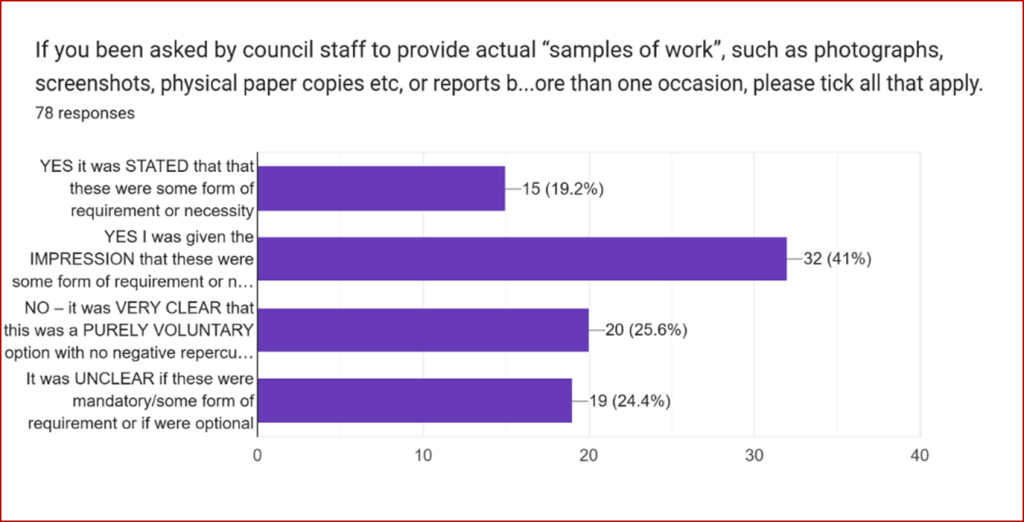
Data from Figure B.3.5.1 is also demonstrated in table form to allow each reason to be clearly appreciated
| Data from Figure B.3.5.1: If you were asked by council staff to provide actual “samples of work”, such as photographs, screenshots, physical paper copies etc, or reports by tutors, did the communications give the impression that these were some form of requirement/somehow necessary? | Numbers | Percentage |
| Yes, I was given the impression that these were some form of requirement or necessity | 32 | 41 |
| Yes, it was stated that that these were some form of requirement or necessity | 15 | 19.2 |
| It was unclear if these were mandatory/some form of requirement or if were optional | 19 | 24.4 |
| No – it was very clear that this was a purely voluntary option with no negative repercussions of not providing. | 20 | 25.6 |
Whilst there is nothing to prevent LAs “asking” for samples of work, there is no lawful requirement to provide these.
The “Portsmouth” judicial review confirmed that a policy of routinely requesting these would not be lawful, and validated a written policy by that LA that such samples were not routinely required, thereby confirming that “written responses” are an acceptable mode of communication.
There is however a difference between a voluntary offer of “asking” and conveying that these are some form of “requirement” without lawful basis for this.
Therefore, to convey a message that these are a requirement or to adopt a blanket policy of requesting these would be, at best, to provide misinformation and incorrect conduct.
Samples of work are pieces of evidence that can be used in a court of law, therefore it is imperative that any such samples are collected lawfully and in a manner that is above reproach.
They are also the intellectual property of the child, and are covered by copyright law, as discussed in relation to responses to Question A.4.
(Copyright, Designs and Patents act of 1988 https://www.legislation.gov.uk/ukpga/1988/48/contents).
https://www.tes.com/…/who-owns-childs-work-not-teacher
Therefore obtaining these without informed consent carries significant potential implications for councils and their employees.
The data in this survey concerningly demonstrates that the extent of misleading, inappropriate or unclear communications from the council would have allowed samples of work to have been obtained with fully informed consent in only 25.6% of cases.
To obtain what could be used as evidence in taking legal proceedings against families is obviously highly questionable, let alone the personal and professional implications for all involved. Further indications of the implications of deliberately or inadvertently misleading information from councils are given in the selection of qualitative data in Section C.
Question B.3.5.2 – Figure B.3.5.2
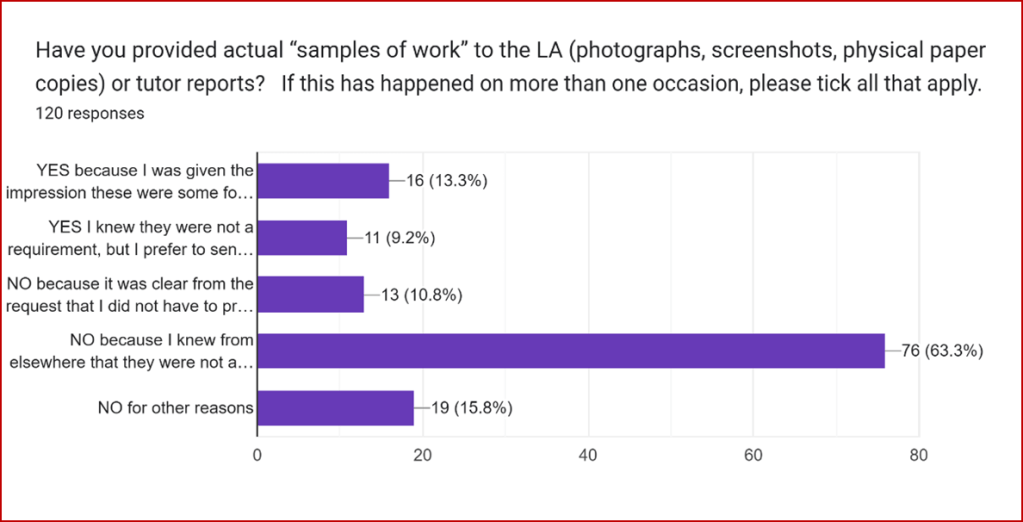
Data from Figure B.3.5.2 is also demonstrated in table format. to allow each reason to be clearly appreciated
| Data from Figure B.3.5.2: Have you provided actual “samples of work” to the LA (photographs, screenshots, physical paper copies) or tutor reports? | Numbers | Percentage |
| No, because I knew from elsewhere that they were not a requirement/necessity | 76 | 63.3 |
| No, for other reasons | 19 | 15.8 |
| No, because it was clear from the request that I did not have to provide these | 13 | 10.8 |
| Yes, I knew they were not a requirement, but I prefer to send these anyway | 11 | 9.2 |
| Yes, because I was given the impression these were some form of requirement/necessity, or because I feared negative repercussions if I did not. | 16 | 13.3 |
On 13.3% of occasions, respondents provided samples of work not because of free choice but because they were given the impression by the LA these were a requirement, and/or because they feared negative repercussions if they did not provide these.
In only 24% of cases (13 +11) were respondents able to make informed choices on how to respond to such a request based on information given by the council.
The main outcome in response to such requests was respondents only being able to make lawful choices and exercise informed consent because of information they had obtained from elsewhere and not being able to rely on information given by the council.
Again, this contrasts markedly with the impressions conveyed in the WG-commissioned evaluation of their 2023 guidance on EHE.
Furthermore, 63.3 + 15.8 + 10.8 = 89.9% of respondents have NOT provided “samples of work”.
This is in marked contrast to claims by some council staff as given in the WG-commissioned evaluation of their EHE guidance that in their considerations of home educators during informal assessments, “the emphasis is often on samples of work”, and that parents “often provided extensive samples”, and therefore could be taken as cause to cast doubts on such claims by council staff.
Such claims by council staff were taken without question as part of that WG-commissioned “evaluation” of the considered efficacy of their guidance.
Question B.3.5.3- Figure B.3.5.3
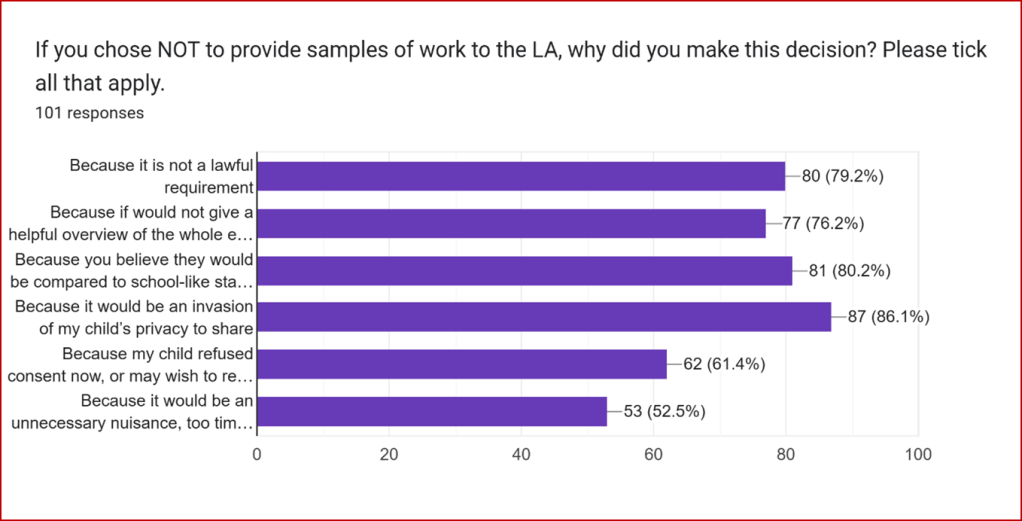
Data from Figure B.3.5.3 is also demonstrated in table format to allow each reason to be clearly appreciated
| Data from Figure B.3.5.3: If you chose NOT to provide samples of work to the LA, why did you make this decision? | Number | Percentage |
| Because it would be an invasion of my child’s privacy to share | 87 | 86.1 |
| Because you believe they would be compared to school-like standardised expectations which you feel are not relevant or applicable to your approach to home education, because you wish your child to develop along their own individual learning trajectory. | 81 | 80.2 |
| Because it is not a lawful requirement | 80 | 79.2 |
| Because if would not give a helpful overview of the whole educational provision or leaning experience | 77 | 76.2 |
| Because my child refused consent now, or may wish to remove consent in the future | 62 | 61.4 |
| Because it would be an unnecessary nuisance, too time-consuming and/or would detract too much from your time spent in home education | 53 | 52.5 |
To enable non-home educators to better understand the lived experiences of home educators, the reasons for choosing not to provide samples of work to council staff were surveyed.
Recommendations in the WG-commissioned evaluation of their guidance, based on information given by council staff of their conduct, such as “ Local authority officers should continue to routinely use brief in-visit assessment tasks and arrange observations in neutral venues or small group settings to see the child learning” are demonstrated to bear no correlation to the accounts and responses given in this survey of lived experience of Welsh home educators.
The evidence provided here indicated the opposite of claims or beliefs that home educators “routinely” participate in visits or provision of samples of work, let alone “routinely” “participate in assessment tasks” (staff providing “work” and witnessing the production of “samples of work”).
The evidence in this survey would raise questions about the likelihood of fully informed consent “routinely” forming the basis for any such assessments and observations.
This is just one example of the statements within the WG-commissioned evaluation of their guidance that does not match with shared conversation of lived experience or with the quantitative and qualitative data provided here.
If and when any measures are conducted on the basis of giving the impression they are or should be a requirement, when they are not, then that would be to behave dishonestly or even unlawfully.
That cannot be acceptable conduct for council staff.
This is further confirmation for significant re-evaluation and review before any consideration can be made of further extending powers and remits,
Especially in the absence of independent complaints, appeals, mediation, advocacy or tribunal systems or services.
Question B.3.5.4- Figure B.3.5.4
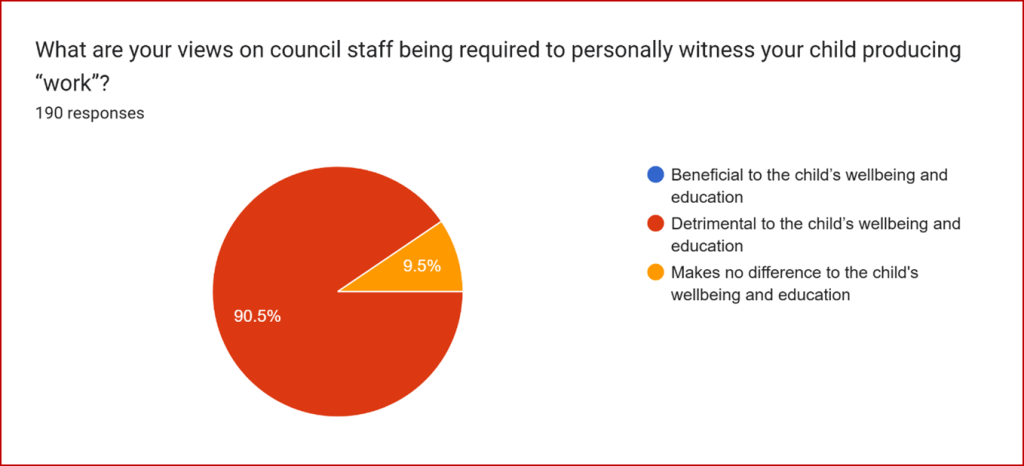
It is notable that no respondent believed that council staff personally witnessing children producing samples of work would be beneficial to children’s wellbeing and education,
and that indeed the vast majority (over 90%) believed this would be detrimental to the wellbeing and education of children.
The WG-commissioned evaluation of their EHE guidance contained reference to perceived desires by LA staff to witness each EHE child producing samples of work only to assess their “work” but also to ensure that the “work” was that of the child and no-one else’s.
The evaluation referenced doubting the “source” of “work”, questioning the “attribution of work to the child”, “attributing work to the child (e.g. in-visit short tasks, or video-recorded activities where consented)”, “one local authority said they “will accept written reports, although we don’t feel that by itself is sufficient as we can’t directly attribute everything to the child” .
Apart from the previously expressed concerns of how this was felt to be “insulting”, as explored extensively in response to Question A.8,
It is notable that the priority of parents in approaching the concept of samples of work is the wellbeing of their children,
Whereas the approaches to obtaining, observing or assessing samples of work given in the WG-commissioned evaluation of their EHE guidance took a very different tone without evidence of consideration of the impact on wellbeing of the children involved.
This again questions the concept of council staff being considered to be in a better position than parents to determine what is in the “best interests” of a child, not just educationally but holistically.
Section B.3.6
Other forms of overstepping and the response of LAs when home educators try to engage to deal with overstepping.
Question B.3.6.1
Respondents were given the opportunity to comment on the following question.
“Have you ever experienced overstepping or inappropriate conduct by your LA in some other ways? If so, could you kindly share below:
Responses demonstrated a spectrum of ways where council staff had overstepped respectful or lawful remits and/or acted in ways that were not in the “best interests” of the wellbeing of the child.
These can be found in Section D.
Question B.3.6.2
This question was an opportunity to explore any challenges experienced in trying to feed back to LAs about policy or conduct.
A number of responses reflected difficulties or obstructions to doing so, for example:
- Yes, I know some home educators try to explain to LAs when they overstep that they shouldn’t really be doing that, that what they are doing is misleading or wrong, but that puts those home educators in the firing line. So most home educators are too scared to try to stand up to councils when they overstep and misuse their powers. How much worse will that be if even more powers were given
- Home Ed Cymru have sent out regular communications to try to encourage LAs to listen to home educators in their area, to help encourage LAs to keep within lawful remits .But LAs don’t seem interested in keeping to lawful remits, only in pushing for power and control over people, only to tick their boxes rather than act in ways that benefit families.
This is of particular concern for Wales in terms of the CWS Bill, more so than England.
This is because not only is the no provision for independent complaints, appeals, advocacy, mediation or tribunal services,
but the only CNIS amendment that the Welsh Government has not requested should apply to Wales is the one that would place a duty on LAs to meeting at least biannually with home educators in the area if they requested this. to allow a forum for concerns or issues in conduct to be raised.
This is one of many points that were omitted from the Welsh Government’s justification of continuing to press for the CWS Bill to apply to Wales that was used as a copy-and-paste response to concerns raised about the Bill, as discussed in this article.
That amendment still would not provide any form of independent process,
those being required to raise issues would be the same home educators who face risks of LAs behaving in the ways described by survey respondents so far.
Respondents have already raised the problem of fear of potential consequences for being considered to be “non-compliant” even when they are behaving lawfully and responsibly.
Plus, there is still no duty on the LAs in England to do anything about the feedback given.
But for reasons that have not been given, the Welsh Government have excluded this lone clause from applying to Wales, a clause that would require at least an appearance of listening to concerns of those with lived experience.
This is rather ironic and somewhat contradictory, given how the Cabinet Secretary for Education in Wales recently told a meeting of the Children, Young People and Education Committee that “local authorities are not as good as they should be at self-evaluation”,
Section B.3.7
Complaints processes.
As already mentioned, there is presently no independent complaints, appeals, mediation, advocacy or tribunal system in place to address issues with conduct and decisions by LAs in Wales, despite the council having the capacity to instigate legal action against families.
The only way that families can have independent input to address decisions made by councils that they feel are mistaken is to allow themselves to be taken to court for non-compliance of SAOs in the hope that a magistrate has sufficient understanding of alternative educational pedagogy and educational law to be able to appreciate their family’s approach and choices.
To do so obviously carries profound implications for the family on personal, psychological, financial and domestic levels, risking a criminal record and all the resultant consequences of that, simply n order to have such an opportunity.
Families in such situations usually do not have legal representation due to prohibitive costs and therefore have to defend themselves.
The need for some form of independent service to at the very least deal with differing understandings and viewpoints on educational provision was acknowledged a number of years ago by the Welsh Government and the former Children’s Commissioner for Wales but there have been no steps towards such systems for how council staff manage existing powers and remits, let alone any steps towards such safety mechanisms for the use of unprecedented powers in the CWS Bill.
At present, any complaints about conduct of council staff in relation to home educators in the area are generally handled “in house” by the same individuals, departments or managers that home educators would then have to continue to have to deal with,
the same people who have the capacity to instigate legal proceedings against them,
the same people who they may feel have already not behaved or communicated in an appropriate, transparent or respectful manner, as touched on in previous aspects of this survey.
The responses to Questions B.3.7.1, B.3.7.2 and B.3.7.3 demonstrate the ineffectiveness and dissatisfaction with attempts at present of making internal complaints.
Question B.3.7.1 Figure B.3.7.1
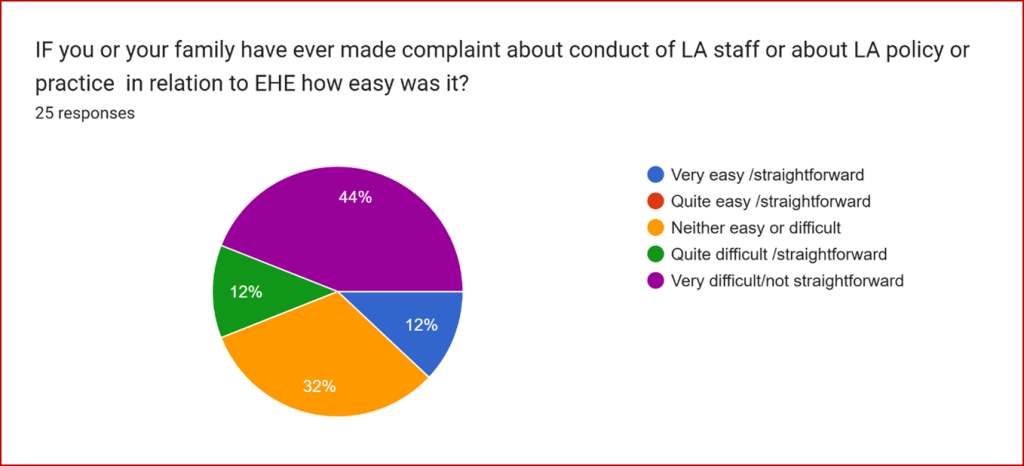
12.5% of the total number of respondents to this survey indicated that they had tried to make complaints about the conduct of LA staff or about LA policy and practice in relation to EHE.
The majority of these (56%) – found this process to be difficult or not straightforward, with most of these (44% of the total) considering the process to have been very difficult/not straight forward.
Only 12 % of respondents found the internal complaints process to be to any extent easy or straightforward.
Question B.3.7.2 – Figure B.3.7.2
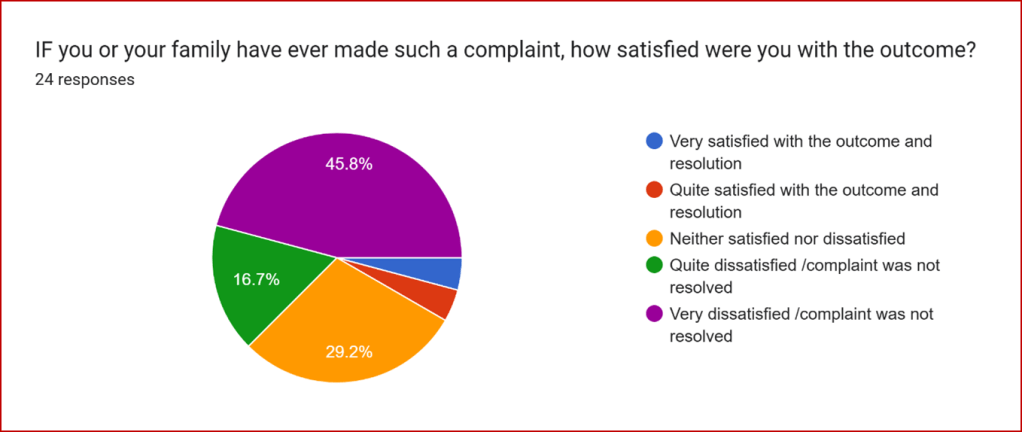
Only 2 (8%) respondents indicated they were in any way satisfied with the outcome and resolution of their complaints.
62.5% were dissatisfied with the outcome of the complaint and/or stated their complaint was not resolved, 45.8% being very dissatisfied.
Question B.3.7.3 – Figure B.3.7.3
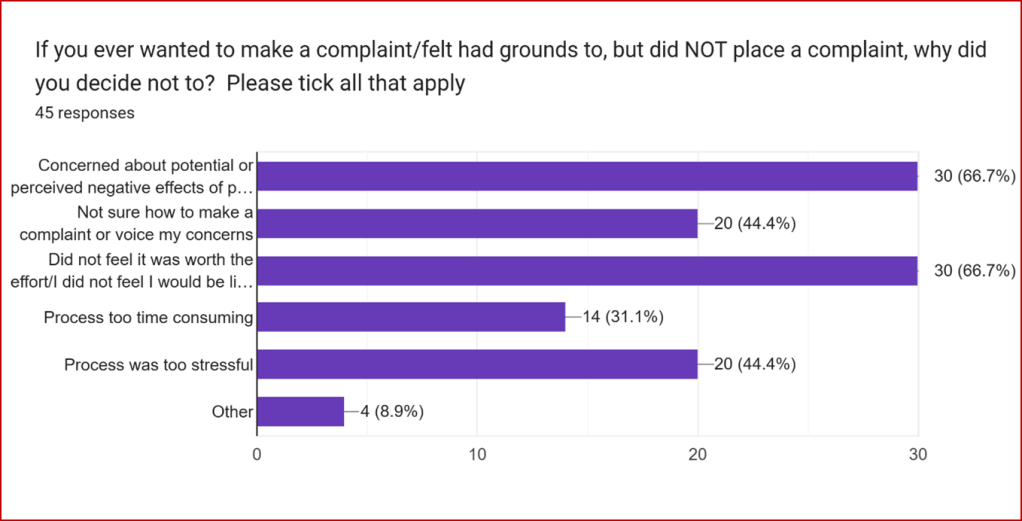
Nearly one-quarter of all who responded to this survey (45 out of 200) reported they felt they had wanted to make a complaint about LA conduct, or that they had grounds to, but did not.
Reasons for not proceeding to make a formal complaint are illustrated in Figure B.3.7.3.
Data from Figure B.3.7.3 is also demonstrated in table format to allow each reason to be clearly appreciated
| Data from Figure B.3.7.3: If you ever wanted to make a complaint/felt had grounds to, but did NOT place a complaint, why did you decide not to? | Number | Percentage |
| Concerned about potential or perceived negative effects of putting in a complaint or raising concerns | 30 | 66.7 |
| Did not feel it was worth the effort/I did not feel I would be listened to | 30 | 66.7 |
| Not sure how to make a complaint or voice my concerns | 20 | 44.4 |
| Process was too stressful | 20 | 44.4 |
| Process too time consuming | 14 | 31.1 |
| Other | 4 | 8.9 |
Concern of potential negative consequences from departmental staff that would have to continue to deal with, and a sense that would not be listened, were reasons given by over two-thirds of respondents to this question for not placing a formal complaint despite believing grounds to do so.
It is vital for non-home educators to appreciate these reasons, to give some degree of insight into the pressures home educators can face in relation to engagement with the local council even in relation to existing powers and remits.
Summary of Sections C & D
The initial aim of providing opportunity for written comments in this survey was enable the provision of a small number of quotes that expressed or summaries issues and concerns in the own distinct voices of the respondents, and possibly to allow the summarisation of the semantic fields and strength of feeling on matters. However, on reviewing the very significant numbers of written comments – a total of over 1600 – it became clear that it would not be possible to simply summarise these comments without also somehow muting or diminishing the impact of these.
Hence the decision was made to instead publish this collation of a representative selection of the very significant amount of qualitative data provided by the many respondents,
The collation presented Sections C and D reflects a mindfulness not only of honouring the time and effort each respondent has made to convey their experiences but also of being able to present the data and the trends in a relatively manageable and readable way, to allow the strengths of feeling and the core messages to be able to be as clearly demonstrable as possible.
Views shared are naturally not necessarily reflective of those compiling the survey but are collated to be a representative selection of the responses given in a way that most optimally addresses each question.
Full (anonymised) responses have been kept on record for reference.
Section C contains qualitative data that relates to Section A, an exploration of views and opinions on a range of potential future measures in relation to EHE.
Section D contains qualitative data that relates to Section B – an exploration of current experiences of home educators in Wales in relation to WG EHE policy and LA conduct.
Both are produced as separate documents and webpages due to the volume of relevant data.
Conclusions
The main issue highlighted by this survey is the need for ongoing conversations with home educators before any measures in relation to EHE can be reviewed, proposed, drafted or legislated upon, given the discrepancies identified between lived experience, governmental policy and proposal, and ideas and conduct of council staff.
Mandatory (or effectively mandatory) measures such as those contained in the CWS Bill or mentioned in the WG-commissioned evaluation of their EHE guidance were almost universally rejected as being considered suitable or acceptable.
No respondent believed that the CNIS clauses of the CWS Bill should apply to Wales.
Reasons giving included not only disagreement with the content, the lack of sufficient scrutiny and understanding of impacts, and the presence of sufficient existing legislation that needs to be used correctly, but with nearly two-thirds of respondents indicating that they “disagree with Westminster passing laws on a devolved issue”.
Likewise, the intrinsic premise within the CWS Bill that councils can always be guaranteed to act in the “best interest” of children and therefore it is safe to not have any independent appeals, complaints, mediation, advocacy or tribunal systems was also almost universally rejected.
The responses to many of the proposals and ideas in the CWS Bill and the WG-commissioned evaluation of its guidance were most concisely summarised as
“Tell me you don’t understand home education without telling me you don’t understand home education“.
The wide range of responses gave significant insights into the concept of home education, as well as the difficulties and challenges that can already be faced by a number of Welsh home educators, and reading these would be a vital step before any consideration of development of policy or legislation.
Whilst full consideration of the range and depth of responses in Sections C and D would seem to be essential for anyone considering developing policy or voting on legislation in relation to EHE, some initial insight into the experiences of home educators can be gleaned from consideration of the semantic fields given in questions such as Question A.12 and Question B.3.4.3
A range of safeguarding risks from various measures within the CWS Bill were highlighted in number of sections of the survey.
These include risks of self-harm and suicide of children in direct relation to impacts of proposed measures in the CWS Bill.
The data shows a distinct contrast to views and opinions given in the WG-commissioned evaluation of their EHE guidance, including marked discrepancy between how council staff portrayed normal conduct and experiences of home educators and accounts and information given by home educators in this survey.
A range of ways in which overstepping of respectful or lawful boundaries in LA conduct can impact home educators in Wales were highlighted and explored, raising questions on the wisdom and safety of any considerations of increasing council powers and remits.
The present WG guidance was generally felt to have worsened the experience of home educators in Wales, not because of need for “strengthening of powers”, or “powers to compel”, as the WG-commissioned evaluation of guidance puts it, but at least in part in relation to attempts of councils to overstep existing ones alongside concerns that this is encouraged rather than curbed by the present guidance.
The inherent conflict of interests was highlighted of the same person or department being expected to both enact lawful remits in screening for whether SAOs should be issued and also being in a non-lawfully binding potential role of “support”, to offer “advice and information” as the CWS Bill puts it.
The survey generated a wide range of quantitative data, which needs to be considered in the context of each question for the significance to be fully appreciated.
Key findings include:
- Over two-thirds of respondents (68.8%) indicated an awareness of potential discrimination or bias of council staff as a potential influencing factor of how they or their educational provision would be viewed,
with nearly two-thirds indicating that feeling treated with suspicion impacted how they chose to engage with council staff. - Nearly one-third of respondents had experienced cold-calling by council staff to make enquiries about their children and educational provision, with only 3% finding this helpful, pleasant or positive.
Over two-thirds of respondents were unable to clearly identify the person visiting or calling despite information about children or access into family homes often being sought. - Reasons for declining visits, unsolicited or prearranged, focused on concerns on parents safeguarding the wellbeing and education of children, as well as protection from bias and production of “paper trail” as evidence of engagements.
- Over two thirds of respondents indicated that they had received misleading communications from council staff giving the impression or stating that visits were a requirement,
with less than one-third of such communications enabled respondents to exercise informed consent in relation to meetings. - Less than 45% of those who agreed to home visits or meetings did so with fully informed consent, knowing these were not a requirement.
- Of the respondents who declined requests or LA-scheduled appointments for home visits or meetings,
only 12.5% were able to do so because the council had provided sufficiently clear and appropriate information for them to know this was an option. - Just over one-fifth of respondents who exercised their lawful rights to decline a home visit or meeting, indicated that they had meet some form of difficulties from their LA for declining a visit/meeting, with the range of these experiences explored.
- Further indication of the extent of misleading, inappropriate or unclear communications from the council is indicated in the finding that in only 25% of cases where “samples of work” were obtained was this with fully informed consent.
- No respondent believed that council staff personally witnessing children producing samples of work would be beneficial to children’s wellbeing and education, with over 90% deeming this to be detrimental to the wellbeing and education of children.
- 12.5% of the total number of respondents to this survey indicated that they had tried to make an internal complaints about the conduct of LA staff or about LA policy and practice in relation to EHE, with only 12% of these having found the process to be to any extent easy or straightforward, and only 8% being in any way satisfied with the outcome or considering the issue to have been resolved.
- Nearly one-quarter of respondents reported they felt they had wanted to make a complaint about LA conduct, or that they had grounds to, but did not.
Reasons included being concerned about potential or perceived negative personal consequences of putting in a complaint or raising concerns (66%) or feeling it would not be worth the effort/would not be listened to (66%).
Difficulties in the process were also given as reasons.
The survey has highlighted the mixed nature of experiences of home educators in Wales in relation to local authority conduct, some positive, some negative.
The information in the survey strongly suggests the risks and concerns that an introduction of the CWS Bill would cause deterioration in all areas, with previously positive engagement becoming negative and with negative engagement becoming worse without any checks and balances or means of redress.
It is beyond the scope of this study to determine the reasons for the apparent persistence of suboptimal conduct by some, such as misleading and inappropriate communications from councils.
This study is not able to evaluate or establish whether this could be the results of, for example, intentional practice, repeated oversights or a commonly occurring lack of understanding.
It is relevant to note that home educators as individuals and as groups have sought to engage with local authorities in Wales to provide constructive feedback and attempt to improve practice by ensuring correct information is provided to council staff.
Likewise, relevant information on commonly experienced issues that home educators can experience in engagement with the council is readily available in the public domain on websites of home education groups and charities.
It is hoped that attitudes conveyed in the WG-commissioned evaluation of their guidance of council staff towards home educators who seek to constructively engage are not factors in the lack of progress in such areas.
Likewise, it is hoped that research such as this is received in the spirit in which it is compiled and published, in the hope that the voices of those with a wealth of lived experience are not just heard, but appreciated and used to lead a more respectful engaging approach to home educators in Wales.
We particularly trust that politicians in Wales will adopt such a respectful and listening approach in hearing the voices of concern and objection, and reject attempts to “piggyback” onto Westminster’s CWS Bill.
Wellbeing in Education Wales
February 2026
Section C
Section C – Qualitative Data on Future Proposed and Potential Government Measures in Relation to Home Education in Wales.
This Section contains qualitative data that relates to Section A of the February 2026 survey of experiences of Welsh home educators, published by Wellbeing in Education Wales.
The summary report of that survey can be found here:
The initial aim in this survey of providing opportunity for written comments was enable the provision of a small number of quotes that expressed or summaries issues and concerns in the own distinct voices of the respondents, and possibly to allow the summarisation of the semantic fields and strength of feeling on matters.
However, on reviewing the very significant numbers of f written comments – a total of over 1600 – it became clear that it would not be possible to simply summarise these comments without also somehow muting or diminishing the impact of these.
Hence the decision was made to instead publish this collation of a representative selection of the very significant amount of qualitative data provided by the many respondents,
The collation reflects a mindfulness not only of honouring the time and effort each respondent has made to convey their experiences but also of being able to present the data and the trends in a relatively manageable and readable way, to allow the strengths of feeling and the core messages to be able to be as clearly demonstrable as possible.
Views shared are naturally not necessarily reflective of those compiling the survey but are collated to be a representative selection of the responses given.
Full (anonymised) responses have been kept on record for reference.
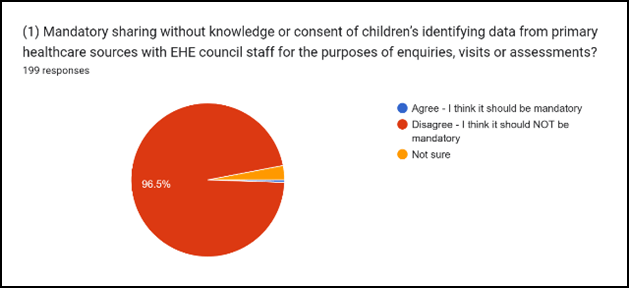
Respondents were asked if they had any further comments on a concept of
“Mandatory sharing without knowledge or consent of children’s identifying data from primary healthcare sources with EHE council staff for the purposes of enquiries, visits or assessments”.
No reference was made in this question to the extensive pilot that is presently running in Wales of what WG have termed “CME databases” based on such mandatory data sharing. Therefore, not all respondents may be aware of this as there has been n public information programme about this extensive data sharing process.
A representative collation of responses can be categorised under the following general summary headings:
Present current practice and ability of medical staff being able to share data if a child is considered to be at risk was acknowledged and agreed with.
Child’s personal health information should not be shared with professionals outside of health unless absolutely necessary for the purposes of safeguarding and the healthcare staff involved will have their own safeguarding procedures to follow.
There are already processes in place that allows healthcare, individuals and others to raise concerns of children safety and wellbeing.
The prospect of this measure making families feel less confident in engaging with health care professionals knowing that data was not confidential was raised by a number of responders. For example:
Won’t work in terms of safeguarding as if anyone is up to no good they will just stop attending Dr’s etc. which could mean worse outcomes for child as less contact with external organisations.
As a medical professional myself this is absolutely unacceptable to place this barrier between the healthcare provider and the patient.
I would be very concerned if this happened without the consent or even knowledge of the parents and children. Some children might not be able or willing to be open with their healthcare providers if they knew that this information will be passed on. Some parents might even be nervous to attend healthcare.
This not only breaks GDPR but this will push families away from primary health care resources in fear of Local Authority turning up at their house under false pretences of safeguarding when EHE is not a safeguarding issue in itself.
Confidentiality of access to healthcare was considered to be paramount by many, with respondents considering breaches of confidentiality to undermine trust.
For example:
Children have a right to keep their medical information private. Doctors have a duty to protect confidentiality of their patients.
This erodes trust
Obviously health care should be private and not shared
It is an infringement of privacy and confidentiality
To do so would destroy whatever trust existed.
this is a breach of confidentiality, a deterrent to feeling confident in accessing NHS healthcare. it is completely inappropriate. it would not safeguard children, it would do the opposite. It feels like a desperate data grab for the sake of numbers and political ambition, not a well thought out measure to protect the wellbeing of children.
Healthcare services should ALWAYS be confidential. Any sharing of information should ALWAYS be with informed consent.
I disagree because sharing a child’s confidential data without parental knowledge or consent breaches privacy, undermines trust in healthcare, and treats home educating families as inherently suspect without cause.
My child’s data should not be shared without consent as medical records are and should remain confidential.
Consent – or the lack of this- was a very frequent recurring concern in responses, alongside the use of datasharing as part of a non-focused widespread datasweep.
For example:
Sharing data without consent is just plain wrong. We have laws about this for a reason. It’s one thing to do this because of reasonable concerns for the safety of a child, but quite another to do it for all children, regardless.
Consent should always be sought when it involves other people’s children.
We should have a say in how our data is used.
I don’t think the LA should have access to any data about a child without the parents’ permission.
It should be with full consent of those who have PR.
Parents and children have a right to know where and who their information is being shared.
Consent should be obtained
No personal data should ever be shared without consent.
They should NOT share data without parental consent.
We should always have a choice and be consulted when it involves our children.
Although I feel that sharing of information between agencies can often be of benefit, it should always be done with the consent of the child or the parent if the child is unable to give consent. This is highly sensitive data that should only be shared with that consent or if there is an indication that the child is at risk. I am concerned about the privacy of data sharing and what else will be done with the information.
I don’t think it should be mandatory, and that ideally permission should be sought first.
A parent and child have the right to know if their information is shared. Both also have the right to a protected safe space. For my children that is our home. I don’t want anyone in it that could stress them out or set them back. A person that had the ability to send my daughter back to school would set her back to the start. I will do everything I can to protect that.
Absolutely not! Needs to be consented at the absolute minimum!
Nothing should be shared without our consent
Data should belong to the person.
This is data belonging to our children and we should have consent over who that is shared with and how that personal information would be shared
Use of data for purposes other than the one it was provided for was another frequently commented on concern.
Healthcare data is not collected to use in tracking people. This is a fundamental misuse of the data.
Taking info from a service that is pretty much mandatory in the UK and using it for a purpose which it wasn’t intended for is a breach of trust.
information should not be shared or used for broader enquiries, assessments, or secondary purposes without explicit agreement.
Risks inherent in data sweeps and sharing were often raised.
Data sharing is high risk and totally abhorrent when no cause for concern
Children’s personal data should never be shared without parental consent, it is a safeguarding risk.
Transparency and consent foster trust; mandatory sharing without knowledge risks undermining that trust
Due to numerous data breaches across sectors, data should only be shared where necessary and reasonable. M daughter hates people sharing HER data. Data should be protected
Too much risk of data breach and misuse of our details.
It is like you people have never heard of hacking or data breaches, which is far too common. Not to mention places are easily selling off our data, even just for playing games! Tbh, what kind of idiot ignores all these things and then gaslights to say it safeguards children by sharing the data. It just shows disassociation from society.
Puts child at risk
Concerned about rights of child and safety of data sharing
I believe it greatly heightens the risks of data leaks, which is a big concern.
Concerns were raised on ethics, lawfulness, the role of state vs parent, and the relation to right to private family life.
Unless in extreme circumstances, usually authorized by a judge, even social services cannot share information about a child/investigate a situation without informing the parents/child even when significant issues are raised so that consent doesn’t apply, parents/child are normally always informed of any GDPR or information sharing… As home educating on its own is not a safeguarding concern, why do we have less rights, respect and cooperation than those with child protection plans or under section 47 investigations?
This goes against Privacy laws. The parent is the one responsible for the child, not the State
Seems dangerous and against human rights
It’s absolutely violating our children’s rights as well as parents.
Breach of privacy and data protection
You can only share if absolutely needed.
It is a breach of data protection laws
Right to a private life
Invasion of privacy. Not necessary or appropriate.
I think it is unethical
The government is not the child’s parent
this is an infringement of rights to privacy.
We are not employed or paid for the work we do daily so there is no need to share anything with any corporation especially since there is no contract and we are not staff.
This would absolutely be in breach of GDPR and infringe on my child’s human rights.
Data belongs to the person and children have the right to privacy within their health and medical records.
Every person’s individual data about themselves is private and nobody has the right to share any of this information with anyone without prior consent.
It unfairly labels home educators as less good parents than those who choose to school their children, and it removes their right to a private home life and will.
This is effectively digital ID for children which is hugely concerning
It’s primarily the role of the parents, not the state, to educate our children.
Motivations for such actions and datasharing were questioned by some
As it stands, we cannot trust LAs to understand the many variations of home education and its benefits. At present they aim to get children back in school as they believe it is best for all children. That is not the case
Some shared their personal experience of their data having been shared in this way as part of the extensive pilots of so-called CME databases.
I think it is absolutely shameful to share data in this way. We have been “found” under the pilot scheme and because I refused to give personal data on my doorstep to a total stranger who claimed to be from the LA, we were reported to social services. I had already provided a lengthy written report in response to their request for information about my child’s education, but they chose not to acknowledge and just turned up unannounced. I have a formal complaint in place to which I am awaiting a response.
Mandatory sharing can make parents weary of accessing health care for their children, it is unnecessary for the purposes of EHE enquiries.
Our information was shared due to a pilot scheme and it’s not ok!
Other accounts of personal experiences included:
I have firsthand experience of a healthcare source providing inaccurate and false information about my child with their previous school.
My child has special needs & school had a huge impact on his health mentally & physically, when we chose home education the la were involved & he was petrified they were going to send him back to school, we’ve had no contact from the LA in almost 2 years & it’s been really beneficial for both of us. I don’t think the health care system should contact the la it should be up to us parents. If we choose to have them involved that’s fine but if we choose not to, we should have that option ourselves
Concerns were often raised on the inappropriateness of using EHE-related council staff as some form of “safeguarding officers”
unless there is an actionable safety concern about their welfare which would come under social services rather than education
Healthcare should be kept separate unless there are safeguarding concerns which are nothing to do with education and are for social services to investigate
Other comments included:
Absolutely disagree how would anyone who doesn’t home educate feel about that for example MS or MPs having their information shared with the general public (their employers)?
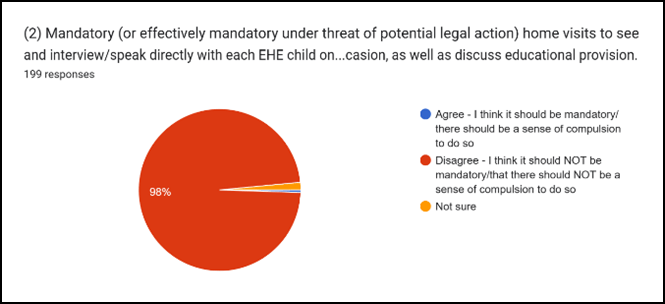
Respondents were able to comment on the concept of “Mandatory (or effectively mandatory under threat of potential legal action) home visits to see and interview/speak directly with each EHE child on each occasion, as well as discuss educational provision”
A number of responses indicated such a measure is not required or acceptable, considering it intrusive, invasive, unnecessary, without consent, violating, compromised sense of safe space, presumptive, against human rights, breach of rights to privacy of family life, disregarding children’s autonomy.
Children should be allowed to study without fear of having to prove their worth to other people.
Children are seen by many adults as part of their day-to-day life
Invasion of privacy and basic human rights. Disruptive to children and families and completely useless waste of resources
not acceptable
This would be completely outrageous.
This is totally overstepping, our children are not the property of the government or the LA, they have no right to demand anything, it is the parents’ choice how to educate their children not the states’.
This is incredibly intrusive and everyone knows it. In no other instance where there is not suspicion of abuse or harm is this allowed, not even police have this power and it’s for a damn good reason. We the public have a right to privacy, this is a huge breach of that.
Home visits are neither necessary nor appropriate. Not all children can cope with intrusive strangers coming into their homes and as with anything else, the assumption should always be that the education provision is appropriate unless there is evidence to the contrary – innocent until proven guilty.
We teach children not to speak to strangers. Being interviewed by a stranger about something they do day to day as important as home education will make home education stressful for them believing they are being judged by an outside person who doesn’t know them. The people who are sent out to assess home education are not trained teachers or education specialists and therefore cannot assess the education.
Again violating. My child is my responsibility and I do not wish to share that responsibility.
Assumes guilty until proven innocent attitude. Invasion of privacy.
It should NOT be mandatory! The home is a safe private space for the child and mother. A mandatory visit to the home is a safeguarding issue and mothers and children will feel vulnerable if a stranger says it’s mandatory to enter the home. (Obviously if there is an actual Social Services concern for the child the protocol should be followed, but for normal families this is not needed). Additionally homes do not look like schools, work is done in family living rooms, and kitchens, there will be laundry and evidence of cooking and washing up. There is a danger normal homes will be judged by school standards when in fact it’s a normal functioning home.
Absolutely disgusting that a stranger should be allowed to visit and speak with children. In the same way as I wouldn’t allow a police search with no warrant. These visits assume guilt and make us prove our innocence. These visits would be traumatic for most children and they need to be protected from them.
Our home is our safe space, no one should be forced to allow anyone into their home unless it’s a police matter only.
*Complete disregard for right to private family life
*Invasion of child’s safe space
*Invasion of privacy of other family members
*Complete disregard for child’s autonomy
It implies a need for them to be seen, which is assuming negative, and it implies seeing them is beneficial
I have made an informed decision to home educate my children. They have experienced school and as a family this is our choice there is no further discussion needed.
My children would refuse to speak
Many responses highlighted the consequences of unnecessary and damaging anxiety and stress to families and children, including discussing what was seen as profoundly damaging impact on neurodivergent children and parents and on those suffering from school-trauma
Would be a disaster for a child like mine who we have had to home educate due to significant school-based anxiety. This could tip her over the edge
This would be extremely stressful for my child whose home needs to be a safe space where she is not subjected to interview. If education is seen as a demand or expectation it would impact her ability to engage. Such a visit could damage our successful learning process where she feels in control.
This would be massively detrimental to my child. She is neurodivergent and the stress of this would make her unwell.
My child has ASD and meeting new people especially at home is traumatising to her.
For some children enforced meetings can be distressing and can also damage the parent child relationship through a loss of trust.
One of my children has anxiety and home is their safe place. A home visit would completely change that.
Children who are neurodivergent or have anxiety for other reasons (and perhaps that’s why they are home ed – if the school environment is not suitable for their needs) will not cope with a stranger being allowed to enter their home, which might be their only safe space in the world. This could be so mentally damaging for them. The idea that they could do so to ‘interview’ a child is horrific, if you know anything about traumatised children (as those who’ve had to leave education owing to neurodivergence often are).
This would terrify some children.
My child is not happy to speak to strangers and the lack of choice in this is already causing him anxiety.
My child would be incredibly uncomfortable in this situation and likely be selectively mute. So what would the LA representative gather from this visit?
This would have a detrimental impact on my child who would find this extremely stressful and would not be a true reflection of them and their experiences of home education
My son had special needs having to speak with someone from the la would be detrimental to him, he would be constantly panicking that they would send him back to school even if I explained that wouldn’t happen, he would be constantly worrying about it. His biggest fear has always been school. He does not like talking to people he does not know & therefore would shut down if someone he didn’t know tried to talk to him.
I find this an unacceptable intrusion to home life and private life. Which other group of society would be asked to have mandatory visits from an agency to come into their home? Some children, particularly neurodivergent children, would find this really stressful, particularly if they had traumatising experiences with authority figures in school. The home should be a safe space for all children.
Furthermore, some children might find it really difficult to talk to strangers about their education or activities in general. This is particularly true for neurodivergent children. My autistic daughter, now beyond compulsory education age, would not have been able to do that.
Home education, as we have said again and again, as has been said by politicians again and again is NOT a safeguarding issue, so why would the LA have to ‘see’ the child, particularly in their home. Where does this distrust towards the parents come from?
Parents are responsible for their children’s education. Period. A written report about the education they are offering to their children should be enough to make it possible for the LA to decide if that child is a child missing in education or not, which is the remit of the LA.
Children say things out of context and a lot of children would be quite frightened and uncomfortable with being interrogated by a stranger. And as a parent, I do not know this person, and don’t know if they can be trusted
Many children (and parents) whom home educate are neurodivergent and regard home as their safe space and I do not feel that it should be mandatory that this is invaded.
Many children with neurodivergence’s find it difficult to communicate with strangers and would not ‘perform’ well if forced to do so.
This can be distressing for both the parent/carer and child to have their home invaded and subject to scrutiny and judgment. If it is necessary it should be optional to meet, in a neutral place.
ALN children in particular may not cope with this intrusion. Many are traumatised by the education system which is why they are deregistered in the first place
My son has autism/OCD and extremely high anxiety so someone coming into our home that isn’t one of his safe people would set off a spiral of devastating mental health!
My child is neurodivergent and home is their safe space. If council employees come to our home, it is highly unlikely my child will engage with a stranger, or agree to be interviewed by them. Following their school trauma, it would trigger off this trauma and set them back, possibly weeks or months in their recovery. In addition, mandatory home visits and interviews are not expected of school children, so it is another example of home educators being singled out. Home educating families should be given a wide variety of options of providing information based on what works for them, for example, I prefer to put together a written response as this works much better for me than being interviewed. The expectation of seeing work on these visits suggests that EHE departments are not fully trained on the variety of learning opportunities in home education and that most learning is not worksheets or writing. Finally, I am not satisfied that all EHE staff have the relevant training and experience to understand the diversity of home education, learning styles and approaches, neurodiversity and diversity of the home educating community. I am also concerned about the safeguarding checks carried out on these staff members and whether they are sufficient enough for staff expected to visit the homes of ALN children.
Parents should always make the decision based on the best interests of their own children on who should meet/speak with them. My child has suffered significant school-based trauma and to be made to meet a stranger and expected to see/speak with them would cause unnecessary distress. Trust parent’s judgement as you would a teacher or someone in healthcare.
Any child who has been deregistered from school for a negative reason would not want this. Many children who are neurodivergent or even just shy would not want this. By all means have it as an option for those who prefer to meet in person, but making it compulsory is discriminatory.
Home is his safe space and he is able to manage his emotions and thoughts with confidence as he knows he will have no unexpected visitors or can choose to interact with any other visitors to the family home.
Many children are home educated because of trauma caused by school not meeting their needs. Home is the child safe space. Visits by a person questioning the child or analysing the child’s education is going to be traumatic for some children. Those conducting the visits are unlikely to understand home Ed methods or be aware of the child’s full history and educational and emotional needs. There are already processes in place if concerns of wellbeing or education being provided.
1. A lot of our children have experienced significant trauma in formal education. This practice will show them they should not even feel safe in their own homes.
2. What extra information is this going to give on education that can’t be put in a written response? It is moving into the remit of social care rather than education.
3. Why stop at EHE children – all children should be interviewed at home if this is for safeguarding purposes. This is not viable.
4. What qualifications do the EHE officers have to speak to traumatised children? Or judge learning environments?
The school system is very outdated and not suitable for all pupils and home education is the only way to protect mental health of whole family in some cases and I feel mandatory visits feel like another pressure from the system as long as the pupil is happy learning life skills not all pupils would be learning the same
Home is a child’s safe space. Some ALN children rely on their safe space to regulate and professionals visiting here can be upsetting.
We all have a right to a private family life. I do not agree with any intrusion into anyone’s home when there are no genuine reasons for concern. This intrusion will be detrimental to not only children’s but parents mental health and wellbeing. Schoolchildren are also in their homes every day and especially during schools holidays. If their houses are not being assessed for safety why are Home Educators being criminalised. I do not agree with children being interviewed and questioned by an adult about anything, unless there are genuine safeguarding concerns such as abuse or neglect.
Having been failed by the school system and as a result suffered both physically and mentally, our home was/is a safe space. At the time my child came out of school and for the next year or two, a visit to our home would have had further detrimental impact. Having recovered over time and having built up wonderful relationships with other adults leading activities such as forest school and an amazing tutor, as well as making lots of friends within the home ed community – this would probably not be a problem for us now – but would have been hugely detrimental in the first period.
When in school my child said he didn’t want to be alive anymore. He is now thriving!
A lot of children are home educated as a result of school anxiety or trauma. They are often completely burnt out. It is frequently the case that they cannot leave their home or converse with anyone due to this. Home is their safe space. Their ONLY safe space. To have strange adults intrude upon this is unacceptable. It will cause additional trauma and destabilise any recovery. Additionally, these children would find it extremely difficult to talk to strange adults . This whole provision undermines the welfare and wellbeing of children.
There are many reasons why this is not appropriate, but primarily because a home should be a safe space for families and their children and uninvited persons should not be permitted to intrude on that safe space
Cause stress, shutdown and regression in neurodiverse or mentally ill children
Children should not be forced to speak to strangers and should not have to prove anything. This may cause anxiety and distress.
My son has left school with LOTS of trauma and education staff coming into the home would set us back beyond belief.
One of my children would not cope with the stress of this. Protection of said safe space.
Although this might work for some people, many home ed children especially those with SEN needs who have been forced out of school would find this an attack to their safe space. Again, often times where possible social workers meet the children they are assigned in public places such as Costa. Why are home elders under stricter scrutiny when no safeguarding concerns are there?
My child is neuro divergent. She is very clever and has no issues with her education but she would feel unsafe if someone (especially those unqualified to judge her) came to her home/safe place and asked her questions and it would feel very unnatural and accusatory for her when she is very happy and capable and doesn’t require this government overreach just because of a small minority of issues with other children who were known to ss, therefore that judgement and assessment shouldn’t be forced on the majority when we are already in regular contact with the local authority annually in writing which they are already satisfied with.
In our own circumstances, our children came out of school due to unmet needs and safeguarding concerns whilst they were in school. Home is a child’s safe space. My children are neurodivergent and do not cope well with people being in their home, even if they are known. You have a right to decide who enters your home and who doesn’t, so this should be a meeting on an agreed basis, at a place that would suit the child. Not mandatory for it to be at home. Only way they should have home visits is if there are social services involvement and evidence of harm being caused to the child.
This will cause extreme stress for a lot of SEND families
My child is highly anxious and hates people being in her environment she doesn’t know. It gets her off baseline and she’s not good for an extended period of time. Trying to then make her talk (she selective mute so wouldn’t talk anyway) would just increase her anxiety!
My child has Selective Mutism; there is no support from the local health board and little understanding about this from anyone not directly impacted. It is highly unlikely that LA staff would have knowledge about this, a visit would exacerbate the child’s anxiety, so negatively impact their wellbeing, but also how the child would appear to a stranger without knowledge of SM would be withdrawn, unable to make eye contact, nonverbal etc all these symptoms of SM would likely flag a safeguarding concern to the LA staff and result in unwarranted protocols being implemented all because of a snapshot visit and staff not have the capacity to understand the complexity of so many ALN, they impact on my child would be incredibly detrimental if this was to happen.
Where to begin with this???
Home = safe place.
I have 3 neurodiverse children, 1 of which also has selective mutism. Mandatory interviews with local authority workers who don’t know my children will be firstly traumatic for them and secondly they won’t be able to engage with the local authority worker and therefore they will not be painted in a good light.
Our homes are our safe spaces, this would be an invasion of privacy.
A member of our household has long term health issues, it could be detrimental for them to have people visiting our home.
As a neurodivergent adult I would find spoken meetings like this difficult.
My children are ND as are me and their dad and allowing people into our home can cause a lot of stress and trauma. It would take a long time to get over it. Anxiety issues and speech impediments also would make this too stressful for our family.
Responses indicated how such a measure is considered both ineffective and unsafe for a range of reasons.
Mandatory visits to all families are going to dilute resources from where they are needed. Such as children (home educated, in school and under CSA) that are known to be at risk.
It would also not give an accurate impression of how safe they are in the home to a HE officer, because they will not behave normally with that person there, specifically because that person is there. If there are reasons to suspect abuse or other concerns, then home visits should be carried out by specially trained social workers or police officers. My experience of EHE team staff over 6 years tells me (as a professional myself) that they do not have the necessary understanding, experience or competence to make any kind of assessment that would be of any use and are actually likely to create problems and damage.
Firstly, this is a terrible way to assess any person, as instead of reviewing progress over a period of time (as in a school report) this takes one occasion when a child could be unwell, tired or just not performing at their best ability. We know this and it’s partly why exams are revised for, but surely we wouldn’t want children revising for home visits?
Secondly, it suggests there is a need for these visits, which there isn’t. There is no extra risk to a home educated child and neither are they ‘less seen’.
Finally, it is discriminatory against many of the children who have left the school system due to unmet needs, especially with Autism, who would find these visits incredibly distressing. Remembering that it is completely understood by those knowledgeable about Autism that invading a person with Autism’s safe space can feel very upsetting and threatening.
This directly goes against meeting their needs, when the EHE guidance is clear we must provide a ‘suitable’ education.
As a sidenote, I would also consider the staff and budget requirements of this, especially when many of these children are not going to merrily engage with a home visit and it may need to rearranged multiple times due to health needs, emotional needs and/or specific needs relating to Autism or similar conditions.
The utter incompetence that I have experienced in my limited dealings with the LA means that I certainly would not allow anyone to set foot in my home, and neither would I subject my child to dealing with them. They are unqualified, unprofessional and incredibly impolite. They have an inflated sense of their own importance and are clearly conflating HE as a child welfare concern.
Threatening people with legal action is coercion and coercion is a criminal offense
The council via the education system have failed my child. How I now chose to provide his education in the light of their failure is none of their business.
Children in schools are not interviewed about their experiences and education. Children in school may well feel their own education is unsuitable, but these viewpoints are not regularly collected or taken into consideration. Parents know their own children best and are (almost always) the best judges of how their children are doing and progressing. Also, some children may find it very intimidating to have to speak to strangers about their education. Young children may also give unreliable, and even false, answers about their own education.
There should certainly not be legal action attached to this as many parents have had to fight for their child to have the correct support at school and have chosen to home educate because this is not offered or possible and should not be legally penalised because they refuse something which would be further damaging to their child.
When schooled children are regularly interviewed in their homes, then home educated children can also be interviewed in their homes.
I think if legitimate concerns are raised it should be taken further but not if there are no concerns. I have children with ALN who would find it extremely distressing to be put on the spot or questioned. A parent’s word should be enough unless there is genuine reason to believe not. If more pressure was made to schools to make sure basic needs were met for children less people would home educate. Making home education more difficult won’t stop people it will cost more in the long run as most parents will jump through hoops to protect their children which is why they are pulled out of school in the first place. School needs a complete revamp its not built for purpose anymore.
I understand the local authority’s safeguarding duties and do not object in principle to a child being met or educational provision being discussed. However, making home visits mandatory — particularly where framed with potential legal consequences — risks creating unnecessary tension and undermines a solid relationship with the council. I know I would prefer it to be positive and to feel I could ask questions without fear.
Most home ed children are underage and therefore will be susceptible to outside pressure to conform. Plus their mental health maybe affected due to said pressure. Plus many home ed officers are not nice to home ed families.
Invasive. Not necessary or appropriate. How can people be expected to trust and accept unqualified local authority staff doing home visits, when they have already been let down by local authority schools and education department which is why they’ve gone home ed in the first place. People go home ed specifically to avoid having to deal with the incompetence of the local authority.
Home is a safe space. I don’t permit strangers into mine and my children’s home. Especially not a male while my partner isn’t there. If this became mandatory I would be fitting cameras with excellent mics so that everything is recorded. I also insist on removal of shoes at the door.
Home visits are not conducted with school children. Homes are children’s personal safe space and should never be forced or mandatory to have strangers intrude on this space!
Only should be allowed if you are also going to speak to every single school child to discuss if their educational needs are going to be met – if not there is a weird assumption that school is automatically meeting a child’s needs which everyone knows is not the case!
Making children mandatorily meet and adult or be made to allow someone into their home under threat is a dangerous awful thing to teach children.
I understand that Councils want to maintain communication with home educating parents. Surely an ethos of respect and understanding achieves more than an attitude of suspicion and obligation.
This doesn’t suit all children families and can cause undue stress. Not to mention those visiting do not always understand home education.
The government is not the child’s parent
The parent(s) have authority over their own child(ren), not anyone else.
the whole education system has failed **** the full time he’s been in school, so no, as his parents we now shouldn’t answer to anyone regarding his educations it’s our business. I’m more than happy for the LA to have someone who is experienced in learning disabilities to just offer support and tips on what to do even classes on supporting him, and so on but not sticking their noses in telling us we are not doing good enough when their education system has never done good enough or right by my son.
Children should not be asked to speak to a stranger without even a friendly witness present to ensure safety and that what they actually say is fairly reported.
Too much pressure to put upon the whole family but particularly the child(ren). Expecting them to “perform” for a stranger. Also an invasion of a safe space where a child can be their true self.
Our homes are our safe havens, you invade them without cause, you make them unsafe!
Overstepping of respectful and lawful remits.
(an issue that is also referenced in many of the other responses above).
Should not be mandatory. It is parents who safeguard and protect children. Families should not be treated with suspicion just because they decide not to take up the state’s offer of free education but education on their terms that is so often unsuitable. Children belong in families. The role of the council is reactionary. Normal loving families should not be put under surveillance and monitoring
We should not be forced to allow entry to someone who we do not know, and who has little knowledge/experience or consideration for home educating families. We are being treated as guilty before proven innocent, and there are no other communities who have mandatory visits unless there is proven evidence that it is necessary.
This is nothing but a gross invasion of privacy, home is the only safe space for some children. Under law we all have a right to respect and privacy.
This is highly invasive and presumes authority to access a child without a reason for concern.
All communication should be kept in writing for the protection of both parties.
I disagree because compulsory home entry and interviews under threat of legal action are disproportionate, intrusive, and assume wrongdoing. Education does not require routine surveillance to be valid or safe.
No child should ever be forced to speak with an inappropriate adult in any circumstance.
EHE staff are inappropriate adults as they have no experience or knowledge of home education, they have no training in how to appropriately speak with a child, they have no legal right to speak to any child and the child has every right to refuse to speak to anyone, if that is their choice, as per Article 12 of The United Nations Convention on the Rights of the Child.
What cause or justification is there behind the suggestion to make this mandatory? If a parent is fully engaging with the LA, providing reports and the education is deemed suitable there is no reason for a mandatory visit. If there is cause for concern these as always should be signposted to the relevant authorities as would be done in a school setting. The LA is not the relevant authority.
Both children and families have the right to a private family life, they have the right to choose who to engage with or not. Many children would find meeting with a stranger
Very intimidating and this should not be forced. Local Authorities already have powers to visit families where safeguarding concerns are raised. It should not be a matter of course. The administration and funding for this type of intrusion would remove resources and time from families and children who really do need support.
Responses from those who presently voluntarily accept home visits were insightful.
It should be up to the parents to decide how & where their children would be happy to do this. Our children are autistic & need to feel that their home is their safe space.
They’re fine with the LA home visits, but they usually just say hello & then go upstairs & I do all of the talking. I feel it would be unfair to force them to talk about their education if they don’t want to as it would be very stressful for them.
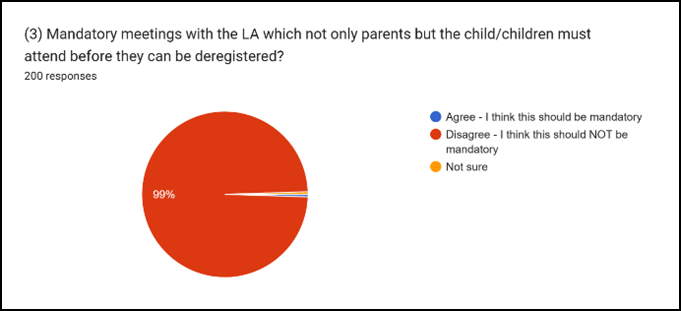
Respondents were invited to comment on the concept of “Mandatory meetings with the LA which not only parents but the child/children must attend before they can be deregistered”.
Many responses to this question mirrored those of the previous question, with a number directly referring to the points already made there.
Additional points include the following:
A number of responses deemed such a measure inappropriate when school is an opt in service, and questioned the motivation behind such a measure. Concerns were raised at attempts of interference with family choice and overstepping of the role of the state. The overwhelming consensus of opinion was that any such meetings should be optional and without coercion or suspicion. Concerns were raised that such meetings, with the delays and potential obstructions to deregistration would be dangerous, damaging to children’s wellbeing, and counterproductive.
This takes away parental rights and children’s rights to do what is best for their mental health and wellbeing. This appears to be intimidating and bullying behaviour for anyone who does not follow ‘the norm’.
This is incredibly dangerous and takes away the right of the family to decide what’s best and allows potential for discrimination by the LA.
Many children leave at crisis point; this could be very dangerous. Aside from that it completely undermines parents’ authority.
Nobody asks a child in school if they want to be there. Nobody speaks with a child before becoming CSA and asks them if they want to go to school.
No other state service requires a meeting on opting out!
This is just a coercive delaying and deterrent tactic.
If parents want a meeting, let them have the option, but don’t force, bully and coerce parents and children.
Can parents still be fined for non-attendance if and when the LA delay the meeting? If the child isn’t able to attend school then just how are they going to attend such a meeting? What happens if the child refuses to attend because it is just too traumatic and triggering?
I do not see how LAs, who have often let the child down hugely at this point and failed to recognise needs, should be given any power to prevent or delay parents deciding to remove children from school. Many professionals have been clear that this further traumatises the child (see work of Dr Naomi Fisher), which is unacceptable. The reality of meetings like this is that they discriminate against Autistic children especially (see School distress and the school attendance crisis: a story dominated by neurodivergence and unmet need, SE Connolly, 2023). Unless we are reducing parental rights by law, which makes no sense, then there is no need whatsoever to give LAs decisions on where a child should be educated. It is already a bit silly to have them involved in decisions around children in specialist schools. There is a big risk that you would push many parents into faster decisions, as they want to avoid these meetings and delays or preventatives put in place by the very LA they’ve already been fighting to get support for their child with ALN. Imo, I would not be sending any of my future children to school at all with this mandatory meeting in place, as in the rather probable case it doesn’t work out, their emotional health would be at risk. We’re talking in some cases about children who are suicidal due to school, who self-harm or cannot eat or have violent physical meltdowns due to distress. This is not an issue to be taken lightly. Equally, unless adults are trained in getting a child’s view WITHOUT LEADING QUESTIONS, then this could be very dangerous and unhelpful. It is intimidating as an adult to sit in a room against multiple other adults who have teamed together on an opposing view (hello, Attendance Policies and being parent to Autistic children), as a child this would be very intimidating.
If a parent is deregistering their child, it should be their choice and only their choice. Permission is not needed
Again, on what grounds are there to justify this action. The parent has the right to decide on their child’s education. A parent has the legal right to never register a child at a school. A school education is an ‘opt in’ process ergo a parent has the right to ‘opt out’ at any given time and does not and should not have to justify their reason for doing so.
The responsibility of education lies with the parent. Not the LA. Ultimately, parental rights lie with the parents. Not the LA. There is no need for a meeting.
Under the law, it is a parent’s responsibility to ensure an appropriate education for their child, regardless of whether they choose to do this through school or another mechanism. The authorities do not have the right to override this.
Home education is the default education. Why should a parent or child have to be interviewed before they can be deregistered? That is taking away our rights. To involve the children in this gives the wrong idea to our children. It will cause them unnecessary stress in a formal manner as if what is happening is wrong (as if being sent to the head teacher!)
So wrong! We deregistered due to my child’s anxiety, and they are happier at home. We should not need a meeting when I can see what makes my child happier.
I’d be more than happy to have meetings except no one listens to the parents or the child their opinions don’t matter. And they think they know the child better than the child’s own parents so no it should be an option for parents but not mandatory.
If a meeting is considered necessary, it should occur at the earliest point of concern rather than only at the stage of deregistration. By that point, families have often already reached a considered decision, and delay is likely to increase distress.
Where concerns arise, a timely meeting needs to take place. However, if reasonable adjustments or agreed actions have not been implemented within an appropriate timeframe and a child remains distressed, requiring a further meeting as a condition of deregistration risks feeling dismissive through the lack of empathy.
I feel that professional time and resources would be better directed toward addressing issues when they first emerge and supporting improvements within the school environment. Early intervention and reflection may prevent similar situations arising for other families in the future.
Home education is a first choice and should remain so.
I also do not agree that a panel needs to agree that parents/carers can provide an education where ALN is included as these parents/carers have to be experts in their children to fight for their rights to an education usually. I think as long as LAs have contacted the family by post/email, given guidance on their rights and responsibilities so that’s parents/carers are informed, then the onus is on the parents/carers to ask questions if they are not sure to be able to meet their responsibilities.
It is a parent’s responsibility to ensure that their child’s health and wellbeing as-well as education is considered, local authorities focus more on a child’s statistics and attendance than this.
The family are the ones who will know what is best for their child.
Parents know their children. Taking consent and autonomy away from parent and showing children this is disturbing
Parents who have got to the point of deregistering haven’t made the decision lightly. In our case it came after countless meetings trying to get support in place by school and LA. It came at a point where the childs wellbeing was so damaged by school not meeting needs that school became hugely traumatic for the child. After begging LA and school for support and it being refused countless times, I do not feel that a meeting would be beneficial to our family at all.if the LA and Wales want to reduce the numbers deregistering they should ensure that children that have SEN or that can not cope in school have their needs met promptly and adequately and before the level of trauma the school has caused the child leaves families with no option to deregister. By the time the family deregister the LA have already failed in their duty to provide a suitable education on many many occasions. A meeting now is pointless. If the school has concerns over safeguarding and wellbeing of child there is a process already in place for the concerns to be raised on individual basis.
As above, my son does not respond well to strangers or a lack of choice, two of many reasons why we decide EHE was the best path for him.
There is no need for a discussion at any point unless a pior safeguarding issue has been raised.
This is placing school as being compulsory and Home Education as something that you may only do with permission of a LA who doesn’t know your child. Education is compulsory and parents actually opt in to school. This should be respected.
If you are deregistering your child it is what you feel the best decision is at that point in time, for me my children were in school & we deregistered them I don’t think my children would of coped with having to speak with the la at that point in time, it was a huge relief off of us to just send an email & done, I think every parent/guardian should have that option
Parents have a right to choose how they educate their child. If they no longer believe school is suitable for their child, and there have been no prior concerns raised they should not have to be subjected to a meeting to justify or feel they need to ask permission to do so.
When the school are not keeping a SEN child safe then shouldn’t have to have any meetings
Not appropriate. Unnecessary and invasive. Parents are responsible for their children and their children’s education. The local authority is not responsible. If the local authority really cared about the children and their education, they would fix the school system. These proposals appear to be about control and nothing more.
Many home ed officers allow the power they hold over families to go to their head, and this is another way to enforce what they think is correct education, which goes against what the family wants or is best for the child.
Absolutely not. Education is parents’ responsibility. It’s not a LA decision.
The education act clearly states it is the parents ‘responsibility to ensure a child has an education either by enrolling in school or otherwise, mandatory meetings which suggest permission being needed for education “otherwise” prevents a parent from fulfilling their obligation.
The government is not the child’s parent
It is the parents’ responsibility to ensure their child is recipe a suitable education so their choice. Parents don’t take children out of school lightly, its hard work, no break and costly. If a parent is deregistering their child, they are usually at crisis point and this is a huge obstacle. How will this all be funded?
Attending School is a choice not an obligation
Parents are responsible for their children first and foremost.
This provides zero autonomy for how we live, parent or educate. My children belong to me, not the state.
In my experience, school welfare officers, attendance officers and EHE team staff (Inc EOTAS) have absolutely no idea how to support children with additional needs and their hard-line approach is actually damaging to any hopes if a child remaining in school, returning to school or parents being supported to keep their children in school.
From my experience of these attendance and welfare officers, if they had been meeting with my children and saying the kind of things they have said to me (which demonstrated utter lack of awareness and understanding), my children would have become school non-attenders much more quickly than they actually did.
The decision often made by parents over many months of turmoil.
I accept that if a parent deregistered a child previously at a school and there was absolutely no indication that it was on the cards, the school making a phone call to follow up or asking to complete a form might be useful. Purpose being to mediate with school if appropriate/confirm rationale. Otherwise- it’s done.
Forcing a child into any situation puts them at risk and does NOT safeguard them. You are forcing parents to put their child at risk by doing this!
The parent knows what is best for their children and family, the LA should have no say. If a parent feels that school is not the place for their child then its not the place, and we should be allowed to remove them without any interference from the LA
Pressure is often put on family and the child not to home educate but my child was withdrawing into himself when in school and it was having a detrimental effect on his mental health.
I disagree because parents have the legal right to choose home education. Requiring compulsory meetings before exercising that right creates an unnecessary barrier and implies state permission is required.
It is the parents right to make this choice.
Parental decision is enough
The education of the child is the obligation of the parents by law and this can be delegated to a school authority so likewise any choice to de register is theirs alone.
As above, why are parents not being trusted to make decisions best for their children, but people who have never met them.
It is a legal right to deregister parents don’t have to explain anything about why.
Overstepping authorities’ position and implying a deeply underfunded and incompetent system has more insight than families into understanding child needs and safeguarding child’s wellbeing.
No home educator removing a child from school (not SEND) needs to have permission.
This violates a family’s right to determine their child’s education.
Delays in deregistering a child struggling in school can be extremely detrimental to the child. My experience of councils in general is they show a distinct lack of urgency or appreciation for how their lack of urgency impacts the lives of the families involved. I find this deeply concerning.
It is wholly inappropriate for public servants to insert themselves into private, family decisions.
My child has never been in school. However, I am an EFL teacher, and I have recently been approached by a local (native speaking) family, asking me to help their 11 year old with reading. The child is almost certainly dyslexic but has reached age 11 unable to recognise all if the alphabet because the primary school refused parental requests for help, on the basis that secondary school would help. This has still not happened. This just on example of local incompetence, which the LA clearly allows, so how do they have the right to tell parents that school is better, when it so obviously is not?
They don’t my child! They don’t know circumstances or things tried! We were told by teachers & headteacher to take away my daughter’s comforts from her room including blankets! As a parent I have the right to choose what education I feel is best for my child.
This will give biased answers and will be damaging to children especially those with special needs
It is the parents’ responsibility to ensure their child is educated. They should be allowed to do this at home without the assumption being made that they will not be able to do this adequately.
I think this is a parent and child choice.
The state should not overstep and require anything.
The parent, as the legal guardian for the child, should not have to expose their child to interrogation.
Parents are primarily the people responsible for their children’s education, not the state. LAs do not always know what is best for particular children. Such meetings could be very intimidating for children. Home education is a legitimate choice and in fact, the default option in the UK. Why should this be any different just because a child has attended school for a period of time?
Parents should be in charge of their child and they shouldn’t have to get permission to remove the child from school.
I do not believe they should be meeting with child
ABSOLUTELY not necessary, education choices are the parents, school is NOT mandatory. Parents do not need ‘permission’ to withdraw, or be talked back into school. The child in some cases may have been withdrawn due to bullying and struggling with school they don’t need to face more scary adults making them feel scared and pressured into staying in school or doubting their ability to thrive at home.
I also feel that this measure erodes our parental rights. We know our children best and we know what is best for them.
This is absolutely unfair and undermines parental responsibilities. Wishing to home educate your child is a right under British law, dependent on parental choice not local authority authorisation. Apart from that, it would place a huge administrative burden on education departments and teachers, who should be focussing on the children who are in school. Again, the choice to remove a child from the school system us not automatically suspicious.
Who is the LA to decide whether a child should be deregistered or not? The child is the parents’ responsibility, not the state’s. How will an LA officer make an objective decision? How do they decide what is in the best interests of a child that they do not know?
How your child is educated is up to the parent – our legal right. We do not need the LA to decide for us, we are adults, who are quite capable of making that decision for ourselves
The distress, anxiety, trauma and harm to children caused by such meetings was a common theme in responses to this question too.
Too upsetting/stressful time for families and children, they need space to calm, heal and plan for the future. too high risk of some schools bullying families into situations they don’t want to be in
This would cause children anxiety and unnecessary distress
Absolutely no, my daughter would freeze if she had to attend meetings
I believe that choice should be for the parents of that child only as only the parents truly know what’s best for their child and other systems and authorities can be biased for all sorts of reasons. Especially if that child is already suffering mentally in the environment and possibly suicidal then forcing them to stay could be extremely detrimental and lead to significant consequences for that child.
As to put a child in a situation if a meeting, again, I don’t agree as you do not know the reasons as to why the child has been pulled from school and how much further distress this could cause for the child.
When we deregistered our son from primary school, it was after seriously considering our options and researching home education and our responsibilities in depth. As parents, we were absolutely certain that it was the right thing for our child. No meeting would have changed our mind. On the other hand, our son was incredibly poorly. His confidence and self-esteem had been utterly shattered by the school and bullying by the head teacher. He was making statements such as “I don’t deserve to live any more”. Being forced to attend a meeting with LA staff would have only increased his trauma further and added utterly unnecessary delays to us as parents removing him from an unsafe environment and it would have added delays to the support and recovery he was entitled to. These meetings proposed before deregistration will likely be at the convenience of the LA, causing huge delays whilst children are left to suffer in environments that are harming them, with untold consequences on their mental health and outcomes.
Absolutely not. At present some children are being deregistered to protect their mental health. They are already being faulty the LA. How can families trust them to discharge their duties properly when they are part of the system that is failing them. What happens to the child who is suffering autistic burnout from masking too long? The child whose needs are not being met? Should we be forcing them into school to continue to be traumatised while we wait for a meeting? This may sound dramatic, but this does happen. Listen to parents’ voices.
For neurodivergent children participating in a meeting can cause trauma or be triggering
Child is highly anxious and this would cause trauma.
This could be highly traumatising for children, particularly neurodivergent children. Some children are taken out of school because they are near breakdown and cannot cope anymore. If they then know that this conversation with the LA official could determine if they are allowed to be home educated or not would put immense pressure on the child and the parent. How could this measure even be suggested in a bill that claims to be about the welfare of children?
1. My children would not have attended anything to do with this. If I couldn’t get them out of their bedrooms (due to school trauma), how am I going to get them to a meeting with a stranger? Also, there’s no way a stranger is going into my child’s bedroom which is the only other alternative under the circumstances. If the tables were turned, would the EHE officer, knowing nothing about me apart from my title, allow me access to their child?
2. What qualifications do these people have to talk to neurodivergent or traumatised children?
3. What would be the reason for this? The decision is down to the family.
4. There are no standard training or qualifications needed to do the job. EHE officers, with all due respect, could be anybody.
Deregistering a child is usually done because of school trauma/mental health, making the child attend a meeting will compound this and could potentially put child under pressure to say they do not want to be deregistered
This would be very stressful for my child
It’s despicable to make and force a child into a setting that will lead to detrimental harm to their emotional wellbeing – you would only listen if it fits your agenda, it has absolutely nothing to do with what’s best for children at all.
School causes trauma for many children so once they take the extremely difficult choice to leave school this must be respected for the child’s welfare
De-registering your child is already an extremely stressful thing to do & usually done because the child is finding school difficult so is already stressed…I know, as I’ve done it twice! I feel this would add extra stress & is unnecessary
By the time we deregistered our child they were a shell of themselves, school and the education system was the cause. School staff promised support and understanding in meetings with my child and in meeting just with us. However, these promises were not kept and any trust my child had in the school staff was gone. This would have only harmed our child more than the education system already had, and at a time when all they needed was time to heal.
It should be the parent and child’s choice to be deregistered and the meeting shouldn’t come before they can be deregistered. The child could be really struggling in the school environment so if this was delayed due to a meeting being mandatory it could impact on their mental health.
Scare tactics. A school can be the wrong place for a child and the parent should be free to give them what best meets their needs. This should not be decided by LA staff. I have been shocked at the poor understanding of epistemology demonstrated by LA staff I have spoken to. There should not be scary threatening behaviour that goes beyond what children and families experience in general in their daily lives and their holidays.
I know too many parents who have been gas-lit by schools and the LA, especially where there has been neglect and failure of duty on the part of the school, who is never held to account by the LA. A parent should be trusted to do what is right for their child and be the voice of their child where appropriate. To force a child to attend these meetings risks children being further traumatised by a system that has failed them, the balance of power is unlikely to be on the child’s side and this would also be unfair on that child
That can be terrifying for children given the abuse they may have suffered leading to them leaving school
Respondents were given the opportunity to comment on the concept of “Council staff periodically witnessing each EHE child producing multiple samples of work”
The overriding message of the responses from 110 respondents into this point considered the concept would demonstrate a lack of understanding of pedagogy and educational philosophies and approaches often utilised by home educators. Respondents demonstrated how such a measure would not reflect children’s normal modes of education and learning and would be based on presumptions of a more linear concept of learning than is often beneficially experienced by home educated young people.
This goes against learning styles and children are not old enough to give consent for their “work” to be viewed.
A lot of home educated children learn in an organic way and might not be able to produce ‘samples’ of work in the same way or at a similar age as children in school. This would totally change the way how parents can organise the education of their children.
Just as an example, my autistic daughter sat her Maths GCSEs in year 9 and had two A* BUT until two years before that had never done any formal Maths textbook learning, refused to do more than a couple of examples later if she thought she understood the concept. She mainly learnt through watching videos and doing some online maths programs. And then when she was ready completed a whole KS3 revision book in ONE week. She would have blankly refused to do some work in front of a stranger. Would that have meant that she would have been forced into school?
Absolutely not. As stated EHE children do not have to follow the national curriculum and may not follow the “normal” timeline of development seen in a schooled child. Even in school many children develop at different times and are considered “behind” but may well catch up over time. The beauty of home ed is that children are allowed to develop on their own timeline using methods that work for them. As a mother of 4 EHE children who didn’t attend school until they were 16, their development would have been considered slow, would probably have raised serious academic concerns, but as a parent they were able to achieve a GCSE in a year, in English, maths, physics, geography, classics etc. to go from zero study to covering the whole thing aged 14 or 15 and obtaining the IGCSE in a year. They weren’t exceptional students, but they were supported, felt ownership of their education and wanted to get their exams for a variety of reasons. Standardising home education would remove the benefits of it and prevent families and children from having the flexibility to learn in the way best suited to them.
I now have 2 children in Russel group universities. A 17-year-old who plays international level sport only has 2 IGCSE’s and at aged 17 is halfway through a degree with the open university while he travels and trains abroad. I also have a 16-year-old who is doing a further 3 IGCS’s so he will be able to take A levels in September.
Home education looks different for each family and children.
This is just ridiculous. Education doesn’t have to be “work”. This is intimidation tactics. This would undo all the good and hard effort families had put in to boost and improve their children’s wellbeing by setting off all those “not good enough” fears that were ingrained from being at school that may only just have managed to de-tox from. This shows such discrimination against home education and also such lack of understanding of what home education is. It is not school at home. to try to make it have to be that would destroy not only a wonderfully enriching mode of education but also smash what is literally a lifeline for many children. It’s not as if schools are exactly doing too well in providing suitable education for so many children, not just those with ALNs
Council staff are not qualified to determine a suitable education based on examples of work. This is not a just nor appropriate way to determine education and in doing so could potentially damage a child’s progress and confidence in their education. A child in school does not have to produce multiple samples of work to council staff nor any organisations outside of the school setting. That work is the property of the child. Home Education does not have to comprise of keeping samples of work and nor should it have to, showing samples of work will not and does not demonstrate progress in education. Home Education comprises of many components including practical hands on work which cannot be evidenced by ‘samples of work’. Outside organisations can often be involved with Home Educated children whereby written work is completed and to ask this to be presented is against GDPR.
Each family home educates differently. What may be considered ‘acceptable’ will not fit for every family. The children may also not want to share their work.
This shows a fundamental misunderstanding of how home education works. Not everyone has physical work to prove education has been taking place because they are facilitating it through experience and not taking the joy out of it by making the child produce a report afterwards. We are choosing not to send our children to school because the school model doesn’t work for us for whatever reason. Attempting to replicate this at home rather misses the point.
This is wrong on so many levels, forced learning. A home educated child follows their interests.
Not at all. Children should not be subjected to performance in front of strangers. Many children would find this extremely intimidating and therefore any observation during this time would not be a true reflection of what a child is doing. In addition, Home Education does not require children to complete work in any specific manner and expecting children to complete work under observation would be imposing a style of education not legally required.
Absolutely not. I don’t agree with abusing animals to perform on command neither do I think it’s safe or reasonable to expect children to do it.
Home Education is not the same as school, nor should it be.
Child does not have to follow the UK curriculum or learning \zstyle that mimics school. The child should not be judged then by individuals who might compare to a certain imaginary standard as home education happens in different ways so could lead to discrimination and unfair marking with no chance of a review. The child may be extremely bright but not performative for example and it would put unnecessary pressure on the child which is why these children have been removed from the school system to learn in different ways and not the traditional school standard way so it’s an unfair way to cast judgement on them.
Home education uses a wide range of approaches, including child-led and play-based models where learning is not always evidenced through formal written work. Requiring children to produce multiple samples under observation risks measuring progress against a narrow framework.
Open dialogue and respectful engagement would provide a more accurate understanding of a child’s learning than mandatory witnessing of work production.
When schooled children have someone coming in to regularly and assess their work individually… Then maybe I’d reconsider.
Not all education is provided using pen and paper, but often could be online, through hands on practical tasks, watching videos, playing games, or hands on practical tasks such as baking, gardening, caring for pets etc. If parents/carers have to fund the education, and provide the education, then they do not need to prove anything
What a load of twaddle! Why!?
There is no way to ensure consistency in what is deemed adequate from work samples. It can also cause distress for a child to produce work that is similar to that of how school required work and cannot show progress, or strengths that the child may have, creating anxiety.
This shows lack of understanding of how children learn and how home education works.
Not necessary and adds pressure and will often overwhelm the child and parents. Many of these kids have already been failed by the system and should be left to learn at a pace and way that suits them
Education does not always happen through pieces of work and limits freedom of learning and expression. Any work done belongs to the child and not the parent so the child is within their right to decline to share their work.
Home education allows for a relaxed and personalised education, not interfered with by performance anxiety or other people’s ideas of what a person should or shouldn’t be learning and able to do. Periodic requirements to perform “work” for strangers would counteract this positive difference between traditional schooling and home education.
All children learn differently. The reason many are home educated is because the one size fits all school system does not work for them. Home Ed allows them to work at their own pace, sometimes that is faster, sometimes slower. If children become judged by school standards, it defeats the object. Home Ed children learn through experience not just written work. They take part in all sorts of hands-on days at museums, science centres and farms to name a few.
Children are not performing animals in a circus! Many choose to home educate specifically out of rejection of the perform/test/compare and rank process applied to schooled children. To force home educated children to perform in front of a stranger would create suspicion and distrust in those not accustomed to being placed in this position during their education in the way that schooled children are.
They are simply not qualified to do so and would need to fully understand home education and not simply compare children to year groups which is a system we have opted out of.
Children are not performing seals.
Children don’t work well under pressure.
Our home ed journey is very much child led, they don’t necessarily complete masses of workbooks or written exercises. The local authority also do not know the child’s aptitude and ability so how can they fairly judge anyone’s work?
“Why is there so much distrust in parents? This puts too much pressure on the children and is frankly very offensive to the home educating parents.
It is very clear that people who write these bills do not have the faintest idea about how home education works. Why can’t you just let parents get on with their jobs of educating their children instead of forcing us to fill in consultation forms and respond to new proposals of bills every couple of year?”
1. Children learn in different ways, and this is the beauty of home-education. Written work is not the parameter by which to measure.
2. The child is a minor; they can’t consent to sharing their work.
3. It puts unnecessary pressure on the child to perform. They’re a person, not a trained animal.
Unnecessary
Some children don’t like to share their work especially if they have written private memories.
Samples of work are not true reflection of a learning journey. For example, most of my son’s numeracy working out is done in his head. What is put on paper does not show the progress he is making, other than maybe improvements in handwriting.
There are many forms of education, and this is an ineffective way of measuring about 95% of them. This puts pressure on a child to produce something like a performance. It is also easy to do a few pieces of sample work to hand over as a box ticking exercise so is a totally pointless way of actually measuring anything.
This does not take into account that a lot of Home Education uses different approaches to formal schooling practices, such as unschooling. These do not necessarily produce ‘samples of work’ that can be evaluated. Secondly, this work is the child’s property and shouldn’t be shared without consent.
Every home educator has a different style of teaching, some are curriculum focused, some are work books & sheets others choose no books at all, if you are a no books educator the la would expect to see work that is not there causing more harm than good because that would probably be then classed as no work available that will then have a detrimental effect on the child. My child’s work is my child’s if he doesn’t give permission for his work to be shown I don’t think he should be forced to.
“This question demonstrates no understanding of pedagogy. Learning can take place in so many different ways and in so many different contexts. As parents we can describe this learning to EHE teams in a way that shows what and how our children are learning, but our children don’t suit the robot model of sitting at a desk and producing a piece of written work to order. They are even less likely to produce such stereotypical ‘work’ under the scrutiny of a stranger.
A lot of education happens intrinsically & doesn’t always result in physical pieces of work
Children all learn and work in different ways. The pressure of “being able to perform x, y and z” and proving that is not person specific which may be why school wasn’t successful. Children learning around their interests doesn’t always feel like such a chore for them and this could spoil their enjoyment of learning.
My child learns best visually they have trouble writing we use different methods for learning not just writing in a book.
I disagree because home education is not school-at-home. Learning is diverse, relational and often experiential. Forcing children to perform work samples on demand reduces learning to compliance. Also, their work is their intellectual property. To insist on inspecting their work, is not actually fair or acceptable.
Learning styles vary significantly and means the samples of work will vary hugely both in volume and level. No EHE officer with current attitudes and lack of understanding of home education would be able to make a valuable assessment of what work samples indicate.
Children are not performing monkeys and do not have to do anything on demand. This in itself shows a complete lack of understanding of how home education works. Some children do not do worksheets or writing. Some children learn verbally or through physical tasks. This is discrimination. If the child refuses to ‘perform’ on the Local Authorities demand then detrimental judgements and decisions are made.
Ridiculous pressure in the child, especially 1:1. This should be applied and required of all school children if this is passed, alongside mandatory home visits for all children.
This question shows a complete lack of understanding about what home education is. Children do not sit at home “producing work” as if they were in school. They are out and about socialising with other home ed families, going to educational days at museums etc, doing hobbies, partaking in all aspects of life – learning on the job so to speak. They are not being bored out of their brains sitting still in a classroom all day only with children their own age.
Home Education is clearly not understood well. It does not and should not mimic school and school ‘work’ should not be used as evidence for education being provided. My child had made significant process personally and academically. I can evidence this in a written report. The expectation to ‘show work’ insinuates that all children follow a curriculum and fill out worksheets/books. Many home educated children left school because that style of learning was wrong for them. If considering children’s well being at the centre of all policy writing/changes, pushing mandatory regulations on how home education happens will mean children will be negatively impacted.
Home education will reflect a diversity of approaches. It also allows for an individualised approach for children tailored to the specific needs and interest of each child. One method is not necessarily more valid than another and there is no one-size-fits-all approach.””
Witnessing work is in direct conflict with this statement and many home education approaches, such as Unschooling. Unschooling is a valid and effective form of education and cannot be thrown aside in this manner. Many approaches are in line with child development (and other countries with better education systems), which UK schools tend not to be, and this means reading/writing does not START until 7 years old.
Also, consider staff and budgets, many of our children would not engage in this work at school for very valid reasons eg. PDA. How on earth is an EHE officer going to get the child to do the work in front of them? How is that good for the EHE officer, who is likely to be faced with meltdowns from many children? How does that meet the needs of the child? It’s complete nonsense. It’s impossible to assess many of our children this way, which is why we as parents have taken on their education and school has been unable or unwilling to teach them.
That is again an appalling invasion of privacy and a misunderstanding of what learning might look like in an individual. I would refer people to Karl Popper, William Godwin, John Holt, Bowlby and multiple other sources to find out why you cannot measure learning in those ways.
Does the EHE member wish to accompany us on every shopping trip? Zoo trip? Or other mundane activities in which most education takes place?
Children’s work is their personal property.
1) This would be a gross intrusion on private and personal life and on the rights of the child and would go against Article 12 of The United Nations Convention on the Rights of the Child.
2) In addition, EHE staff are often unable to correctly grammaticise a sentence themselves so it is rather ludicrous to assume that they could “”judge”” whether someone else can do so.
3) Home educated children are not required to produce “”work””.
4) insisting children produce “”work”” like a performing monkey, when they are not legally required to produce “”work”” would be unlawful.
5) Requiring many children to produce “”work”” is ableist.
Absolutely not. They are not qualified to assess my child, and no child should be required to perform for a stranger.
My daughter would almost certainly refuse to cooperate.
This could cause so many issues.
Teachers told me **** would never read above aged 7 and was unteachable…3 months into home education, daily reading one and one he read Charlie and the chocolate factory to me. He picked the book, he doesn’t like to miss reading time or word of the day. My children have a rare medical condition … writing can be painful to impossible… They were constantly told off for their poor writing despite them knowing about the condition. One school didn’t believe about the condition because the school nurse of 20+ years experience had never heard of it… we were cleared, the school did not come out well. That has given my children, PTSD. My daughter is terrified of male teachers and male people in authority especially.
This is a awful idea I don’t see how this could be achieved my children would be so stressed!
No! No! No! Home education is NOT school. Children don’t have to PRODUCE work. Are you calling parents liars? Children’s work is their own property. We have chosen to home educate – not follow the school system. We do things differently. If I wanted someone to watch them do multiple pieces of work, I would enrol them in school.
This is not appropriate. The reason the child is educated outside of school is often because they suit an educational style different to that of schools – will council staff be trained to be able to sufficiently understand these different approaches?
This pushes home ed to look like school, with the very pressures of standardised testing and education performance that home education chooses to be an alternative to.
Home education is so diverse, and each child’s work will look so vastly different, I do not see how they would know how to approve or disapprove of the work because it would not fit their tick boxes of a general schooled education.
The child’s work is their own property. The child may not wish to share their work. Additionally learning in home education is not always worksheets and lessons in a traditional sense, especially SEN children. Learning may be via play or games, and there may not be physical copies of that type of learning. Asking for work may be pressuring parents to teach in a way that is not ideal for their child.
Witnessing them producing work is a demand to perform like a monkey in a circus. Have some respect for the family creating a wonderful home for their children.
Most home educators do not assess the progress of their children’s learning by the worksheets they fill in. This proposal shows a severe lack of understanding of the nature of home education.
would not be a reflection of normal learning patterns or a good demonstration of how they are progressing. This is just not the way the children normally learn, and we will not change the way our children learn and flourish in order to jump through unnecessary and counterproductive hoops. Our duty is to our children, not to council staff.
“Work” is not necessary. It doesn’t prove anything other than that the parents are (at least some of the time) following a more school-like routine with their child. This is not objectively ‘better’ than any other style of education. Children should not be made to perform for the benefit of the LA officer. This suggests that a written statement from the parents is not to be trusted or believed, and it doesn’t make for a very good relationship between parents and the state.
One reason many of us Home Educate, is to accommodate our children’s uniqueness in their strengths and weaknesses, and individual pace and style of learning, so having many a child won’t be doing schoolwork in the same fashion as it is done in school
Traumatising and harmful to children, counterproductive.
I will not consent for my child to be watched over. She has severe anxiety, OCD and has self-harmed. This would tip her over the edge
Learning and understanding aren’t shown by producing work. Home education can be achieved in many ways (visits, practical tasks, discussion, worksheets, online resources etc). Home education isn’t done at set times because children can be learning at any time of the day. Many children who have attended school have trauma from school type work and having their work marked by teachers. This would be hugely traumatic and have negative impact on the child’s wellbeing. It also wouldn’t be truly reflective of the education that child is receiving.
Child is highly anxious and this would cause trauma.
As a high percentage of children in home education have some sort of SEN and a lot this includes anxiety to be put under a spotlight like this is very detrimental to MH.
Too much pressure to put a child under.
This would negatively affect the ability of my child to continue engaging with learning and impact our education approach
They shouldn’t have to actually see the child produce the work, as this would put too much pressure on the child.
The anxiety and stress my child would feel would had a negative impact on my child’s learning & confidence. It also completely goes against how we home educate, we follow their lead and interests.
Home education is not school. I think this would cause a lot of stress for the children and the parents. With home education everybody learns and teaches their children differently, so to have someone from the LA watching and scrutinising everything you do can be very damaging, especially when they are used to a school setting and don’t understand how home education works for each family, because believe me we are all different.
Lots of children are now EHE due to school trauma and ‘schoolwork’.
I disagree as children will then feel under pressure and would ultimately massively struggle.
It could cause the child stress and again it shouldn’t be mandatory.
Some respondents raised concepts of infringement of rights, questions of lawfulness and issues relating to lack of consent.
If you opt out of a service you don’t have to prove that you are managing without it. This is authoritarian.
It’s as if they don’t believe what we are doing
It is, of course, also highly offensive as it suggests that LAs believe parents and children might conspire against them to show faked work.
The work belongs to the child who may or may not be comfortable sharing with strangers. How would refusal be perceived the LA rep?
Home education is nothing to do with the local authority. The clue is in the name! Why are they proposing to force people to do things? It’s not within their remit.
Responsibility for child’s education is removed from council upon deregistration. The law specifies a fulltime education suitable for their age, ability and any SEN needs. Requiring specific evidence is the start of a slippery slope of oversight and micromanagement from a department that failed to provide the above in many cases.
Who are they to decide suitability. Can we run our own investigative services to decide the suitability of their assessments and visit their homes and speak with their family members about them? No.
Government is not the child’s parent
They don’t pay for it so it’s none of their concern.
They have already failed my child so now it is none of their business as far as I am concerned.
Should be up to child
Again, this is an invasion of privacy and some children may not be comfortable so again it should be personal choice
Again, complex. Would question purpose of this and if not to pass judgement on suitability, then there’s no purpose. If it IS to pass judgement- a whole other conversation needed!
It is the parents’ duty by law to feed, clothe and educate their children. They are there for every single step. They know strengths and weaknesses. LAs cannot even grasp the concept of this yet they are supposed to be more qualified to do so! They are not and need to be reminded of their duty because do already do not follow the law.
A parent’s word should be taken
Intrusive, damaging and inappropriate.
Intrusive and irrelevant.
Invades a family’s privacy.
Lack of appropriate training, skills and resources to be able to undertake suitably individualised assessments even if these were acceptable, were highlighted in a number of responses. For example:
But I know there will never be such a budget or such staff when social services themselves are stretched to the limit, CAMHS won’t even see a child until they’ve actually attempted suicide in many parts of Wales, GPs are too overburdened already (and don’t all have the understanding) and training in neurodivergence for most council staff involves going to an online portal, watching a video and reading a PowerPoint then answering multiple choice questions and getting at least 7 out of 10 over multiple attempts.
[Yes, I’ve done those courses in so many contexts. They are a useful introduction or overview, but they don’t train a professional from another area to actually connect with a child in a way that will be at all useful to anyone.]
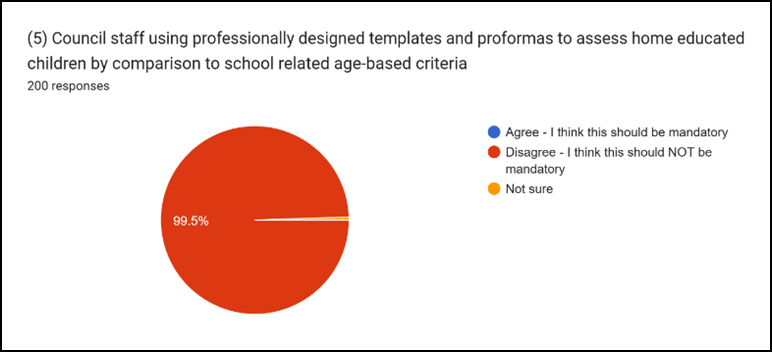
Respondents were given the opportunity to comment on the concept of “Council staff using professionally designed templates and proformas to assess home educated children by comparison to school related age-based criteria”.
This was a concept said to be favoured by council staff in the WG-commissioned evaluation of their EHE guidance, although the source of this possibility was not mentioned in the survey to allow exploration of the concept in its own right.
Concerns expressed via respondents echoed those given in the responses above, and a number of respondents referred directly back to those answers as they felt the same principles and concerns applied.
Whilst can be helpful to categorise and summarise responses, the following selection of responses provides a remarkably helpful and informed insight info the concept of home education for those who do not have lived experience of this.
Reading the following responses provides an excellent opportunity to glean a fuller understanding of home education, so rather than attempt to categorize this section we simply provide the following selection of testimonies and insights which speak for themselves,
Tell me you don’t understand home education or alternative pedagogy without telling me you don’t understand them. This would destroy true education. This would greatly damage so many children. It would undo months of hard work of building up the self-esteem and desire to learn that are so often knocked out of kids in the school system by doing this very thing – making them feel under pressure to measure up to someone else’s ideas, making them feel not good enough if they fail and making them feel in constant anxiety of not keeping up if they succeed. This kind of approach to children is the very reason we chose not to send our children to school.
Following school system would hold our children back; they learn far more when not limited by an outdated curriculum
Many parents have chosen to home educate because the school system has failed their child purely based on this criteria. If you judge a fish on its ability to fly it will always be classed as failure. The school criteria is not set up to accommodate all children. It is strict and rigid and ergo categorises children who are unable to learn in this way as failures, placed in lower groups/sets/classes and restricted when it comes to exams. This is not a fair system and does not allow those children to succeed and demonstrate their abilities.
Every child is different and requires a tailored education that suits them. A template will create a “one size fits all” which is exactly what many of avoid by home educating .
Under the law, an education should be suited to the age, aptitude and ability of a child, NOT whether they are matching what they would be doing in school. Bringing in school comparisons misses the point that home education enables a parent to tailor the education to the child’s needs rather than meeting arbitrary criteria.
Children learn at different paces. While literacy and numeracy are very important. Some parts of each may be hard for a particular child while they may excel at other parts of the subject. Council staff are not able to assess this.
You can’t compare a home educated with a schooled child. We don’t learn following a curriculum.
Home Education is not school at home and is not required to replicate it. Children can work at their own pace and be completing projects/works/activities which are not the same as those in a school setting.
Home educators regularly outperform their state educated counterparts where ALN are not an issue. This based on individually appropriate education, this can’t be assessed with algorithms that aren’t designed to understand it. This is reducing individuals to a tick boxing exercise, which repeatedly fails to encompass a wide enough catchment.
We are home educating following our own unique curriculum for each child, how could anyone assess that effectively?
I don’t think Home Education is comparable to school on any level.
Every child is different and doesn’t always learn at the same time of every child in their class , some children and younger than they age and every child should have the right to learn at their own pace with out rushing or any pressure
This would be too stressful for the child again that they may as well have remained in school.
Home Education is not the same as school nor should it be. Home Education laws state that the child does not have to follow the UK curriculum or learning style that mimics school. The child should not be judged then by individuals who might compare to a certain school standard as home education happens in different ways so could lead to discrimination and unfair marking with no chance of a review. The child may be extremely bright but not performative for example and it would put unnecessary pressure on the child which is why these children have been removed from the school system to learn in different ways and not the traditional school standard way so it’s an unfair way to cast judgement on them. Children who are tested in school and fall below the standard age-based criteria (which would therefore mean the school was failing them based on these standards) they are not then automatically removed from that school and moved to a school with a perceived better standard of education or forced into home education so home educated children should not be treated with this bias or extreme SAO measure either.
Using standardised templates designed for classroom settings is unlikely to yield an accurate picture of home education.
Completion of age-based worksheets or written responses can demonstrate task compliance, but they do not necessarily demonstrate depth of understanding. Any adult could transcribe or replicate answers; this does not, in itself, evidence learning.
In contrast, much of home education learning is applied and contextual. A child demonstrating an understanding of time through reading and interpreting bus timetables, calculating the impact of being one minute late, or exploring comparative weight through real-life objects reflects practical numeracy and reasoning. These forms of learning may not always align neatly with template-based assessment, but they often show meaningful comprehension.
Assessment methods should therefore seek to understand how concepts are grasped and applied, rather than relying solely on standardised written outputs.
All research shows children do not hit the same targets at the same time/age. To compare school child to school child is ridiculous, never mind home educated to schooled.
This is part of the problem with school in that they are taught at a curriculum-based age and not a developmental age stage. The requirement is to provide an education that is suitable for age, aptitude and ability including any special educational needs. My son isn’t on a level with his year five peers due to multiple learning needs, so this would be an unfair measurement, especially as most EHE’s have absolutely no training or understanding of ALN
No child is the same and should not be required to fit a mould based on age. This risks undermining a child’s abilities. Children’s education should not be about ticking boxes and fitting a mould. Home education is about learning in a way that is tailored and fits the child. No two educational journeys are the same and this risks letting children down as many are in the school system.
School related age-based criteria do not account for individual ability, just a tick in the box exercise
Many HE children are neurodivergent and have spiky profiles, where some skills are advanced and others delayed. To compare to school populations by age again shows complete misunderstanding of the fact home education is bespoke to each child’s needs and therefore cannot be benchmarked to children receiving a one size fits all education in school. It is also discriminatory to children with disabilities and additional needs.
Fairly obviously, there is no comparison, as it’s a completely different type of education. Not necessarily better or worse, just different.
Many families use alternative ways to educate and won’t appreciate an invasive approach.
Children learn at their own pace. They should only be showing their own progress and not compared to any kind of criteria
The Victorian based one size fits all school system isn’t fit for purpose. Home Education is real world based not curriculum based and children progress at their own pace it’s not a competition.
School is not a perfect example of how education should be. Children learn differently.
EHE is not school and the one size school criteria of assessment is not appropriate for school children let alone EHE children. Imagine telling a fish they were not progressing properly because the cannot climb a tree….. children have different strengths and weaknesses, using standardised comparisons reduces motivation in non academically gifted children.
The government is not the child’s parent
Why compare the two, like comparing apples to oranges. If LA staff cannot evaluate and determine a suitable education without rigid protocols then maybe they shouldn’t be in the job.
Each child is different. Home ed allows for the fact that one size does not fit all children. School levels are arbitrary in any case.
Home education is tailored to suit the individual, that is its main positive attribute, and trying to assess progress by the one size fits all approach is again…completely missing the point.
Hugely disagree!!! The curriculum is not fit for purpose for many children. I speak as a parent with one child in high school and two who are home educated. When a child only has a certain capacity, at home we can work on their own pathway and make sure the important criteria for them is covered for them to have a path to follow, from which they can be successful and lead a happy, independent life. If we have to struggle to follow a curriculum that has no use to their future, just to tick boxes, it is a waste of all resources and the likely end result would be negative.
HE gives children the chance to learn at the right pace for them! Please don’t take this away!!
Council staff have no lived experience of home education – in fact they have their own experience of schooled education and often that of their own children and school-based work training as a basis to their approach. This is not representative of the vast array of styles and approaches utilised in education outside of state schools.
This is vile. We have opted out of this system and wish to be able to follow our children’s individual progress
We do not follow the National Curriculum but my child has skills and knowledge/ experience of things that children in school necessarily do not have.
Children learn at different rates
Home education is not always academically based. Education is progressive learning but not always of traditional classroom subjects so this would be pointless.
Our local authority already uses templates which they ask you to complete (which change all the time) and they overstep and ask for more information than they are entitled too.
This is crazy!
Home education is NOT school at home.”
Home-education is very different to school education. The learning is broader.
There could never be a form that incorporates everything that a home-ed child learns.
There is no comparison.
The whole point of home ed is to work at the pace of the child and child led learning so it wouldn’t compare against a schooled child.
School environments are not right for everyone that is why they left. Some children work and learn better and happier educating at home rather than a full loud classroom dressed in uncomfortable clothes for example cold in winter because they can’t wear a coat indoor, hot in summer because they can’t take off the blazers.
All children are different
Many home-educated children are home-educated due to a school-based education not being right for them. They may not learn things at the same age as school students, they may be ‘ahead’ or ‘behind’ in some areas using school based criteria. There is more than a one-size fits all way for children to learn.
Every child is an individual and learns at a different rate. Many children are home educated because they don’t fit the pro forma of school and so these type of assessments do not fit the model of home education at all and should not be conducted at all.
Assessments can be hugely traumatic for some children. All children are different. My child struggled in school and found tests in school very difficult. Despite poor results on tests at school and asking for support many times the LA didn’t meet needs. She is thriving at home but not on an academic level with peers because she never was. But she does now receive an education that meets needs and home. We have made huge progress with child’s wellbeing and self esteem. Testing would have a negative impact and achieve no benefit.
Council staff are not trained for such judgement calls. Age related criteria are arbitrary and do not relate to individual learning journeys. Children such as my son have spiky profiles with rapid gains in some areas (proficient reader since 4 years old) but slower gains in others (only just beginning to form letters consistently at 6) which do not match arbitrary proformas.
This is totally against what home education means. Children learn at their own pace without pressure and anxiety that school produces. I have known children who have learned all of the work necessary to pass a GCSE in 6 months where school children need to learn it for 2 years plus in a school setting. It is all subjective and an inefficient way of measuring education.
I have grave concern that these proformas and templates will be very biased towards a traditional schooling approach and will completely fail to take into account different educational approaches like unschooling, game schooling, child led learning etc, and the learning that goes on just by participating in life. Furthermore, to compare children to school related age based criteria is also unfair, in that it is not comparing like for like. School is not the same as home – how can you possibly compare the two? This approach also does not take into account the time that a child may have needed to recover from the damage school did to them so may appear to be ‘behind’ their peers.in school as a result. Children (particularly neurodiverse ones) have spiky profiles and can be advanced in one area and not in another, and this will may not be sufficiently taken into account when using arbitrary templates and proformas. There is no ‘behind’ or ‘ahead’ in education – each child develops at their own rate.
My child was taken out of school because he has special needs, he does not learn like some children do we have to do it a way which suits him. Whilst in school i was told he was doing different work to everyone else because he couldn’t do the work they were doing, so based on his age is wrong & unfair to him because he does learn at a lower level than the other children that were in his class. There should be no comparison to school because home education is different for everyone for many reasons & that can not be compared to a school led education
Everyone home educates differently we do not follow a curriculum nor should we as that system is antiquated and out of touch with reality! So how do you plan to standardise this?
Not every child fits in one box.
As explained in my previous answer, home education is not school at home. Children learn in different ways and can’t be assessed by comparison to a school based model.
It’s like trying to assess how well someone plays a musical instrument by asking them to sit down and write the notes on paper.
Age should not be the criteria all children learn at different rates & ALN effects this heavily. This would put children with learning needs at a disadvantage. These children also tend to thrive out of a school setting so enforcing school would create huge mental health issues & not improve academic success
Home education is specifically to avoid such arbitrary comparisons.
Apples and pears.
Also see any of Albert Einsteins quotes on education.
To even consider this as an options shows you do not understand education. Education cannot be mass controlled like this and I know one inventor of the theory was part of the soviet union -Vygotsky. None of which accounted for human evolution and long-term effects – the mental abuse, which rises every year in schools forcing parents to even consider home education in the first place. Home education is a personalised education to suit the individual child – not the masses. Making this idea quite frankly stupid
Not one child is the same, and they should not be compared to anyone else, everybody learn at different rates, and some children may prefer a more hand on approach rather than an academic one. That doesn’t mean that that child is behind just because they don’t follow the so called norm, even in school with a class of 30 students, it’s impossible to teach them all because you are expecting them to all be at the same level and that’s not the case, you will have some who would be afraid to ask for help because they will feel like a failure and others who would find the work to easy and would become board and then probably start playing up and then they’d be held back and seen as a problem child.
Home education should not mimic school. It can be much more child specific. If schools cannot adapt to meet children’s needs, then home education should not be forced down the same path.
This is the exactly why my child was home educated she was behind her peers and school informed me, “its ok they’re just behind and some kids never catch up” that was from a trained well known ALNco.
Not every child is the same, they all learn differently and at different paces no child should be ashamed or put to a set standard based of others especially if they have ALN needs or any other needs. Schools need to change completely – 30 plus pupils to 1 teacher in a single class and all with different abilities and needs made to sit at a desk and copy work for 5 hours a day is not the way forward.
I disagree because home education is not bound to age-based school standards. Using school frameworks to assess autonomous education misunderstands its philosophy and diversity.
School based progress requirements are not the same as natural individual learning progress. It is simply incomparable. School requirements are arbitrary to make it easier for a teacher to teach en masses. Home education is tailored to the individual and can allow for particular aptitudes, interests and sensitivities.
All children are working at their own level especially if they are neuro divergent so cannot be compared to school level
EHE is where you provide an education suitable to that individual child, this may not follow the national curriculum at all. A proforma is not an individualised learning plan.
Evidence of yet another discriminatory way of judging children and making decision s to their detriment even when parents are meeting the Legal requirements.
Home education is not school education, tests or workbooks are not legally required so will not work to access children’s knowledge, many do not follow the national curriculum.
The arrogance of this question is mind blowing – as if school is a good measure of anything. Maybe if you think learning by rote, memorising to pass tests etc is a good indication of how well a child is doing fill your boots. But I know as a home educating parent that I would be insulted if you compared my son to a school child – home ed children outshine school kids in every single respect. And I now have proof of that as my son is now attending a 6th form at a school to do A Levels and at the first parents evening all the teachers said they were blown away by our son’s intellect, understanding, interest, engagement etc. One even said – he is so much better in every single way than any school kid I have ever met. He certainly has made us sit up and think in the staff room. Whatever you did – well done. (by the way he is at the best performing state school in Wales!)
No one persevered more or longer than we did to keep our child in school education. She has additional learning needs and disabilities, and the local authority could not offer suitable provision to meet her needs. The school environment was not suitable and was causing trauma, this was agreed by everyone involved. If you compare a home educated child to a school child in terms of progress, (which by the way does not happen in schools- all practice should be person centred), you are measuring provision and progress against two completely different environments and learning styles. You will force home educated children to fail by standards that are only suitable for school educated children and you will do more harm.
You can’t ask the sun and the moon to follow the same standards!
All children are at different stages and learn at different paces
We do not follow a curriculum we have opted out of a school system and will not be assessed as if we are in it.
Why? Not in the child’s best interest at all, extremely damaging and unnecessary.
Because a lot of HE families do not use the NC, so benchmarks like this are not helpful
Schools do not ensure that individual children understand a subject area before moving on, often leaving children behind in certain aspects in order to fill a quota and tick the curriculum box. Home education is designed to work at the child’s level of understanding where it currently is.
Effective education looks and evolves differently for every child and the main issue with school for a lot of children is this rigid, archaic and unproven method.
Where are the research and evidence that this would be effective and is suitable?
Our schools are failing so many children, comparing home educated children to a standardised system that is falling is ludicrous. If educators engaged with the home education community to try and understand how education ca look different at home but still be suitable and beneficial, a lot could be learned. This whole bill seems designed to standardise and reduce the options people have to educate their children.
Children learn differently and many are starting regain a sense of self-esteem after leaving school, to compare them again and test in this way would be very damaging. Not only this, but it’s not needed and evidence shows home educated children may learn at different times or different paces, but often have better outcomes than they would at school.
EHE guidance states – “1.12 Children who are home-educated are not required to:
follow the Curriculum for Wales or any other specified curriculum, or meet criteria for the number of learning hours. The home education approach can be anywhere on a continuum from a formal, structured, schedule-based and mostly within the home environment, through to autonomous or child-led education. Moreover, it can vary over time and subject. For example, a child might move from a more autonomous approach when younger to one that is more structured for GCSEs (if the child chooses to sit them).”
Home education and school education can be profoundly different. That’s the point. Some children thrive with more freedom to lead, often meaning the will be ‘ahead’ in some areas and ‘behind’ in others. I’m trying to model not comparing to others for my children as it is a very detrimental mindset to get stuck in. It is one of the sailings oof the school system!
This would be unfair as all children develop at different rates & many home educated children are neuro diverse.
Often one of the reasons that children are de-registered from school is because the school system expects all children to develop at the same speed & parents want to get them away from that because it’s not good for their self-esteem.
No child/home educated person should fit into government or council brackets as this is why they have left school environment
Templates and preforms never work as no person/family fit in 1 box.
People learn best when they can learn at their own pace and in the way that works best for them. This means that a child might be streets ‘ahead’ in one area and ‘behind’ in another because their learning journey will not resemble this imagined ‘ideal average must do at this age’ learning journey human. That person does not even exist in a school.
The law states that each child is entitled to an education in line with their ‘age, aptitude and ability’, template forms generally lack the ability to account for nuances that affect each of these areas.
Shocking to think that they can use a proforma for this. Each and every child is different with different needs and abilities. The school system can’t support them, how on earth do you think thus can be measured!
Home education means children are free to study, learn , grow and investigate the world at their own pace and in a manner that ignites their own interests. What they learn cannot be measured against standard tests or a meaningless grading system . Children DO NOT all develop at the same rates in every area of study and need to be allowed to progress at a rate applicable to themselves.
It is not the job of council staff to “assess” home educated children. This would be unlawful as is entirely beyond the lawful limit of their job. The only person who has the legal duty to “assess” a home educated child is their parent, as per Section 7 of the Education Act 1996.
All children learn differently, even in schools, and since they clearly don’t care to ensure that schooled children reach a certain level (see above), why should they judge HE kids on some artificial scale. When they can’t even write a professional letter themselves, how can they possibly judge a child?
This could be interpreted individually by the staff members. And children are all different whether they are home educated or in school.
They don’t know my children. Their medical conditions, what they are struggling with that day. It doesn’t need to be a race! Stop putting pressure on CHILDREN! Allow them a childhood, they learn when they want and when it sticks and by golly do they make up for lost time.
This is horrible will penalise those with learning disabilities and anxiety.
Home-ed children do not follow the same schemes that school children do – and that’s kind of the point! We don’t need to. We home educate so they can follow their dreams, study whatever interests them, and take more time over the things they want or need to, You CANNOT compare the learning journey of a 10 year home ed child passionate about and in control of their own learning, who is reading and reading on a subject that excites him which would be labelled as A level standard, with a child in the school system who has no time to deviate from the curriculum. Home ed children cannot be judged by a system they don’t fit into. Our children are doing LIFE!
Not every child learns in same time frame
If every home educated child has to be assessed using these so should every child in school. If parents are to be assessed on this basis so should teachers.
Requiring home educated children to be assessed by the local authority during home visits is inappropriate and disproportionate, as it imposes a school-based assessment model onto educational approaches that are legally distinct, and risks causing unnecessary stress without clear evidence that such measures improve safeguarding or educational outcomes
Parents should decide the curriculum on their terms, not the states’.
Home education provides more learning opportunities and topics to study than schools that have limited choice due to curriculum requirements
Education is not tick-boxes, it’s lifestyle.
There should not be comparison. The education should be suitable to the individual child.
Measuring home ed by school standards is a mistake and misunderstands that home ed is an alternative method of educating, not an emulation of ‘school at home’.
Again, ridiculous because the curriculum is not the same so how can they expect it to produce the same results.
Children should be learning but there is no legal requirements to stay in line with their school year group. Children at school don’t always perform at their set year group. Some are ahead, some are behind. SEN children/all children may be constantly learning but not keep in with their year group but they may be thriving and enjoying learning at their own pace.
The assessments used in social services are already adequate for where there are any safeguarding concerns. Children do not develop at the same rate – one of my children was reading at 3,but didn’t write for many years, the other read at 8 but was writing before reading (!) by copying words , I supported both of them equally but they would have looked very different on paper.
Not a fair assessment for children who have missed a lot of learning at school due to school based anxiety. Wellbeing comes first not attainment.
Comparison with other children of the same age is a very poor method of measuring a child’s success in education. Council workers with no understanding of home education or of the individual child, assessing them with templates and proformas sounds like a horrible idea. Surely home educators get to choose their own criteria for measuring their children’s success.
Ridiculous. The beauty of home education is that children can flourish in their own time and along their own learning paths. The criteria that schools use are so artificial and detrimental, those criteria do not and should not apply to home educated children and young people.
Children in home ed are not given diagnosis like dyslexia (in my personal experience) and would not in school be compared to peers without this being taken into account
No way!! Home educated children will not follow school-based timescales and standards and this is a good thing. Expecting all children to learn to read via phonics at age 4 is unrealistic, expecting all children to be able to count to 100 by age 5 is unrealistic, expecting all children to learn a foreign language at age 11 is unrealistic, etc. Some home educated children might for example excel at science at an early age and be years ‘ahead’ of their school counterparts in that area, yet not be reaching ‘expected’ standards in their spelling. This doesn’t make their education ‘less than’ the school equivalent. After all, who actually decides what the age-based expectations are, and who benefits from these? Home education is child-centred on an individual level and is all the better for that.
All children do and should be learning at their own rate, not based on school norms. A very high percentage of home educated children have additional needs, which means that they may progress along school norms, or may be well below or above. What matters is not where they are, but that progress is being made.
Each child is different and works at their own pace, so may be well advance in one subject , but struggling in another. Not fair or appropriate to put a child under pressure, just so the LA can tick some boxes
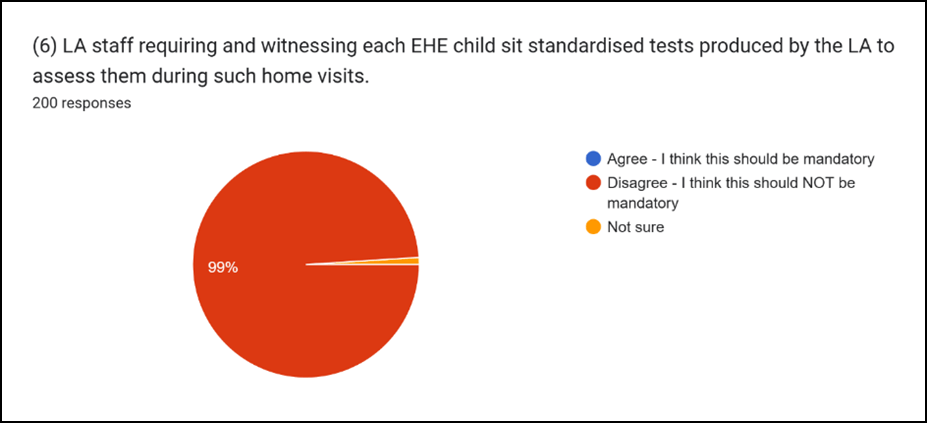
Opportunity was given for respondents to comment on the concept of “LA staff requiring and witnessing each EHE child sit standardised tests produced by the LA to assess them during such home visits.”.
As with the previous survey question, this was a concept said to be favoured by council staff in the WG-commissioned evaluation of their EHE guidance, although the source of this possibility was not mentioned in the survey to allow exploration of the concept in its own right. Whilst there is obviously overlap with the concept of proformas and templates explored in the previous question, as this was a separate proposal and consideration in that WG-commissioned evaluation, respondents were given the opportunity to express experiences and opinions relating specifically to the use of tests here. Given that degree of overlap, concerns expressed via respondents strongly echoed those given in the previous responses, with a number of respondents referred directly back to those answers as they felt the same principles and concerns applied.
As with responses to the previous question, whilst it is helpful to categorise and summarise responses, the following selection of responses continues to provide a remarkably helpful and informed insight into the concept of home education for those who do not have lived experience of this.
Therefore, this selection is provided to allow these testimonies and experiences to speak for themselves, in the hope that these will enable non-home educators to glean fuller understanding of home education.
Standardised tests have consistently shown to hamper a child’s ability to learn.
Countries that do not use them have a far more advanced education system
Absolutely not! An exam is not a fair way to assess a child’s ability or knowledge. They are a practice of being able to memorise information, hundreds of thousands of children are failed by this criteria. An exam is not demonstrative of their intellect or their abilities. To implement this would seriously damage the education that a child is receiving at home.
There is no “behind” for a home educated child. Many of us don’t follow the curriculum. They should not need to be assessed.
We chose not to send our children to school partly because we fundamentally disagree with standardised testing, particularly at a young age. Not all children perform well in tests which are not always a good indication of a child’s actual capabilities. Again, trying to force a school model into a home environment completely undermines the point of choosing an alternative to school.
Tests cause stress and are unnecessary. Is as home educators know exactly what level our children are at because we teach them! A simple check list to parents on what our children are able to do would be more suitable. But again, I don’t see why this would be needed. We take the responsibility of home educating our children and we don’t take it lightly. We want our children to be successful. We want our children to learn just as much and more than school educated children. Someone coming to our homes, our children’s safe place and testing them is intrusive, can make our children feel unsafe, judged, and like they or doing something wrong.
Our home education isn’t standardised. We follow the child’s lead so when they are ready to move on, we move on. We wait until they are confident in a subject before moving on.
Absolutely not. This again would impose much stress upon children not required by law. Education styles differ to suit each child and standardised tests do not reflect a child’s ability and can give a false impression of the level or type of education happening.
This is a pointless exercise. It’ll catch all those undiagnosed home ed ALN kids who can’t get diagnosed because the current system doesn’t allow it. Second settings etc,. It’ll achieve nothing other than stress kids out, just like it does in school.
Children leave school due to unmet needs and trauma, its so psychologically damaging to bring that into their safe space
Many home Educated children learn so differently that any standardised test would destroy the way they learn and function. Standardised testing ruins all the confidence any child builds.
Why should a child be tested on what they are learning it’s just put fear into them I don’t believe this should happen in schools either
My 14 year old will probably never sit tests he wouldn’t have even if he remained in school. All I want from him is to be able to live life and do basica in life i don’t want anymore from him.
Home Education does not mimic school in a home environment. Learning is often child led, not pressurised like school with a completely different learning styles and psychological basis compared to traditional school based learning, therefore there is no standardised test that could fairly test all these variables and would put unnecessary pressure and distress of children who otherwise are very happy, clever and capable as they are without this overreach. It goes against the psychological approach of home education as a whole.
Mandating local authority-designed standardised tests during home visits risks replicating the formal testing environment that some families have consciously chosen to leave.
For many children, such testing may not accurately reflect ability and may be detrimental to wellbeing. Any assessment approach should be proportionate, sensitive to individual needs, and respectful of the diversity of lawful home education practices.”
Tests, as much research has also backed. Proves nothing.
Nope and nope. Education is compulsory, exams and standardised tests are not. The LA would do better to learn more about WHY children are being home educated in the first place and fix the issues in schools rather than hammer home educating families
There are no words for how wrong, inappropriate and ridiculous this is!
Children should not be subjected to the stress of tests that would not give the full picture of what they are capable of. These risks deeming some who have strength in areas not covered as “failing” even if they have made significant progress.
What if the child doesn’t follow the curriculum or has special needs!?
This again shows lack of understanding of HE – how does the LA propose to test all the possible things to learn about? Does the Government want to force home educators to “teach to the test” like they do in schools? The responsibility lies with the parents, not the LA. The LA is to ensure a child is not missing education.
Absolutely not. I am teaching my child as I feel fit. They don’t know my sons struggles or what he excels in. All children are different
Ridiculous proposal. If we wanted standardised tests, we would stay in school and do them there. We are home educating because we don’t want these things.
We’ve left the system and this goes against everything home education stands for. Extremely invasive and will cause enormous stress on the families. Not needed and will be the wrong approach.
Why? Why would this be necessary?
Far too stressful and my ASD son would insist they completed his fitness test first to make it fair.
Standardised testing is simply a test of memory under pressure and not understanding, some children struggle with tests due to nerves, therefore the tests are not always an accurate indication of understanding
The government is not the child’s parent. Also, children who are musically talented, good at building things, amazing at sport, etc etc cannot be measured with a standardised test
Absolutely not!
Again, they have failed my child so now it is none of their business.
This does not allow for educational freedom. Employing generalised tests to determine general progress in education requires that the student is learning things relative to the tests, and not pursuing other educational activities better suited to themselves. The whole point of home education is that it allows a different path for those who do not thrive in school, who need to be allowed to thrive in their own unique way that will likely look very different from what is expected in school.
Many HE children are so because of trauma and pressure from schools! You’d be amazed how much more efficiently children learn without the constant pressure of tests!
If you are interested in spending money on testing, maybe put it towards GCSE and equivalent qualification funding, so that HE children can access them more easily, rather than using testing to monitor and throw children back into school because they don’t fit a standardised testing system!
Unlike school-based education, home education is often non-linear and school-type testing is not appropriate for personalised educational approaches
Again we have opted out of this stressful and unhelpful system to design an education where our children can thrive as individuals.
Standardised tests should not be mandatory for any child whether EHE or within schools- they show the effectiveness of the teaching not the child’s development or the child’s intelligence just the level of their memorisation. Most children find standardised test to be anxiety inducing.
Child is highly anxious and this would cause trauma.
How are these tests going to be measured- they will be I’m sure, designed around state school years/levels which do not necessarily match a home education. They will also put the children in an awful position at home, feeling monitored and tested, feeling scared in case they get an answer wrong, re-traumatising many children who have left the state school system.
Why is there so much obsession with testing below 16? Why can’t children just be and learn at their own pace and according to their own passions and interests?
I am so glad that both of my children are nearly beyond compulsory education age because they both had so much freedom to learn whatever they were passionate about. It makes me sad and angry that future home educating families might not have that choice anymore.
Home education, where children are allowed to learn at their pace and according to their interests learn to love learning and often become enthusiastic lifelong learners. Isn’t that what we would like for all children and adults?”
1. Constant testing is one of the reasons my children didn’t/don’t go to school. It causes unnecessary stress and upset. They still wrote exams when they were ready and didn’t get anything below an A. Constant monitoring wasn’t necessary for them to get there. In fact, that would have been absolutely counterproductive.
2. Children are ready at different times to ‘write tests’. Some may never be and it may not be necessary for them to have success as adult members of society.
3. What are you testing for and what is the relevance?
4. What is the purpose of the test? If it is to compare to a national standard, there is no comparison of a home-educated child and a schooled child. Our education is much broader generally.”
The whole point of home ed is to work at the pace of the child and child led learning so it wouldn’t work to sit any standardised test.
Absolutely not! I know for a fact my autistic daughter would have a melt down and refuse to sit let alone do a test.
Just no
Every child is different in the way they learn and no child should be compared to another.
Testing does not show learning or progress but rather how well (or badly) a child performs on a test. Test also provoke anxiety in this case needlessly as parents who are committed to their children’s education are fully capable of detailing where they are in their learning.
This does not take into account the many reasons parents chose to deregister children from school. They can include school trauma and anxiety, difficulties with a ‘one size fits all’ approach of school, neurodiversity, school failing to meet the child’s needs. Forcing people to sit exams could retrigger trauma, anxiety, doesn’t take into account the needs of neurodiverse children (e.g. anxiety of being observed whilst working), and puts enormous pressure on the child and parent. Exams should be optional.
This is a definite no for me, my child does not learn in the same way other children do so therefore a standard test would be absolutely no good for him. Standard tests are done by age & my child does not learn like a school led child at his age therefore he wouldn’t understand the test nor would he be able to complete it, this would be detrimental to him & very unfair tests should be kept for school led children, 1 of many reasons people home educate is for this reason they know their child would not cope doing these sorts of tests.
The vast majority of home-educated children are not educated at school because they struggle with the pressure and demands of immediate oversight. This is exactly what testing is. It is enough to show their progress retrospectively.
I’ve witnessed health visitors with little knowledge run ‘tests’ to see if a child meets milestone. Children have off days too like adults. They are not robots.
No, absolutely not. This would be traumatic for many children and absolutely useless as a way of measuring a home educated child’s knowledge, understanding and abilities.
I see why they might want to do this because it would make life so much easier for them, but as a way of measuring children’s aptitude or achievement, is totally useless. It’s actually laughable; it’s so inappropriate as a tool to measure learning.
Most teachers disagree with standardised tests in schools, one of the major perks of home ed is not having to subject children to the pressure of regular testing. Testing doesn’t improve academic ability it just puts undue stress on children causing mental health issues
No. Hard no. If I wanted tears, I’d send child to mainstream. Square pegs round holes.
How intimidating and threatening would this be to children with trauma from school!
Any child would feel under pressure and would lose trust in “professionals” as adults.
Home is a safe place, not a place for interrogation, bullying, forcefully practices, lack of privacy. How would they feel if their boss suddenly turned up at their home demanding they watch them sit tests!
Children are killing themselves as a result of test pressure and you want to force that on more kids? That is not safeguarding, that makes you a danger to children.
This is putting children in a box and expecting them to all be the same, and making them feel like a failure if they don’t answer your questions correctly, this can be very damaging to a child’s self-esteem.
I disagree because mandatory testing imposed by the LA removes parental autonomy, creates stress for children, and inappropriately imposes school metrics onto alternative educational approaches.
Children are working at their own pace and standardised tests may not fit that agenda.
Children are not performing monkeys. Some home educated children do not learn to read or write until they are older. The tests will be based on curriculum which shows a complete lack of understanding of home education. Where a 6-year-old child may be able to tell you about nature, how to stay safe at sea, talk in depth about Egyptians but because that is not on the curriculum they will be deemed not to be receiving an appropriate education. Home educated children usually have education tailored to their interests not what somebody sat in an office has decided they should learn. These tests will not be based on the child led approach most home educated families follow. Apart from that the stress and anxiety caused by being tested and threatened with being taken away from their primary caregiver to go to school for a substantial part of their day, if they do not do well, is detrimental to all children’s mental health and wellbeing.
Oh dear where do I even start. Again, does anyone understand the meaning of home education? It isn’t home schooling, it isn’t trying to recreate a defunct system. I know a home ed child who learnt to read at 9 and got an A in A Level Biology at 13 – how does that fit into your standardised tests? My son learnt to read at 7 and is now going to Cambridge Uni to study maths. At 7 he’d probably have failed your ridiculous standardised tests. Standardised tests are the problem in school – we wouldn’t do them at home.
This would cause significant emotional trauma to many Home Educated children, many of whom have left school due to ESBA, chronic unmet needs and school based trauma.
My child would not engage and become distressed. How would that be supporting their well-being?
Children learn in different ways at different levels you cannot test children who are learning in an individualised way
I would leave the country before I let this happen.
The whole point of EHE is that it is not standardised, so this would be pointless at best
Neurodiverse and mentally ill children will not engage. Education is about what can be learned not how children perform under a test.
This is ridiculous, pointless and needs to be re-evaluated in schools!
Home education is about ensuring the child has an education that is suitable for them. A home educated child may have a completely different learning trajectory, including achieving things earlier, all my kids gained IGCSE’s early Spanish aged 13, several IGCsE’s aged 14 so they could stagger them etc. But the same children would have looked behind at may points in their educational journey if asked to complete standardised tests.
As above, but also that tests are not the best way of viewing or understanding progress. Children learn differently and many are starting regain a sense of self esteem after leaving school, to compare them again and test in this way would be very damaging. Not only this, but it’s not needed and evidence shows home educated children may learn at different times or different paces, but often have better outcomes than they would at school.
My child is not a performing monkey. Even school children are not required to be tested in such an intimate one on one way (or possibly more than one witness!). Even without saying it the child will likely be aware that if they perform badly there is a risk they will be forced into school. Can you imagine the pressure ? What a ridiculous and cruel suggestion.
This would definitely make parents feel that they want to try to avoid the LA!
Not all home education test well again why they have been taken away from an out-dated education system
This would cause so much anxiety & stress for my child and would have a huge impact on their health and wellbeing.
Standard Testing is wrong for all young children school or home educated.
Big Brother
Standardised testing is one of the most problematic aspects of the state schooling education system, they ignore the fact that all children are different and learn in different ways, and respond differently to a test environment, as well as take time away from actually teaching. My child is home educated as I want them to love learning, discover more of the world and have a thirst for knowledge, there is no place for standardised tests in this space.
I would also be concerned as to how the LA would use these results, if a child fails would they be forced to go to a school, but what if they were home educated as they failed whilst at school? This may bring about double standards.
Nope again no man or woman is the same every family raises their offspring their own way so you cannot force them to be the same or do the same without being indoctrinated with the same information for the same source which can differ depending who’s narrative you believe to be true
Absolutely NOT
Home ed don’t follow the national curriculum…. This is like asking a fish to climb a tree and wondering why they are failing
Home ed children DO NOT fit into a school shaped mould – and that is exactly the point. Home Ed is a gloriously broader, more enriching education.
Testing is meaningless. Tests only show how well a teacher is doing at getting kids to memorise and parrot information, they do not demonstrate real ability, knowledge or understanding.
Why should our children feel intimidated by someone watching over then demanding they do work in their own home
I have never agreed with “standard” testing. Children shouldn’t have that kind of pressure so young. I don’t even think the word test should be used in schools unless the kids are testing something for themselves. What’s a “standard” kid? Who says? If my kid isn’t standard does that make less than? You can’t force learning. You lead to failure, kids messed up, stressed out families. Mental health is as important as the body. Kids have changed since so much, as has life. It’s time the schools and government caught up.
Home ed is NOT standardised! It is rich, and fulfilling, and exciting, and wide, and deep, and follows the child’s own passions.
Not every child learns at the same speed, doesn’t mean they are not learning
How would this help? Some children at school would “fail” these tests. If home educated children “failed” them how would this be any grounds, therefore, for criticism of parents?
Requiring home educated children to sit standardised tests produced and administered by the local authority during home visits is inappropriate and disproportionate, as it imposes a school-based assessment model onto educational approaches that are legally distinct, and risks causing unnecessary stress without clear evidence that such measures improve safeguarding or educational outcomes.
We are busy home educating. This is a distraction.
Absolutely not! Standardised tests could produce a huge amount of stress for a child, which is one reason many children aren’t educated at school but rather by their parents. Children learn at different paces and home education allows for a wider curriculum and time to focus on things not usually learnt in school. A standardised test would not reflect this.
Absolutely not. Many children can’t manage school because id standardised testing. To bring this into home education would be a huge travesty to those trying to educate children in a way that doesn’t created standardised testing pressures that often damage children who find these pressures detrimental to their learning experience and general wellbeing.
Absolutely not. A lot of our children are home educating because they couldn’t cope with school. Replicating school at home is not the answer.
This defeats the point of removing a child from a stressful schooled environment and in particular puts stress on parents of children who are neurodiverse that would never sit for an examination of any kind.
ABSOLUTELY NOT! Do all children in school match standardised tests, yet it a home ed family failed the tests they may be pressured to put the child back in school. Home education should be catered to the child to work at their own pace.
I have seen so many children be stressed – we are trying to avoid this at home and enjoy the love of learning instead. We aren’t doing school at home, the education system is outdated in its approach
Another horrible idea. Standardised tests were one reason i took my children out of the school system. I have no problem with explaining my educational philosophy and goals to my EHE, or of asking for help and support in achieving them, or even revising them, but I object strongly to being assessed according to someone else’s educational goals.
This would go against the rights of children to have an education that is suitable for them, to have an education of their choice, as many home education approaches deliberately avoid the pressures and counterproductive concept of “testing”.
No this would be horrific and would backfire terribly. Perfectly capable children would refuse to perform or experience extreme anxiety at this requirement. It would cause severe breakdown in relationships with the LA.
This would create a huge amount of stress for many home educated children and is not needed. Children are required to learn at a level which is appropriate to them as individuals, not compared to school norms.
Again, each child is different and working at their own pace, to accommodate their strengths and weaknesses and this does not allow a child to learn something when they are actually mentally and emotionally ready to learn it.
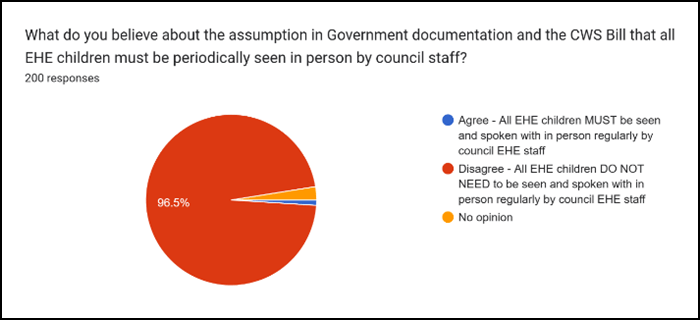
Previous written responses were from opportunities to comment on answers to multiple choice comments on whether or not the respondents believed certain measures should be made mandatory for EHE families.
The opportunity to comment further was given in the invitation to respond to the question, “What do you believe about the assumption in Government documentation and the CWS Bill that all EHE children must be periodically seen in person by council staff?”
Responses expressed can be summarised as:
- Very ineffective “tick-box” method or attempt at safeguarding, with a range of reasons given why it would be ineffective or counterproductive
- Assumes children are “not seen” unless seen by a member of council staff, respondents report this mistakenly presumes an element of social isolation.
- Double standards of not “seeing” children who are pre-CSA, who are at significantly higher risk statistically speaking, and of not “seeing” school children during school holidays
- Double standards according to those who feel their children were let down or not safeguarded in school.
- Intrusion into family life,
- Parents safeguard their children against intrusion or speaking to strangers
- Treating parents and families with mistrust, as if guilty until proven innocent
- Taking council time and resources away from families who need them, wherever they may be educated
- Lack of evidence of benefit or need
- Damage and stress to children of such meetings and encounters
- How the perceived need for such meetings or encounters damagers and undermines the trust-based parent-child relationship.
- Lack of understanding of council staff of home education
- Option of flexible voluntary contact with genuine support available if requested more beneficial
- Conflict of interests of staff who are employed to take measures for children to attend school, with some LAs having targets for this.
Responses included:
Children are seen regularly in so many ways. such interviews would be intimidating and traumatic for children, however “nice” the person may seem, if the children have any sense of informed consent to such meetings and know that this person is really there to see if they are going to force them (back) into schools or not.
For the same reasons as above. I have a safeguarding duty to my children so I won’t have them judged and visited by a stranger who has no qualifications in ALN or different neurotypes
This is not necessary. It is an invasion of privacy in a child’s home and life. If an LA had a concern about a child they should be contacting the relevant authority to take action and investigate further. This is outside of the LA remit.
“Unless the LA have an extremely good reason to be concerned about the welfare of the child, it is totally unnecessary to need to see the child. Children are not checked up on before CSA. They don’t go out to families during the 6 week holiday to check children are “”safe””
Many children (especially our ND children) will not tolerate a meeting, will not participate in communication with a stranger and will be extremely anxious. All that will do is cause trauma for the child, and is likely to cause further issues with the LA.
I have found council staff to be some of the most ill informed people around when it comes to home education. Home educated children are seen regularly by doctors, dentists, community members, etc. In all cases where this did not happen, the child was already known to the authorities who failed in their duty of care. This form of intrusive surveillance is wholly unnecessary and assumes the state has a greater remit of control than they actually do.
Council staff are not trained to assess the education of our children. Possibly leading to ill informed decision and further problems where need not be as a result. Children should not speak to strangers.
One early contact is an enough for us. Should we need help or advice, we can contact them.
The local authority already has powers to see children where safeguarding concerns are raised. Home educated children ate statistically less likely to suffer harm and children of school age are actually at a lower risk of abuse than those under 5 and especially under 1. Professionals are already under a duty to report concerns and any member of the public can make a safeguarding report about a home educated children of school age just as they can with those not of school age who are actually at the highest risk.
Forcing home visits will not safeguard any children but will take away resources from those in need.
Why? the LA bring nothing to the table except stress and mistrust. They are there to judge when we have done nothing suspicious to require that judgement.
The LA does not ensure the school system is held accountable for any child’s education.
Maybe the LA should start holding schools accountable for their failings instead of persecuting Home Educators
No because not every child is seen by council staff at school and would it be the same for children who go through school holidays will they be monitored.
This is my son’s nightmare he hates having to speak to people he does not know.
Children who are home educated are not invisible. My child for example is seen regularly by the dentist, Dr, neighbours, friends who are in school and their parents, friends who are also home educated, her grandparents and other family members, home ed charity registered committee members and more. She is seen often and regularly and it should not be assumed that if the council doesn’t see her she is in some kind of danger or safeguarding concern.
The Home Education community is being heavily discriminated against and assumptions are unfair. It feels like the sort of monitoring that a criminal would receive for no apparent or fair reason. We are not criminals and are children are not at risk.
Flexible, voluntary engagement — such as library drop-in sessions — would encourage constructive participation rather than compliance under pressure.
No findings have shown this is either necessary or beneficial in any capacity.
My EHE officer asked for suggestions on events they can do for children with ALN. If they are able to put eyes on a child and ensure safeguarding with no concerns, then I don’t see an issue with this. What I have an issue with is when it is enforced by the LA.
Only if there are legitimate child safety concerns should visits be in-person contact be mandatory. These could be with other professionals such as a GP or something.
Children absolutely do not need to be seen by council staff! Children have a right to privacy and to be safeguarded against their information and data shared without their consent.
There are plenty of other services that regularly see children, (medical staff, clubs ect) all of which are required to pass on concerns if they arise. Leading with suspicion on parents purely because they home educate is asking for issues in miscommunication and distrust.
The Government is misunderstanding HE and assuming that all of the children are kept at home, when this couldn’t be further from the truth. As a HE family we are closely involved with our community and are often out and about going to events, groups, public places as part of our learning. If this is put into place, the LA staff are going to be constantly on the road checking families that they already know are safe and providing an education, just to check a box, meanwhile stretching understaffed departments further and taking support and safeguarding opportunities away from children that do need to be seen.
Why would they need this? This doesn’t happen for pre-schoolers who arguably are at a more vulnerable age being younger. It doesn’t happen for school leavers aged 16 who are still legally children until they turn 18. Why would it need to happen for children between the age of 5 and 16 years?
It depends on each family and situation.
This is a massive intrusion on family live and breeches human rights
EHE children and their families live very busy lives we don’t have time to waste on silly LA remits and the LA don’t have time to do this.
The majority of children who are EHE are at home because they have been failed by LA and school
Again assumes parents require checking up on, that there might be a problem unless we prove otherwise.
This is an invasion of the child’s privacy. If there are no serious safeguarding concerns this is unnecessary
The government is not the child’s parent.
Will they be checking on all children not yet CSA? Surely they are higher risk?
Enough goes on in schools where children are not receiving an appropriate education or a teacher/ other children pose safeguarding risks. Maybe schooled children should have the chance to speak too if HE children are required to?!
Many (maybe even most from my long experience in the home educating community) families have neurodivergent challenges or disabilities to contend with, some of which would need specialist training to recognise and appreciate. Inexperienced and inadequately trained council staff should not be put in a powerful position of creating snap shot impressions of young people
This would be harmful for some children who are otherwise thriving in community.
My child is seen regularly by adults who are professionals and communicates with them about EHE. He is a member of the community and therefore has adults outside of his family to discuss this with, not a council member who job remit is to force him back to school.
Child is highly anxious and this would cause trauma.
I feel it’s an absolute invasion of privacy and our right to family life for the government to monitor our own children. Most local authority staff do not have the skills to do such a task.
Why is the UK government and the Welsh government so obsessed with seeing EHE children? Why are EHE children singled out like that if we all agree that EHE in itself is NOT a safeguarding issue? If you are so distrustful of parents, why don’t you bring in regular face to face visits for under 5-year-olds? This is the cohort of children statistically speaking where abuse happens the most. Why do you discriminate against EHE children and their families?
What would the purpose be? If safeguarding, isn’t this the remit of children’s services?”
Unless the child/ children are known to social services I do not see why they should need to be spoken to.
This is unnecessary, any child who may require additional monitoring is more than likely to already be under the remit of the council via social services. If a parent states their child is happy and healthy that should be enough. Many children who are under the remit of the council still end up hurt or worse dead so regularly seeing children who are home educated isn’t going to make any difference.
“There are already processes in place if anyone has concerns about a child’s wellbeing. If these current processes are followed robustly then those at risk can be safeguarded. Diluting resources to target home educated families will only cause more at risk children to be missed.
Home educated children are seen by tutors, home Ed social groups, other groups, doctors, dentists, neighbours and others regularly.
Parents should be trusted to keep their children safe
Being seen by others does not guarantee safeguarding issues are identified. Parents of children who struggle to be “seen” by others, e.g. too anxious to leave the house, should be trusted and supported in their ability to support their children’s needs to help them make progress in a way that works for the kids in question. Children’s needs and welfare should be especially in terms of mental health should be put above the government watchword of “safeguarding”.
Plenty of other people and professionals see these children on a regular basis.
The primary role of EHE officers is not welfare risk assessing. This is the job of Social Services. If the EHE has concerns about the welfare of the child whilst carrying out their assessment of the suitability of the education, then obviously this information should be passed to Social Services, but it is not their primary role to carry out regular checks. This does not happen in any other circumstance. School children are not checked on at home during the school holidays.
I think it should be up to the parents & child if the parents & child decide they do not want to have face to face meetings then they shouldn’t have to, in some cases children with special needs feel that they are safe at home being educated to have to meet a professional body regularly would be detrimental to them I know my child would he doesn’t do well with new faces or understand why they would need to see him, for us having no contact with the LA works better for us.
My son sees paediatricians, dentist psychologist OT and many other ‘professionals’ why does someone who is not qualified in his needs have to see him?
Children do not require an official visit to add pressure and potentially deepen any trauma.
My personal experiences gave taught me that staff lie, manipulate and twist as a means to cover their own backs for fear that every home educated child is at risk of harm.
EHE staff do not have the skill to judge anything by meeting the children. They will only make children more anxious about professionals, in my experience of local authority EHE staff.
If there are welfare or safeguarding concerns, these should be investigated by appropriately trained social workers or police officers, not inappropriate staff from a department which is supposed to identify children who are missing education.
If serious concerns are suspected, then a judge (after appropriate process) can appoint an appropriately trained person to discuss with the child what a parent has claimed they have been learning, to try to establish whether the child’s experience radically doesn’t match the parents’ written report.
Otherwise, numerous good home educating parents are going to be deemed not providing suitable education, simply because their child clams up when faced with an adult who doesn’t know how to talk to them.
If school attendance orders are then issued on the basis of the inappropriate child/EHE staff chat, then many children will be forced back into schools that have no resources to support them; children will be further traumatised and have an even worse experience of what school might mean; and the children who are coping in school systems will have their education massively disrupted by an influx of children who can’t handle being there.
This will not lead to a generation of better educated young people. It will cause huge stress and disruption; teachers and TAs will leave because it’s already hard and not adequately recompensed and we will have an even bigger mess of an education system.
I have been a teacher, school governor, health care worker, child counsellor and home educating parent (and attended school as a child). I know teachers, heads, support staff, ALN staff, counsellors, GPs and consultants and fellow home educators. This bill is potentially so disastrous for everyone concerned.
Home educated children are not missing in education so shouldn’t be tarred with the same brush. They are seen out in society at groups & libraries etc so if any safeguarding issues arise they can be passed on by scout leaders/swim instructors/sports coaches/home ed group leaders etc. safeguarding is everyone’s business.
The issue is not the current law but the fact that social services & schools are failing vulnerable children as seen in the devastating case of poor Sara Sharif known to SS from birth & registered at school
Children are already seen regularly and it makes no difference. All you are saying here is doctors, tutors and all other workers don’t mean anything, only LAs matter, they are the dictators here and rule all, even though they cannot understand the fundamentals of home education but apparently they are perfect.
These children are seen in public daily, and they get seen by medical professionals when they need a doctor’s, dentist or optician appointment, there is no need for a council worker to see them.
They can be seen in person by many other people, shopkeepers, neighbours, healthcare professionals, scout leaders, cadet leaders etc. They are not being hidden.
My child is a seen child. They have a GP, dentist, school nurses who we contact if any concerns or illnesses. If this is something they must again be required to have specific training and qualifications to do this. This is not acceptable at all. If there are genuine concerns or any genuine concerns made that is what social services is for. We cant be blurring the lines of job roles and professionals.
I disagree with the assumption because it is based on suspicion rather than evidence. Safeguarding already exists for all children. Home educated children should not be uniquely targeted without cause. It is frankly discriminatory.
Council staff and professionals regularly saw children like Sara Shariff and it made no difference to the outcome, where is the evidence that a child being seen by council staff makes them safer?”
I’m sorry but when you can show me a council member of staff who is educated at Oxbridge, a trained lawyer and a trained therapist who has known my son since birth and loves him then maybe. If not – again really? because council members are superior to parents how exactly?
My children are seen in official capacities, through therapies, home Ed groups, in the community, by family and friends on a daily/weekly basis.
I believe that if anyone has concerns about the welfare of ANY child, in school or not, they should contact the necessary departments who should then ensure the wellbeing of that child. That is already in place for all children.
They are our children at the end of the day – and again it would cause so much stress and trauma which could then be used against families of similar situation (‘child doesn’t know how to socialise – get back to school!) they don’t understand our children’s needs
Unless there is a very strong safeguarding reason then no, I don’t see this as necessary.
Again this is unfair to EHE families especially those that have children who for mental health or other reasons would find this highly distressing and detrimental to their health and education
.
I am an adoptee who has experienced trauma. I care very deeply about child protection, however, the use of Sara Sharif’s murder to emotionally blackmail people about this Bill has been disgusting. Sara was so let down by Social Services and the Family Courts, but she WAS known. Again, it was a multiagency failing. However, it really has nothing to do with Home Education. Home Educated children are seen regularly by many people. Even in burnout, children see family and often professionals relating to that burnout or related diagnoses. They are not invisible. Random EHE officers are not trained in ALN or in safeguarding, they don’t actually have a clue and already have the necessary powers to refer to SS if needed.
I’m not sure what it is supposed to achieve. What exactly will LA reps be able to determine from such visits other than said child exists? My child is extremely socially anxious, how would this be perceived by strangers?
I feel this should be done in a way that each family is comfortable with. Our children would not be happy talking a lot to anybody.
Not all neurodiverse people can deal with strangers
Our child is thriving, and is regularly seen by friends, family, our local community, other home ed families, tutors, youth club, dentist, & gp/nurse when needed etc.
Providing there is no safeguarding issue then I disagree. We are seen on a weekly/monthly basis by healthcare. Most of the awful cases that have hit the knees have been children in school or under SS and are ‘seen’. I don’t think it will help anyone
My children are seen regularly by council staff, be it at the library, leisure centre, council run activities, in the area by local councillors etc these people all have a much greater idea of who my children are and how they are doing in a natural setting that an EHE officer would have from an annual meeting.
My daughter is regularly seen by our GP, Optician and dentist. If there are or were any concerns for her welfare I’m pretty sure this would be reported by those professionals.
Absolutely no need to be seen by council staff. Our children meet with so many adults and other young people as they live their happy, fulfilled, rich lives.
Home educated children are in regular contact with a myriad of responsible and professional adults including, but not limited to, doctors, dentists, nurses, librarians, neighbours, parents, relatives, family friends, home education meet up groups, tutors (potentially), sports club coaches, school educated friends’ parents and home educated friends’ parents.
To assume that all children are unsafe with their parents unless seen periodically by a random person from the council is, quite frankly, ludicrous.
As above, LA staff are incompetent and unfit to assess a child. They are not trained and have no real understanding of HE. There are already laws in place to enable social services (who at least have appropriate training) to check children if there is cause for concern.
This is presuming all parents home educating are in some way, either failing their children, lazy or abusive. And because of failings in government departments, NOT the home education community, they are making US the excuse and scapegoat of their mistakes. This should be if parent and child is willing. Not forced.
Why do council staff need to see my children? They’re seen at the library, supermarket, home ed groups, by health providers, at the bank, by other humans in every walk of normal life.
Infringement on privacy
Money spent in this way would produce more results if spent on keeping children who are in council care safe. This is where most abuse happens not in home educating families.
A universal requirement for periodic in-person meetings is neither proportionate nor evidence-based. Contact should only take place where there are specific, evidenced safeguarding concerns, not as a default for all families, particularly where compulsory meetings may cause distress and negatively impact a child’s wellbeing.
The government should leave families in peace.
A lot of home educated children are home educated due to system failures. Putting them in such a position in front of those responsible is unethical
After birth, there is no mandatory monitoring of parents or babies/young children (health visitors etc are optional). Parents are not usually assumed to be incompetent, but are free to reach out for help if they feel the need. The same should be true of children aged 5+.
This is based on the assumption that home educated children are not ‘seen’. This is untrue, they attend drs, dentist, groups, activities and are part of the community. As with any child who is in need, the only time someone should need to view a child is if there is concern to their welfare. Hoelme educating should not be a concern it itself. Missing from education and home education is not the same. NSPCC reports have shown that home educated children are twice as likely to be reported to social services, yet are significantly less likely to have a negative outcome from that. The report has found that home educated families are disproportionately scrutinised for their choice to do so.
Children should not have to be inspected by council staff.
It is completely unnecessary and degrading.
It is the family’s responsibility to educate their child, this is just unnecessary time and money they do not possess anyway as a council. And for most children this would feel unnatural and scary, children in school would never be put through this same degrading process.
Unless there is social services involvement which should be deal with by social services I don’t see why the LA needs to see the child?! Incorrect judgements about the child could be made if they are shy etc and it’s a huge invasion of private family life
This would feel like harassment.
This assumes that it is only the views and experiences of council staff “seeing” children that counts. Children are seen by a whole range of others, including those who know them better and who are far better able to be of use including in safeguarding.
Theres no reason to insist on seeing them just because they are home educated, only if there is a good reason to be concerned for their wellbeing.
Completely inappropriate.
My children are regularly seen in Dr’s (at least once a year in flu vaccine), dentists, opticians, home ed classes and activities. They aren’t hidden away. How would council staff have the time and funding for this?
Absolutely not, this indicates overarching lack of trust of parents by the state, and all parents being assumed to be harming their children unless proven otherwise. In the rare occasions where abuse is happening, those parents responsible will be good at hiding it. In situations where a family may be a cause for possible concern, social services should have responsibility for monitoring, not education staff.
This simply implies that parents can’t be trusted to care for their own child
Respondents were invited to comment on the following statement.
In a recent Welsh Government report surveying the opinions of LA staff,
it is repeatedly stated that they believe council staff should not just undertake home visits,
but during those home visits witness each home educated child producing “”work”,
not only to evaluate the child
but also to be sure that the work was produced by that child and no one else.
What are your thoughts and feelings on this assumption and recommendation? “
This question mirrors one earlier and allows verification of responses and exclusion of ones containing errors. However, it is repeated to specifically allow parents to consider the concept of verification of the source of their children’s “work” being considered to be necessary.
This is the first mention of a “WG report” or the views of council staff.
Alongside the wide range of concerns already expressed in responses relating to previous questions, the prevailing message of responses related to the “insulting” “offensive” and counterproductive concept of routinely considering parents to be “liars”.
That such attitudes would decrease any productive engagement rather than enhance it, and also that they reflected double standards.
Safeguarding and wellbeing issues for all involved in the concept of strangers entering private family homes and placing children into stressful situations were also frequently explored and addressed.
To allow optimal appreciation of the free expression of feeling and concern on this topic, the following representative selection of responses is not categorised.
“How downright insulting to parents and to children. Calling us liars unless you can prove we are not!
And that’s as well as all the issues about the awful idea of strangers in a child’s home and safe space making them feel under the microscope, making them feel not good enough, making them feel under threat of being taken from their families and education and forced into schools. “
This would have a traumatic and distressing effect on hundreds of children. Our children are not trained monkeys that perform on command. My child would say no and I would support her
Learning takes many forms, as adults most of us have been educated through the school system and have the belief that this is the only way to educate a child this leads to bias in ‘evaluating’ what education is and children will be evaluated based on school curriculum and criteria. This removes the child’s autonomy in learning and would be extremely damaging to their progress and confidence.
It’s actually barbaric. Sorry…not helpful. It’s ridiculous, and discriminating, and ironic given the state of the education system.
We are not at school. We do not test. Council staff have little understanding of how home education works and not everyone fills in worksheets or produces reams of written work. This again demonstrates a fundamental misunderstanding of what they’re actually dealing with.
Home education isn’t all about producing pen to paperwork. It is education in whatever form that may be. Not all children produce work on paper. A lot may be done in person, in conversation, online or on day trips out to castles etc. Home educators would be deceiving themselves and their children by producing work not done by themselves.
Nope, my child wouldn’t work under pressure and certainly wouldn’t be able to produce age/school year appropriate work due to ADHD and letting them grasp a subject before moving on.
Just wow! My daughter would be so anxious and intimidated by this, and I would be too!
This is a ridiculous proposition. LA staff are not qualified to assess home educated children as home educated children are not required to produce written work at all and education can take many forms. This will create an atmosphere of hostility and mistrust, open opportunities for false claims about families and not truly reflect the education which is taking place. Home educated children work at their pace and are not required to follow the national curriculum so it would be illegal and unfair to impose national curriculum expectations as a measurement of a child’s education when it is not a requirement to follow it at all.
Why? Do they require a camera set up in school kids’ homes to check parents aren’t doing their kids projects and coursework? It’s consistently double standards.
How horrible! What an awful position to put children and families in, so damaging to their mental wellbeing
I feel the LA should believe the parent responsible for educating a child to their ability/aptitude. I feel Home Educators have no reason to falsify this information. However, I know of a school that manipulates the testing system for their GCSE scores and yet the LA does not investigate them.
No, it’s up to the parent to educate the child if schools and the LA done their jobs properly parents wouldn’t be pulling kids from schools. So no, once a child leaves school to be home educated it’s up to the parents, they should just be the option for extra support if needed for if the parents want to speak to someone or ask someone about the work, but it should not be mandatory.
Do they go to children’s home after school to ensure homework is being completed by that child? No. So why are children who are educated at home and their parents being unfairly judged and demonised? “Work” is subjective and could be biasedly judged. Also, a child under pressure who hasn’t ever been monitored by strangers is not going to produce work under pressure to meet the unfair requirements of the council and therefore education could therefore be deemed unsuitable even if that child completes work when they are comfortable and happy around their family and familiars regularly.
Or they could produce work under pressure with eyes on them and it might not be the same standard that they would complete without those eyes on them which again could and would most likely be unfairly judged.
Observation should be supportive, not coercive. Home education often occurs outside the home, and practical constraints mean in-person witnessing must be flexible. Any visits must not be used as a wedge for increased intrusion.
Starting off assuming parents are lying about the educational provision and requiring proof is not fostering a good parent-LA relationship and puts stress on the child to perform in front of someone. This is an incredibly inappropriate attitude.
I think it’s rubbish. As stated before, this ‘work’ takes many guises and not all pen and paper
LA staff are not qualified to assess such work. Some children learn best through play-based learning methods, so this policy is discrimination at best.
That is the child’s safe place no I don’t agree with them entering the home they are not teachers how would they actually know what the child’s level of learning is and do they go to the children’s homes that are in school the ones that may not be of a higher level of education, no
Absolutely no need not only is it not their business but removes any level of trust that the LA has with the educating parent. A big NO!
This is not just witnessing a child produce work, this is forcing a child to work under pressure. Many of which with additional needs may struggle with. This is again showing a distrust in parents, who know their children best, what is best for their child. This also undermines the incredible effort, time and work that parents put into educating their children. Reducing the burden in schools and trying to do what is best for their child.
That is a ridiculous idea which not only undermines the privacy of the family home and the right of the parent to educate in the manner of their choosing, but also treats all parents as deceitful. More crucially, children are not performing monkeys who can produce on demand when a stranger is watching, making it utterly meaningless as well as utterly disgraceful.
Utter ridiculous. A teacher does not stand over a child whilst it completes work at school or homework. Some children are EHE because they work better in a non school environment this would absolutely traumatise them.
It assumes that all parents are lying and covering up, that we should be treated under suspicion rather than respected as loving families providing a bespoke education for our children, often after being let down by schools and LAs that can’t provide appropriate placements in the first place. I think it’s disgusting how home educating families are being treated, considering that we are collectively saving the Government thousands if not millions of pounds off their ALN budgets.
Oh my goodness why would someone else do my child’s work that’s a ridiculous idea.
Disgusting. Why are local authorities working from a position of distrust. They would build better relations with home ed families if they worked from a position of trust.
Absolutely not. Way too much stress. These kids are out of school due to lack of support and plans not being followed, bullying etc. This is detrimental to their and the families mental health and you will lose contact very quickly with all home educators. No one wants to be told what to do. We know our kids better than you. Keep away.
Why is there an assumption that parents are not going to do best by their child. This is the problem that the LA seems to think home educators are poor
I think these people have too much time on their hands.
What would be the repercussions if they as a stranger ask a ND child to do some work when that child is in their safe place at home and said child doesn’t want to at that moment in time and throws something at the stranger?
I disagree. Invasion if privacy and too much pressure on child.
Treating EHE as if they are doing something wrong
do they not trust the parents?
Message is home educating families are lying or producing false work. Oversteps, even beyond families who send kids to school. Total invasion of privacy. Makes me feel like I’m being treated like a criminal.
This is a huge overstepping of authority, the Education Act states clearly that the LA remit is to simply ensure a child is in receipt of a suitable education. Suggesting that parents are lying about their child’s education and progress is not conducive of good working relationships and proves that they do not understand the current legislation. It seems home educating families need more protections from LA overstep.
This is despicable, why are the government treating all parents that are trying to do their vest for their child like criminals, well actually worse than, in the current climate.
I disagree
The parents are responsible for the child’s education, and they should therefore be able to deem whether it is suitable or not, rather than someone who doesn’t know them. In addition, why should children be forced to perform in this manner? It’s hardly going to make the visit a positive experience. Why would a parent fake the child’s work? That’s a very unrealistic fear that the government have. What would be the point? It’s as if the government think that all home educators don’t have their children’s best interests at heart.
Again none of their business as they have failed my child
The requirement to perform in front of strangers, the idea of being graded or assessed, and their option to be educated at home or not being under review will have a negative impact on the child’s wellbeing and education. It will undoubtedly affect their personal curriculum to appease the LAs idea of what they should be learning and be capable of doing and cause unnecessary anxiety.
My child like many, was not provided with adequate SEND support within mainstream education, hence the reason we de-registered. It has taken a year to rebuild confidence in my child after an intense year of stress and anxiety and feeling a sense of resilience with learning. He is now flourishing. Such pressures of treating on demand would cause unmeasurable stress and anxiety. I wholly object to this.
I think that this is ridiculous. Work is not only written. In my circumstances if a visit had to take place, it would be better to take place in their one to one tutor sessions. I think that investigation into learning should only take place if there is concern at the annual report stage. I do not think it benefit anyone to be mandatory!
This statement is tantamount to declaring that council staff believe that parents are to be assumed to be lying about their child’s capabilities until proven otherwise!
Can you imagine the stress on some of the children??
My child struggles to write so doesn’t do standardised work- therefore it would not be fair or reasonable to force him to do this!
I do not agree with this. Some children have ALN and a stranger coming into their homes will make worse
Basically, you’re saying that you don’t trust parents and you want children to perform to a stranger.
Some children don’t perform under pressure like this and may feel uncomfortable
Child is highly anxious and this would cause trauma.
What pressure to put our children under- to be assumed they will sit with local authority strangers and be able to produce work on demand. My neurodiverse children would absolutely fall to pieces and shut down in this situation. What skills do these local authority workers think they have to be able to engage with these children and for the work produced to be a fair representation of where the child’s skill sets are at that time.
I find this proposal very insulting and offensive. Why don’t they just trust the parents and the children to tell the truth?
Good luck with that is my initial response. That actually made me laugh.
1. They are not educational professionals. You may get a former teacher visiting, but even then, what are they trying to achieve? Even children in school learn at different levels and may not produce work. My children didn’t when they didn’t feel safe at school; I am sure there are other children in the same position.
2. Children may not always comply no matter how much the local authority wants it; children don’t tend to appreciate the power of the local authority
3. Some children may not produce written work; they are home-ed because they need a different way of learning.
4 It assumes that the home-educator cannot be trusted and creates and adversarial relationship off-the-bat.
Many children would not cope with this demand.
Comes from a place of mistrust which is damaging to any relationship. A lot of pressure to put a child under.
Send children usually end up EHE due to no other choices available. EHE is the only provision that supports the wellbeing of my child. PDA profiles mean that testing broad categories off the bat hinders mental health and wellbeing. Healing, structure that fits, security and connection in their safe place with their safe parent or caregiver must come first. EHE is chosen as school structure does not fit. Testing ticks boxes for NT adults. Testing does not meet the needs of all ND kids. PDA kids feel pressure and regression with judgement and evaluation. Having to perform for outsiders is not a better fit than school.
Absolutely ridiculous to put children under that kind of stress, schooled or home educated.
Everything should be done in writing so it’s a paper trail a d record where no-one can make things up.
Terrifying …expecting a child to perform
Will the LA person have a pre-conceived idea of what children of specific ages should in their opinion be doing? I can judge how my child is progressing.
A child’s work is their own personal work and if that child does not wish to show a stranger that is the child’s right and choice.
Orwellian and invasive of family life. They cannot effectively monitor schools and pupils as is with no funds, Victorian structure, and poor outcomes for children and teachers alike. They should not be allowed into a family situation to impose failing systems in the private, family space.
I think the LA staff should focus their energy and resources on children currently in their schools who are not receiving an appropriate education. The children with SEN who needs are being ignored and not met despite countless meetings and requests. Maybe if they ensure that the children not coping in school receive the support they need to attend school and learn while at school, less families would be forced into home Ed. It is interesting that during meetings about unmet needs and children struggling in school home Ed is sometimes suggested by LA staff. Making schools suitable for children with SEN and ND should be the main focus if the aim is wellbeing and education of children.
That is absurd. School children are not mistrusted in such a way, not teachers in schools. No one accuses them of falsifying their pupil’s work in order to secure their own pay. Why would parents, proud of their children’s work be thought to do so? What would they stand to gain since they are under no requirement to produce any written work anyway.
Home education is by design wide and varied (as individualised as each Home Ed child).
To visit children and force them to produce work is ridiculous. This puts a child who does not need to sit a test or produce work in a stressful situation and detrimental to their wellbeing. To judge the level of education they are receiving via this method is ineffective and will force children who do not need or want to be in school into the school system. This is not good for their wellbeing or education this is a blatant misuse of power and a method of control.
That assumption is offensive to the honesty and truthfulness of parents. It is assuming that they lie and produce fraudulent work. If there are suspicions of this then perhaps witnessing each child producing work could be appropriate, but certainly not as the rule.
Failing to take into account the needs of neurodiverse children.
If my child had to produce work to evaluate him this would be detrimental to him, he does not learn the same way as other children his age & his work would show that, plus I feel that his work is his work & therefore if he chooses not to have his work seen then that should be his decision to make. The assumption that somebody else would complete his work is completely false & untrue.
So you are calling parents liars? What is your evidence to suggest we are not trustworthy?
“Not only do I disagree with mandatory home visits which only add pressure and distress to an already traumatic experience, insisting the child perform on command is abhorrent to me.
The key factor is that there is no legal requirement for any work to be completed just that they get a fulltime education fitting to their age ability and any SEN needs.
On a personal note, my own autistic PDA child would not be able (not unwilling, not would refuse, literally wouldn’t be able) to produce any kind of school work ‘on demand’ as his environment and relationship with tutors has to be carefully managed otherwise any hint of education causes him to spiral due to previous education-based trauma.
Nope. Absolutely do not need to put and judge my child in a small window and make long term decisions. Can I come and see them work on a day of my choice and watch them work and decide their suitability? My home is our safe haven. I decide who gets to come in it.
The very premise demonstrates that whoever is drafting this has very little understanding of pedagogy. Education is not about producing ‘work’, but about learning.
I’m confident that if someone went to talk to a group of school children a month after they have all passed a written test that they crammed for, a huge proportion of them would have no recollection of the facts they regurgitated a month earlier. Yes, many would, but many would not. No-one is suggesting follow ups with school children about whether ‘work’ has led to genuine learning. This is not a valid measure of education and shouldn’t be used to judge the education of children who don’t necessarily even learn that way in the first place.
When my children had holiday projects for school, everyone knew that much of the project had been assisted (or done) by the children’s parent. Mine would do their own project and never won the competition because they couldn’t compete with grown adults making stuff. It’s an open joke. But no-one asked for them to be watched while they did it. No-one asks me to record my school attending children doing their homework. And teachers do not have the time to truly know whether all 30+ children in their class are doing the work themselves, understand what they’re doing or have learned anything.
My child is not a performing monkey & would most probably refuse. Due to his needs he requires a low demand environment for learning with lots of trips & hands on experiences to enrich his studies which I am fully able to provide but forcing him to complete worksheets at home in front of an LA representative would put all our hard work under jeopardy as could result in him losing trust in me if I was seen to allow this
No thoughts that are appropriate to write down. Their need for control is embarrassing.
That is a child’s own personal work and may be personal, causing tbem to shut down and not express themselves for fear of outsiders seeing it.
Once again missing the point of home education. Delivery an educated suited to the child and not the masses.
This is a massive breach of privacy, how would they feel if a stranger went into their home to watch them and scrutinise everything they were doing with their children, and how do you think that child would feel having someone judge everything they were doing. Everyone as a different approach when it comes to teaching their children, and every child learns differently, you can’t have one size fits all.
I disagree. The best placed people to assess a child’s progress and development is close family and friends. The child is less likely to put barriers up with people they know well and are familiar with.
Forcing a meeting will cause break down between the Local Authorities and home education community.
I find this assumption deeply distrustful and offensive. Expecting children to perform in front of strangers to prove something may induce unnecessary stress and anxiety. It also presumes dishonesty from families and reduces children’s education to proof-production rather than recognising relational, organic learning.
I expect some children will find this stressful. Mine would personally enjoy it.
Leave children comfortable. Very subjective and don’t think LA can handle it.
Do no agree. Too much pressure for the child and intrusive.
It implies parents are lying! Will create fear and mistrust. Puts kids under unacceptable pressure and forces them into a system of assessment that they might not agree with, could be incompatible with their neuro type and disrespectful of the education approach they are following.
My child would simply refuse and they would be right to. It is a massive invasion of privacy but also just like the exam system or regular school tests, what you see in that snapshot often has little bearing on what happens normally.
Ridiculous why would a parent go through so much effort to home educate a child and not produce their own work.
Children are not performing monkeys, they do not have to answer the demands of a stranger who has entered their home and is treating them and their family as liars and criminals.
EHE are not required to follow the national curriculum, and only to provide numeracy and literacy, how are they planning to access that if the child hasn’t leant what they are trying to test?
This is deemed anxiety inducing for a home educated child. Children attending school don’t have to proof they are the recipient of their own homework.
Again, this shows a complete lack of understanding what home education is. My son didn’t do a piece of work till he was 14 and started to prepare for GCSEs. In fact, he got a 9 in GCSE Spanish without ever doing a piece of written Spanish until the exam. He learnt it entirely by interaction with a Spanish person. However, he read vociferously throughout his childhood and did maths entirely mentally. He turned up and did GCSE English – a grade 8 without any practise at all. He would have no idea what a verb is yet he has read so much he can write really well. Cleary enough for an A star in English. I hope this shows you what nonsense you are adhering too. Has anyone making this up even been with any home educated kids or been to any home educated groups or talked to any home educated kids or parents?
It is clear that there is a severe lack of trust on the part of Local Authorities in parents, full stop. Many of whom are parents themselves and don’t face this judgement. Parents want a supportive and working relationship with those who want to support their children’s education. It is difficult for parents to trust and want to engage more with the LA when this is the narrative we constantly hear.
Overstepping. Again, they are our children who are they to judge my children’s work.
Invasion of family privacy, stressful for a lot of children, especially those with SEN
Children learn in different way and some may not produce any visible work when they are learning. Also why are they expecting parents and children to lie ?
It’s insane and not based in the realms of reality.
It’s insulting to families and would cause actual, real harm to children. It won’t happen in my house.
Again, that is pushing standardisation that are not applicable to EHE the varied pedagogies used by families.
It’s very insulting, overstepping and completely unreasonable. Councils are supposed to serve their constituents, not intimidate.
This is such a hostile stance to take. It’s assuming that parents are manipulative and untrustworthy. This is not the stance taken in many other cases where authorities interact with failed precisely because it would bread distrust etc. How can the LA expect to have a beneficial relationship with home educators if they assume dishonesty?
If the LA staff are starting from this point of strong bias, then how can they assess accurately? Also, I’d suggest that it creates an immediate barrier in ‘working with’ parents and children, as they are automatically assuming that we are in some sort of conspiracy to produce and show false work? Not to mention, it again shows no actual understanding of home education approaches where ‘work’ may not be produced in this way at all, as it isn’t needed when you’re one to one and was developed to teach and assess large classes.
Not possible and a massive overstep
It displays such a deep level of mistrust in parents that it is offensive. On a more practical note, the proposed solution is simply unworkable.
This would be completely unfair on the children & would definitely cause extreme stress for both of our children.
Why is the local authority assuming the EHE community is trying to cheat our children out of an education and do not have our children’s best interests at heart? We are doing what is best for our child and the education they receive is perfect for them. Their education is a wonderful world of interest, exploration, varied locations and activities, loads of nature, life skills, maths and English in day to day life, they are thriving and have a passion for learning and expanding their knowledge and skills. This couldn’t be further from the person they were when in school.
Work is a subjective so how would it be measured?
Lack of trust in parents, guilty until proven innocent approach
Undue stress on child and lack of understanding of home education
The whole point of home ed is to give parents/children choice of how to learn. This would completely undermine any of this.
Leave children alone to be children.
Disrespectful and lacking in understanding
“Work’ and knowledge are two different things. Children learn in a variety of different ways and that doesn’t always look like producing physical work. The surveyed staff show a lack of understanding about the importance of this, which Is really quite concerning if they are to be the judge of our children’s progress.
The aim of education is that a child is exposed to, experience and able to retain a vast amount of knowledge and apply it critically where appropriate, in the real world this is rarely done by producing work when dictated to, more likely through conversation, debate or projects, not a work sheet.
I think it is unfounded.
I do not agree with this. I think it’s a massive overstep and it will reduce the relationship with families and LAs.
Seriously have you seen the kind of adults your education system has provided for in this country. No consent and show me the consent of the governed.
Are you calling me a liar when I respond about my children’s education?
My child does not have to ‘perform’ for this arbitrary pointless performance.
Frankly, I would not comply. I would not subject my child to such intimidation, and the assumption that as a parent, I am lying about my child’s abilities is incredibly offensive. On this basis, we must assume that those in the Welsh government who are producing these suggestions forge work for their own children. I suspect they would not appreciate the accusation being levelled against them, so how do they think we would feel?
This could cause a child a lot of stress.
Completely derogatory
My child will point blank refuse to do any work in front of anyone but me, and if they were to be forced into doing so would result in my child causing harm to themselves and to the person demanding such a thing
It is intimidating children and scaring them in their own home
Good luck. When my son wants to “write” his story, he is running about the house acting it out. Crack on LA person, don’t trip over a cat, no you aren’t borrowing my lightsaber to block his sword attacks. Also, mind the cats. My daughter will stare you out, won’t speak, move until you leave. Watch her draw? Uninvited? You’re braver than I am. How about I come and sit right up close and personal to you when you’re getting your work done. Ridiculous.
This will cause extreme distress to (neurodivergent) children having strangers in their home.
I think it’s awful, it presumes all home educators are liars. It will be stressful for the child and impossible for disabled children.
Our word as parents should be enough, they are our children! Our responsibility!
Stop calling home educators liars!! My child is not being evaluated by anyone else, especially anyone who doesn’t believe their parent’s word.
Invasion of privacy and not fair on child to be put in that situation with someone they don’t know
The whole suggestion that parents cannot be trusted and that LAs are beyond fault. Of course, not true. The LA is the one failing our children’s needs at school.
As a home educating parent, that feels deeply unsettling.
I am legally responsible for providing a suitable education, and I take that responsibility seriously. I plan carefully, adapt to my child’s needs, and put her wellbeing and development at the centre of everything we do. To assume that work must be witnessed in order to verify authenticity is treating parents as liars, rather than as committed caregivers.
For my child, education flourishes in an environment of trust and emotional safety. Introducing a requirement that feels like surveillance would risk undoing the confidence and calm she has rebuilt. Safeguarding and accountability are important, but they must be proportionate and centred on the child’s wellbeing.
It would cause her significant worry and anxiety, one of the very reasons we chose to leave the school system in the first place.
I am not asking to avoid accountability. I am asking that decisions consider the real and potentially detrimental impact on children like mine.
It assumes wrongdoing by default and places an unnecessary burden on families
It feels accusatory and will lead to a breakdown of trust and relationships.
The assumption is that the parents will not be honest in their dealings with the LA, signifying a lack of trust. It is not surprising that parents do not trust LAs when so many of them are presiding over failing schools and unsuitable staff.
I believe that this puts pressure on families to stick to the recognised school curriculum, and does not make allowances for the family choosing to study or not study particular aspects due to personal views or beliefs. It does not allow for children who learn differently to be taken into account, it doesn’t take into account that educating takes so many forms and is not always book and paper based. The bottom line is that the parent and not the council are responsible for the child’s education and the parent should be allowed to raise the child according to their own standards and not those placed by the government. This does not apply to where there are genuine safeguarding concerns, but a family’s privacy should not be disturbed if there is no genuine concern.
This is ridiculous and is tantamount to accusing home educating parents of being liars. Home educated children should not be out under the stress of having to ‘perform’ well for adults watching them. Also, what counts as “work”? Going on a nature walk and chatting about the things we’ve seen and heard on the walk would be educational, are they going to accompany us on a walk?
Has anyone considered the pressure this will put on the child? I think it’s a case of heavy handed LA approach to a system they still don’t understand. Home education doesn’t look like school, and attempting to evaluate a child whilst watching them work will be detrimental to children who might find that pressure from a stranger very intimating.
Studies show that being watched produces different work and effects to that of producing work under less pressures circumstances. This measure is ill thought out and doesn’t place the child’s welling at the centre in my opinion.
It would put undue pressure and stress on both children and parents.
“Completely and utterly ridiculous.
Many many children cannot work under pressure.
Having men peering over them will make them freeze under the pressure.
Also lots of children with learning difficulties may be what the council class as “behind” this is completely unfair and degrading on the child.
We are to trust what goes on behind closed doors at schools. Why is that not being extended to families.
This is overstepping. Is this fine with homework from schools?
They just don’t trust anyone who won’t adhere to their tick box system! Why should we lie about our own children’s wellbeing and what they can achieve? It doesn’t achieve anything long term for us, so it’s a fear based controlling assumption to make of parents that they are distrusted with their own children’s wellbeing. A child shouldn’t be watched to see if they perform work under pressure, no child is going to do well in this situation!
Disagree
That’s ridiculous. Most children will not ‘perform’ in the presence of a stranger in the home. This will lead to inaccurate assessments of the child’s ability. The parent knows the child’s ability best and can be trusted to accurately report their child’s learning progression.
The child may easily not perform, and if they do it would be under pressure of a witness.
It’s not accurate.
incredible lack of respect and trust of families. undermines any trust we can have in them in return.
insulting. traumatising. meaningless. waste of time and resources. counterproductive
My child is due to access an online school and she will be assessed by them. No further assessment is necessary and will cause undue anxiety and stress for her and us as her parents.
Destroys trust. complete disrespect for families. how can we trust LAs when they clearly don’t trust us.
How shocking. People are innocent until proven guilty even if in a court of law. This assumes we are guilty of being tricksters and dishonest unless our children are forced to approve otherwise. The government and the LA are the ones who try to trick us, who product deliberately intimidating and manipulative guidance and who try to trick themselves into our family homes and private lives. They seem to assume we are doing the kinds of tricks and manipulations that they do.
How downright insulting. Saying parents are liars and cannot be trusted unless can force their children to prove otherwise. How dystopian.
What a derogatory attitude! How dare they make out that home educating parents are a bunch of people that routinely cannot be trusted. Especially when LAs themselves so often demonstrate that they cannot be trusted themselves.
LAs think it’s ok to mislead us in their letters inviting themselves to meetings as if these are a requirement. LAs think it’s ok to mislead that we have to provide samples of work as if we don’t have a choice, or to openly and wrongly state they have a legal duty to monitor us when there is no such legal duty. LAs think it’s ok to be dishonest and misleading. Don’t tar normal families with the same brush and assume that we are too.
Demeaning. calling us liars before even start.
Insulting. makes us out to be liars.
Insulting. How dare they assume we would be faking information, especially when that information could be used as evidence in a court of law!
Completely wrong and overstepping the mark.
I disagree with this, it puts unnecessary pressure on the child to perform in an unnatural environment.
Mistrust of parents. The vast majority of parents have the child’s best interests at heart.
Because of one or two bad parents we shouldn’t mistrust all parents. They know the child best and can assess best of all.
It is insulting and assumes parents are going to try and cheat the system. It assumes that children producing ‘work’ to prove their learning is the gold standard of education, rather than trusting that learning can happen in the absence of worksheets and ‘projects’ – I call this busy work because it just seems to be activities done for the sake of producing evidence, and not for any actual benefit to learning. I have avoided this kind of activity for years and both my children are now (self)studying for GCSEs with no issues whatsoever.
I feel that assuming the worst of home educated parents, which this does, is not a way to create a good working relationship. Children are not performing monkeys and will not produce their best efforts for strangers, but would be judged on this ‘performance’.
As a parent of an autistic with demand avoidance child this idea terrifies me. My son rarely completes pieces of work, but learns through shared experiences and following his interests. He simply would not be able to do this.
All is shows is a bias, belief that parents can’t be trusted to raise their own children
Irrelevant, box-ticking, resource wasting, overreach and intrusion into a home educating family.
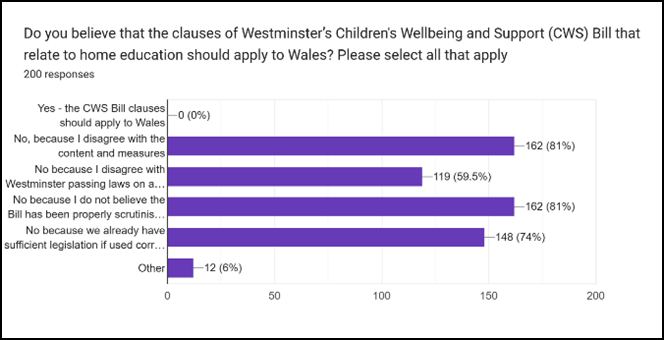
| Data from Figure A.8 Do you believe that the clauses of Westminster’s Children’s Wellbeing and Support (CWS) Bill that relate to home education should apply to Wales? | Number | Percentage of those responding who considered this to be a key factor |
| No, because I disagree with the content and measures | 162 | 81 |
| No because I do not believe the Bill has been properly scrutinised or the impacts understood. | 162 | 81 |
| No because we already have sufficient legislation if used correctly | 148 | 74 |
| No because I disagree with Westminster passing laws on a devolved issue | 119 | 59 |
| Other | 12 | 6 |
| Yes, the CNIS clauses of the CWS Bill should apply to Wales | 0 | 0 |
Respondents were asked if they considered that key clauses of the CWS Bill should apply to Wales,
with a range of potential reasons to select from if they did not agree it should.
Free text responses allowed reiteration and deeper exploration of these.
Alongside the main categories used below, reasons given to objecting to the concept of the CWS Bill applying to Wales included:
- Misuse /overstepping of existing powers by LAs
- Failure to use existing powers by appropriate agencies if safeguarding measures were needed
- Inappropriate influence of media reports in ways that are felt to be “propaganda” and “scaremongering”.
- Mistaken belief that schools is required for “socialisation”.
Consideration of inappropriate or lack of use of devolved powers in Wales,
lack of appropriate scrutiny, and reliance on secondary legislation.
Welsh Labour is officially claiming to want more devolved powers for Wales. This was part of the push for more Members of Senedd. Now they are happy to give devolved powers back to Westminster that they have already. Make it make sense.
I sincerely hope that Plaid Cymru and other opposition parties will vote against the motion in the Senedd out of principle.
Education is devolved and therefore bills on education should be passed and scrutinised in Wales.
They should not piggyback on England’s decision because they have not had time to make their own decision. A decision should be made for Wales that suits Wales. Taking into consideration the thoughts of education professionals and home educators alike. Seeing where existing problems actually root from and without prejudice of home educators
The particular worry in this case is also that the Welsh government is willing to write a blank cheque to Westminster, and this is happening just a few months for the next Senedd election, knowing that Welsh Labour will most likely not be in government after that.
The Welsh government piggybacking on an English bill is lazy. They should have their own debates, consultations, and own opinions.
Wales is separate from England, we have our own rules.
What’s the point of being devolved for certain areas if we’re not going to make decisions for ourselves?
If this was a beautiful piece of legislation that was fit for purpose anywhere, then it would be ideal to use it as a template onto which we fit how Welsh authorities work, so that we have the best legislation for our families and children.
But it’s not suitable and shouldn’t be adopted just to save the bother of doing something ourselves when it is so fundamentally flawed.
The bill was rushed, and ignored all reports, it was even built and passed before essential reports were made of its impacts. Placing children in danger.
I disagree because the measures are disproportionate, insufficiently scrutinised, and unnecessary given existing legislation. Education is devolved and sweeping oversight measures undermine parental rights without evidence of need.
Wales has its own rules and powers that suffice.
If you want to protect children, this bill must not be applied to Wales
Devolved areas should not be snuck into Westminster legislation without the ability for Welsh citizens, MPs or MS to fully engage.
The inclusion of Wales in this bill was done in an underhand way, without the scrutiny that it deserves.
The CWS Bill is extremely concerning because it relies on a shocking, emerging constitutional practice: the suggestion that fundamental questions about state authority, parental rights, and religious freedom can safely be resolved after legislation is enacted, through guidance, consultation, or what officials describe as ‘future arrangements.’
When Parliament leaves fundamental questions unanswered on the face of legislation, those questions do not remain open. They are resolved by default in favour of the executive.
Education is a devolved matter in Wales, and any significant changes affecting home educating families should be carefully scrutinised within the Welsh legislative framework. The current proposals are disproportionate, lack clear evidence of necessity, and risk undermining child wellbeing and parental responsibility where existing legislation already provides sufficient powers if applied properly.
Westminster doesn’t recognise Cymru’s needs, we shouldn’t encourage them
The CWS Bill is a dreadful, ill-thought-out mess. The Bill is not fit for purpose for England, but even less so for Wales. We’re being treated as an afterthought.
Trying to fit square peg into round hole.
It is ridiculous to try to shoe-horn Wales into such a poorly designed English Bill.
that Bill is going to be challenged through several judicial reviews anyway, do we really want to waste Welsh taxpayers’ money on such a foreseeable problem.
It is entirely wrong that a bill pertaining to a devolved issue should be rolled out with barely any scrutiny by Welsh authorities.
Sufficient existing legislation and powers to protect children if used correctly, therefore motives behind the Bill questioned.
We don’t need more legislation, we need LAs who behave appropriately and respectfully using the powers they already have. LAs don’t need more powers. It’s a waste of taxpayer’s money and it is counterproductive. It would damage the wellbeing and education of children.
There are sufficient measures but because LA s constantly overstep and try to push children towards school there is a huge barrier
There are already sufficient strategies and legislation in place. This has arisen through misinformation and propaganda that is not correct and a lack of education about what Home Education actually is. It is merely a practice to try and force children back into a school setting that has already caused damage to their progress and ability to enjoy learning and education. It is an attempt at removing the rights of parents and the autonomy of the child. It is an attempt to remove a space where the child feels safe and can learn in a way that works for them and provides them with a varied suitable education according to their needs. It is also hugely ableist to those children that are home educated due to disabilities that they school could not or would not support.
There are no changes that need to be made. The points which are made to try and push this legislation through are incorrect. There are other ways to ensure the safety of children without having to single out home educators. All our children must be safe, home educated or school educated. The safety of children should be taken into consideration from any concerns from doctors or social workers or those who see things that HAVE to be addressed. THEN the tragedies that have happened in the past may have been intervened with in an appropriate manner rather than using these examples to use against home educators as a whole, disregarding the fact that other professionals didn’t do their job roles as fully as they should have.
There are already guidance and legislation in place to safeguard children and vulnerable adults. You have both of the children’s acts and working together to safeguard children. If these were followed and implemented properly then there shouldn’t be an issue.
The current system is good enough
There have been some cases where children have tragically lost their loves, and home education has been blamed, when if those organisations such as social services, education etc had followed safeguarding processes and legislation, then you may have had a different outcome. Instead of investing and investigating where it went wrong and fixing it, innocent people have restrictions placed instead. I’m so sorry that the young people lost their loves, but this is not down to home ed.
Existing sufficient legislation if used correctly will safeguard children and prevent them from harm. Particularly from school-based trauma.
The entirety of the Westminster Bill is erroneously focused on “safeguarding” despite studies proving that Home Education is not a safeguarding issue. The bill is nothing more than state control dressed up as care for children when the Bill does no such thing
Why change a system that is already in place and working. Children do not belong to the state.
We should not need to prove anything to the state. We are working hard and doing a good job, thank you.
A ridiculous waste of time and money.
Laws are not needed to tell parents how to parent and educate their children. There are sufficient guidelines and monitoring currently in place. If there are child protection issues, which are separate to education, then there are already laws and guidelines for this which social services should be following.
Simply, as a parent, it is my role and responsibility to raise and educate my children as I deem appropriate – even if the government doesn’t like what I do.
The bill is 100% flawed and dangerous. There is completely sufficient legislation to protect children. All the recent cases being used in support of the bill would NOT have been helped by this bill – the required steps already available were not followed.
Discriminatory view of “school is best”, anti-home education bias.
There’s this idea that school is the premium education provider, that school socialises kids and that school represents a safeguarding organisation. All of this is entirely false and has been repeatedly proven to be. And yet as home educators we can’t be trusted because they state refuses to treat home ed as an equally valid educational resource. The LA come as judge and jury instead of equals.
I totally disagree all children learn at their own pace a lot of children school does not work for them whether it’s the bullying anxiety the environment we are the parents and we should decide. And if you actually got the facts on school issues I think you would find a lot more problems with those rather than home education parents and children
If this bill was passed when my son was younger I would have left the UK. Home education is the fastest growing education demographic for a reason. People saw how their children thrived in Covid and many continued as happy children surely is a priority. Others like myself did it from the beginning. The questions shouldn’t be how can we make home ed be like school but how can school be like home ed! After all the highest percentage proportionally of firsts at uni come from home ed kids.
The idea the state should remove parents’ rights is abysmal. The fact that the education provision offered by the state is unfit for purpose and poses a serious threat to children’s wellbeing and development, is totally underfunded and ineffective and has no actual basis in delivering effective education suggests the time and resources would be better spent making schools accessible to all.
Guidance may soften how power is exercised, but it cannot limit the power itself in law. Nor can it prevent future reinterpretation by those with different priorities, different political pressures, or different understandings of what the public interest requires.”
The bill is dangerous and destructive, it invades our rights to a private life, it assumes guilt where there is none, and discriminates against a legal group of people in society just as shamefully as Nazi Germany discriminated against Jews. Are we to wear identifying emblems too? There are plenty of laws to protect children if they are actually implemented correctly but we as home educators are being punished for the failings of those in authority.
It shouldn’t be passed at all! They have rushed this because of a social services errors and backlash from misinformed public. The news and media scaremongering non- Home Educated people. There is (or I have found) a sort of jealousy from parents whose children are struggling and can’t Home Educate for whatever reason, be it work, health, whatever. There’s spite from teachers and schools when children are removed because you are highlighting THEIR (not the child’s) failings. It’s schools that need to go under the microscope and reevaluate them. They are clearly no longer fit for purpose and haven’t been for a long time. Children have changed, parenting has changed, the world has changed, it needs to catch up not bring generations trauma just because that was what was done back in the day.
References to specific cases of child abuse in media/scapegoating of home education, diversion from government and LA failings and mistakes
I understand the concerns raised due to cases such as Sara Sharif have brought this to attention but it was not due to home education that this happened. It was services failing to follow through on protocols to ensure a child’s safety. While in education safeguarding concerns were raised and this was not followed through. Home educating does not increase the risk of harm and abuse on children, many children who are subjected to abuse and neglect are still in the school system. This is not the right way in ensuring a child’s safety and will actually cause more harm to children.
I am a children’s healthcare professional, and I have seen firsthand how understaffed, underfunded and under resourced services are. The health, education and social care systems are broken and not working as they should because of this. Home education is being scapegoated for failings in the system and austerity.
Another bill rushed through as a knee jerk reaction to a specific incident. Not appropriate.
EHE is not a safeguarding issue, the issue is that systems and local authorities fail time and time again to act when they are already involved in children’s lives. Sara Sharif would have died regardless of being EHE even in school as the professionals involved failed to safeguard her.
The reasons they’re giving for creating this bill are based around diverting attention from governmental failings. More laws for them to ignore / for relevant agencies not to have enough funding to implement, are not going to protect children. Neither is an identifying number.
The tragic Sara case was a disaster waiting to happen long before the parents pulled her out of school. She was already known to social service. An ignorant judge placed her with an abusive father and step-mother. Action should have happened years before it did. The school could not and did not protect her.
Lack of consultation and engagement with families in Wales being counterproductive and causing division. Bill being rushed/pushed.
No proper consultation with home ed families. Will cause distrust, anger, and distress, to children and families.
The proper procedures have not been followed in terms of consultations and so on.
The Bill is rushed, not considering the actual wellbeing of children, not asking for the real-life views of children, young people and parents, making judgments based on inaccuracies and pointing blame at a community, many of whom have been terribly let down by Education already.
Discriminatory to cohorts of children, for example disabled children and those with ALNs
No, because I believe it actively discriminates against children who are neurodivergent, especially Autistic children (see School distress and the school attendance crisis: a story dominated by neurodivergence and unmet need, SE Connolly, 2023). I also believe it puts adopted children at risk of school trauma, as I believe they would be effected by the elements of the Bill referring to children who’ve been on a child protection plan. This is highly concerning. My husband and I are considering adoption due to my background, but if parental choice around education was reduced, this would really make us reconsider as we’ve experienced the trauma that school can cause both ourselves and through our children.
Measures too damaging and invasive, overreach of state powers, lack of accountability for use of powers.
My child would suffer greatly if this bill went ahead. My child is learning every day all day in a way that suits him. If he has to have an official person judging his every move on what and how he is learning he will shut down completely and refuse to learn anything. His behaviour will be drastically affected by people not just by coming into his home which is his safe space and judging him but also indirectly by having to prove to an outsider what he is capable of. It will have a knock on affect with not only myself and our family but the wider community as a whole as his behaviour and mental health is going to radically change for the worse.
Same as above. Too invasive, disruptive to the learning of each family. Everyone has a different approach and the home Ed officers are not caring enough to listen and always have an agenda to cause as much grief as possible (I’ve had this problem and now won’t allow anyone in my home).
I disagree with the content and measures.
This bill in its current form seeks to take away parental responsibility for education which is the kind of thing a dictatorship would want to do health care will be next, it is deeply worrying that the state wants control of our children & there’s no scrutiny or acknowledgement of the impact that this bill will have on children under witness protection/estranged families (for safety) nor how it will impact families with children who have additional learning needs
This bill strips human rights and gives it to the state, while also treating parents instantly as abusers for simply being parents! That is dictating not safeguarding. That is assuming you are all knowing even though you don’t.
This bill is very dangerous, it’s taking parents rights away and giving them to the state, the state as no business deciding what is best for our children. They already have a register for every child born, so they should already know who is and isn’t in school, this is a totally breach of our freedoms and rights.
It’s subjective, people can overstep or think they’ve got power
These two questions address the presumption in the CWS Bill and in the WG-commission evaluation of their guidance that LAs will always act in a child’s best interests, with no provision made for independent appeals, complaints, advocacy, mediation or tribunal systems in relation to LA decisions or opinions.
Note that all respondents to the survey answered both questions.
These questions relate to two measures in the CWS Bill.
- The growing range of “certain children” where the Bill would result in consent being required from the LA before a child could be deregistered, where rather than just considering if education would be provided the LA not the parent is placed as the determiner of what is in a child’s “best interests”
- The pilots for mandatory meetings before deregistration of any child, where the LA are expected to make some consideration of what is in a child’s “best interests”.
However, the inclusion of those measures in the Bill was not mentioned in this part of the survey, to allow consideration of these concepts in their own rights.
Comments were provided in relation to the question
“Do you believe the LA will always act in a child’s “best interests” when decisions are made about deregistering a child from school?
These can be generally categorised as indicating concerns and beliefs that:
Parents are in the best position to determine what is in a child’s best interests.
Parents understand their children in ways others cannot and advocate for them when they cannot.
Absolutely not. We as parents know what is right for our children. We know our children better than anyone. We know their needs, their interests and how they learn best. We can give them what they need 1 to 1. A stranger cannot comment on any of this.
The best interests test is a subjective one, parents are the ones who know their children best not strangers who may have never even met them once before. Families need to maintain the rights to make the decisions for their children and not have this removed.
Definitely not. My daughter physically couldn’t make it some days into the school environment she is thriving now being home educated they could assess her on a good day and feel she could go back to school but that would have a massive effect on her mental health and also her learning. A child trying to survive isn’t a learning child they just exist. When a child is severely anxious, they won’t be learning anything
As the mother who carried, laboured, and birthed my children, I have their best interests at heart. Random unqualified local authority staff just doing a job to earn a living for themselves, blindly following orders regardless, do not have my children’s best interests at heart.
The LA doesn’t always know what is in the child’s best interests. That is why they have parents. This task requires a skill-set nobody has apart from their parents.
The LA haven’t spent years getting to know the child, therefore it’s impossible for them to know what’s in their best interests. Even if they are the most well-intentioned altruistic LA person, they’ll never know the child as well as a parent does.”
We know they don’t
Child and their parents know best.
Every child is different.
The parent understands better than a stranger the needs of their child
Deregistering a child is for the parents and child to decide and not the LA
Parents and children are best placed to make the choice. LA’s do not and never will know the individual circumstances enough to make informed choice.
Only I have my child’s best interests as a priority, not a stranger who knows little to nothing about my child
Parents are almost always better placed to make decisions for their children. They know them better and love them.
They do not know my children. It is parents who advocate for children, not some person working at the council. It is parents who children confide in, not random council staff. It is parents who really care, and who are the ones who have to pick up the pieces as and when councils and schools do not act in a child’s best interests.
How can anybody but the parent know what an individual child’s best interests are?
No one knows the child better than the parent. Children experiencing distress related to school often mask their issues when outside of the home. In many instances the parents are the only people seeing the child’s true levels of anxiety and mental distress. And what about those parents who want to home educate for philosophical reasons? If there is no compelling push factor causing parents to want to deregister their children, ie no mental health, no EBSA, no self-harm etc but they still believe they can offer a great education for their child purely because they dislike the restrictive curriculum or want to be able to live abroad in the winter, or want their child to be able to pursue a sports passion etc. Will a member of LA staff genuinely be able to understand this desire or will they stand in the way because it’s not the ‘norm’? What right to appeal would the parents have? Why should they have to appeal in the first place? It’s the parents’ responsibility to ensure the child is educated, not the states!
Misuse of existing powers, either by not using appropriate powers when required or overstepping and abusing these.
They don’t (act in a child’s best interests) using existing powers, LAs often overstep and use coercion or deliberately misleading tactics.
They announce meetings as if they have to happen to try to trick you into having them. People who trick other people should not be given more powers.
We are thankful that our LA is supportive and very good at her job however this is not widely the case across other councils and to give them the power to make decisions when deregistering a child is removing the legal rights of the parent and handing them to a person who knows nothing about the child and will be governed by strict guidelines that do not allow flexibility, empathy, compassion or understanding.
I know plenty of people who’ve been treated appallingly by so called authorities who clearly are more interested in exercising their power than actually putting the child’s best interests at heart, too many to trust that the LA genuinely has anyone’s best interests at heart other than their own.
The LAs have been shown time and time again to have failed children, made poor decisions and acted wrongly.
The LA acts in the LAs interest, they manipulate information to suit their ends (e.g altering deadlines to fit themselves, insisting on home visits, trying to manipulate and intimidated to access information they are not entitled to. None of this is in the child’s interest, it’s to fit a tick boxing exercise that isn’t fit for purpose and causes no end of stress and conflict.
I work as a youth advocate and I’m part of a court case to prosecute a social worker for lies and damaging and abusive practice. I see other local authority staff messing up all the time with the countless complaints I write, and how children don’t feel heard and supported.
I think it is hypocritical to have the Elective Home Education Office hold the Educational Welfare Officer status at the same time. This is a conflict of interest and causes concern around Support for EHE families when that same person is the prosecutor for school system. This creates great distrust between local authorities and families. I also feel that no local authority could possibly know or understand what’s best with regards to my child’s learning when you know nothing about them or how they learn. This could look particularly different to what the LA ‘perceives’ to be education or learning.
No, the LA never acts on the child’s best interest they just want to come out to judge in the hope to get children put back into schools as too many parents are starting to home educate as the school system is not working for a lot of children.
State overreach
LAs are subject to human error which can cause significant harm to children and families.
I know from long experience that a minority of staff do not do so.
Clear evidence shows they don’t
No. While many staff aim to act in a child’s best interests, distrust exists due to rigid or compliance-focused processes. Trust could improve if decisions were transparent, genuinely child-centred, and collaborative with families.
To date, the above has never been the case and I don’t believe that’s changed.
The LA only listen to ‘professionals’ and take absolutely no notice of parents/carers.
No, because 99% of the time tribunals on LA decisions are granted in favour of the family. How can a system with a limited budget fairly consider the child and the Government’s cost savings at the same time? This bill proposes to remove powers to appeal as well.
In my experience staff are not always honest and act in the best interests of the child preferring to save money over giving a child what they actually need
Cost comes before need
The local authority very rarely accepts any responsibility for its shortcomings in other areas of council oversight, the failings in many areas are plain to see and nothing has improved in many years, for example at least 1 school in my area was in special measures for almost a decade, the roads the councils are responsible for are atrocious, I have in the past had to raise safeguarding concerns about photos on social media with both the school and LA youth service provision and a friend of mine has had to raise a data protection breach concern with the local school. They need to get their own houses in order before trying to overstep on the current legislation
History shows this isn’t true
When I took my son out of school, he was a physical and mental mess with a shattered nervous system. School did not see anything as he masked! If it was up to them they would have said, he’s fine and in their ‘professional’ opinion better off on school. Having taken the home ed route (unplanned), we now have out son back, he is thriving and due to take his GCSE maths two years early! I am aware of many, many cases of ill practice within schools and councils, and giving them more power will mean more children at risk of harm. My son was 7 and didn’t want to live anymore. He has since been diagnosed ASD and Combined ADHD (although, apparently, he was ‘fine’ in school, according to the headteacher) He now has everything to live for. If he had been left in school, I can’t even think about where we would be now. Our family would have split up for a start!
On a personal level, I’ve had experience of the LA and had to fight with them to get what’s in my child’s best interests. Best interests not only according to me, but according to numerous professionals as well.
LAs are driven by targets and limited by budgets; they ultimately act in the best interests of those. Whereas parents put the child first.
The local authority was not interested in my child’s education or wellbeing while he was registered at school. I removed him from the system to give him a safe environment to be able learn on his own terms.
The LA weren’t interested in helping when I requested help.
Definitely not, as with schools it will be a one size fits all approach, and this is the reason many families have taken to home education to enable them to tailor their children’s education to what they need. It will become a power surge and a tick box target.
The LA doesn’t act in the best interest of children when they are on role in school so I doubt they will when deregistering.
I think they have a set of boxes to tick and anyone mistreating a child and using the current home education laws to hide behind won’t be picked up by any of the things proposed anyway. They will simply punish families who are doing the right thing now to show they are doing things.
I have had personal experience where not only were my child’s needs not a priority but were second not only financial pressure but personal opinions by LA staff. In our case it took a tribunal to force them to bow to what was right.
Funding and behind the scenes criteria will always impact a decision. For example, my child was noticed to be very gifted, but instead was put to use by teachers cleaning and arranging all the crafts stuff and helping ither children who were behind, instead of being encouraged to excel in her own learning journey “because we can’t have her getting too far ahead of herself”.
Belief expressed by respondent that Local Authorities are already misusing law to fit their narrative and are not open and honest.
No. While many individuals act with good intentions, systems are fallible. Decisions can be influenced by policy bias, workload pressures and institutional culture. There must be safeguards against error, individual bias and personal opinions. Each individual will approach families differently depending upon their personal beliefs. This cannot be the jurisdiction of the Local Authority and is not fair.
I have had issues with the LA went requesting flexi schooling. They overreached and missed the school. Even said in the meeting they have no policy on flexi schooling and rely on ‘unwritten rules’. In addition, when we began home educating, someone from the La turned up at my address unannounced and then told me they were able to as they have a duty, I’m addition to telling me they have a duty to see and speak to my child. This is misleading and I worry how they will behaviour with more powers
If the LA had the child’s best interest in mind, a large majority of families would not have to home educate. The support. ALNs and system as a whole is not fit for purpose and ignores the child’s best interests. Parents have to fight for many years for the most basic of help. It has never been about their best interests.
The LA is barely managing to support the needs of those in school, as we know so many schooled children are being faked due to lack of resources etc. When so many children are being failed in school by the same LA I struggle to see how the same LA can be considered to act in the holds best interests concerning deregistration especially considering the hostile approach already seen and being proposed by this bill.
Very often, we parents have been fighting for years or months while schools tell us they ‘don’t see’ the signs and symptoms of Autism or ADHD and keep reminding us how long the waiting lists are. The LA would need professionals in ALL conditions and ALL presentations of ALL conditions. If they’ve already made it clear that they suspect parents to lie (see not trusting parents to provide work from their child), then how on earth are they suddenly going to make informed and unbiased decisions for the child?
If the child is present, there are also concerns about leading questions, especially where a child has a condition that makes them more vulnerable to this. Parents should be allowed to act as now in the best interests of the child. LAs already have the right to give SAOs etc. and report to SS if needed.
No absolutely not. The school staff, the education system, and local authority have proved time and time again that they don’t have the best interests of children at heart.
We have had very poor experience of the school lying in all sorts of official documents (I have evidence to prove this). The LA will be led by schools, who will never agree with this decision unless (potentially) the child is ‘hardwork’.
LA never had any issues with my children’s education then suddenly threatened child services involvement when we politely declined meeting in person. Online Teams meeting was not even offered by the LA.
This has been clearly demonstrated by how many ALN children have been failed with support turned down, yet high % overturned at appeal.
I have already been told I have to have meetings and school do checks whilst awaiting confirmation on LA this is grossly misleading and I have no trust in the LA.
Although it is illegal, schools are known to place pressure on kids with low attendance to home educate instead so that it stops affecting their statistics. The LA and schools can’t even be trusted to do what’s best for the children currently attending schools and no one holds them accountable for it… Again why are they punishing home education
The LA would only be looking out for its own “”best interests””, and not those of any child, in order to avoid the scrutiny of admitting its own failures.
The shocking scandals relating to children in care in Wales prove that this is not the case. Council workers are as fallible as the rest of us and will act to protect their own interests.
There is so much distrust embedded in this approach. To brand parents and homes as inherently unsafe is profoundly unethical and unfair.
So much evidence already of this not happening.
So much evidence to the contrary
It looks bad on their system if children leave it because they have failed the child and not provided them with a good education. So of course they are going to fight to keep that child within their grasp.
Sometimes it’s about targets
every public body makes mistakes on individual and corporate levels, it is inevitable.
They do not know the child like the parents do. The parents, and only the parents, have the right to decide what is best for their child.
There are so many examples of when councils fail children on a whole range of levels. Have you seen the latest article in the Times about the suicides of children who have been let down by councils, where councils refused to meet their needs even when parents have begged for this?
There is so much evidence out there that they so often do not.
There is an article in the Times about how many children with SEND commit or attempt suicide because of how councils have failed them, as just one example.
There are already cases where this has not happened. LAs do not always know better than the parent what is in a child’s best interests, and they also often work under personal and professional bias and a political agenda.
LAs so often demonstrate that they cannot be trusted themselves.
LAs think it’s ok to mislead us in their letters inviting themselves to meetings as if these are a requirement. LAs think it’s ok to mislead that we have to provide samples of work as if we don’t have a choice, or to openly and wrongly state they have a legal duty to monitor us when there is no such legal duty. LAs think it’s ok to be dishonest and misleading
Look how many appeals and tribunals over SEND and ALN issues find against the council – even though those appeals and tribunal services are already massively stacked in favour because of the difficulties for ordinary families to go through the process without legal representation whereas the LA has all its resources freely to hand.
The state is not a coparent – and if it were, it would not be an equal coparent, given all the powers and resources it holds compared to that of ordinary families who are just trying to care for their children.
I believe the LA does what suits them
Institutionalised bias and discrimination against home education/belief that “school is best”.
Local Authorities have a history of bias and discrimination and could also have “targets to hit”.
Because they are biased into believing that children are better off in schools. Data shows home educated children are more likely to finish university and to follow a career that is based on their qualifications. They also are better at exams
They are totally uneducated on home education, neurodiversity, and will act using their opinion bias.
Schools clearly do not want children registered as it shows downfalls in the school/teachers/education. LAs want to keep our children in school and to make the correct quotas, not what is best for our children.
They want to keep children in school, more children means more money for that school.
There is massive evidence that the officers go in with a mindset and attitude that the parents don’t know what they are doing. They never stop and think what’s right for everyone. No one like them in the home educators’ community and we do our best to avoid all forms of visits as they’re not helpful at all.
They are biased and hold institutionalised views
What an individual employed by the LA thinks of as “best” will be personal to them, just as there can be vast differences between parents on what they think is “best” for their children.
The education system needs a complete reform and until its suitable and fully adaptable for ALN children, WITHOUT parents having to home educate due to issues in school, then the LA and schools are unlikely to act in any child’s best interests. As proven by the fact that parents have to fight in the first place.
Please look at the figures recently published for Wales. Some councils are very anti home education.
Because we can see already that even with less powers that the LA sometimes doesn’t act in the interest of the child. The parents know their child the best and if they decide that home education is the best course of action for their child then this will be the case.
There is an enormous bias towards school, and an intolerable amount of pressure is put on parents to continue forcing their child to attend. Needs are ignored. I feel that the LA will continue this pressure and not act in the best interests of the child as a result.
“I have talked to them. They admit that they believe children should all be in school.
They have no understanding of the needs of any child that is different in any way. They don’t understand neurodivergence. They don’t truly understand that learning and education can happen in so many different ways and often needs to be delivered and facilitated differently to the ‘schoolwork’ model.
They don’t understand that many children will be educationally much worse off in school than they are being home educated.
These people often use the term home schooling & don’t even understand the difference between that & home education so cannot be trusted to fully understand the many nuanced learning styles of home education nor the complex reasons families choose to avoid school. School is not the best place for many children to learn however most government officials naively believe that it is
LA may be against the child and parents’ wishes
I don’t believe the LA will be qualified to understand what would be in the best interest of every single child they meet. I also think there is a general bias to school being best.
Every time I mentioned EHE in school meetings I was told that it is awful for the children as they are lost to the education system. When it was the system that was preventing my child having an education and having a negative impact on their health and wellbeing.
The LA are not a neutral part of the process, and so are unlikely to really act in the best interests of a child.
If you are already of the mindset a child should be in school and have no idea about the rich, fulfilling, exciting, free, enigmatic lives home Ed children lead, full of opportunities, and have no idea of the day to day needs of each child as a parent does, the LA is not in a position to decide what is best for each individual child.
For a local authority to admit that a school, within its own remit, is failing to provide a suitable education and that a suitable education would be provided elsewhere, then the local authority would be admitting that it is failing in its duty.
When they have a stated aim that all children should be in school, there is no way that they will actually put the child first. They will have targets to meet to ensure they keep children in school.
If the LA was against home education this would impact their decision.
They are there just to get children back in school, where they struggle and it’s not always the right environment for them
There is a presumption that school is best and that isn’t always the case
The LA have one job and that’s to keep the child in school. Even if it isn’t in the best interests of the child
No LA can understand a child’s needs as their parent does. And they are already approaching the situation with a bias in favour of school.
Some LA may be prejudiced if proper specifics are not in place
No. I do not believe it can be assumed that decisions will always reflect a child’s best interests. There is no statutory requirement for local authority officers to have specialist training in home education approaches or the full breadth of SEND and neurodiversity needs. Where understanding is limited or based primarily on a school-centred model, decisions risk overlooking the individual child’s circumstances. For some children, particularly those who have already experienced anxiety, unmet needs, or distress in school, an inappropriate decision could be deeply damaging to their wellbeing and sense of safety.
Every child is different and schools are the LAs responsibility, if they are unable to act within the child’s best interests whilst at school then they have no right to if home educated. It’s contradictory and invasion of the child’s safe space.
As the funder for the school, they have an interest in its future.
If school is always seen as the gold standard, LA will always attempt to keep the child in school above all other options.
I believe the LA is biased towards school attendance being best for the child. I think they are against home ed families.
Lack of capacity of council staff to make such decisions, not an appropriate role for them.
They do not understand the child and the child’s needs
It is not up to the LA what is best for a child unless other concerns have been raised.
They do not know the child and the process will be bureaucratic, a paperwork process rather than an individual case by case one. The LA simply wouldn’t have the time, skills or capacity to fully investigate and support from a personal perspective. They are already struggling to work within the existing legislation as it is and this bill does not come with the money to fund an increased workload.
No because the LA staff do not always understand the true nature of home education.
My EWO is lovely and very understanding but not all EWO are like this. After all the job of a EWO is to get a child in school.
The LA do not know our children so cannot put their best interests at the forefront if their decisions.
Local authorities work to tight budgets and time constraints. Giving anymore responsibilities to these departments is financially irresponsible and entirely unnecessary.
Absolutely not. There would be no relationship with the child to even begin to be able to advocate.
Even if they wanted to and had the empathy and understanding, they are too under resourced and undertrained to do so.
They never have before
Because they clearly don’t get it.
They are not qualified and don’t have enough insight.
I believe in most cases the LA wants the best for the child, but they are not equipped to know what that is. Regardless, it is the parent’s responsibility.
Parents of children with ALN have to fight for the most basic of support for their children and mostly have door after door closed in their faces. Acting in a child’s best interest would need an in-depth knowledge of that child, expertise and experience in the factors which led parents to deregister, beyond a textbook or course. That will not be the case and power/position will take precedence over parent knowledge of their own child. This is very worrying and absolutely not in the best interest of a child’s wellbeing.
Their understanding of children’s needs is poor.
The LA is highly unlikely to know what the best interests are. They don’t know the child.
This is, quite clearly, an extremely inappropriate function for a local authority.
It is a conflict of interest. As such, a local authority could never be impartial and should never be in that position.
They won’t have enough time to understand each and every child’s situation so will just judge them all the same way.
How can they possibly do that? They do not know my children.
No council ever would be guaranteed to always do that.
Respondents were able to add comments to the question, “Do you believe it would be SAFE to have mandatory LA oversight, monitoring and decision making about home educated children without fully independent complaints, mediation, advocacy or tribunal systems or services?”
Comments reflected overwhelming incredulity at any belief it would be safe to allow LAs to operate in relation to EHE families without such systems and services, let alone if LA powers were considerably increased.
The dangers to the wellbeing of parents and children were also referenced, including the risk of harm and suicide as a result.
The responses identified the lack of such independent complaints, mediation, advocacy or tribunal systems or services as a considerable safeguarding risk.
Give someone loads of powers over a family, over children, powers to override parents, with no accountability for how they are used and no comeback when they are misused or when mistakes are made? Are you crazy?
Children can and do commit self harm and suicide because of school environments. but you want council staff to have the power to force them to stay in such environments – that’s not safe – and with no independent way to appeal- that is really unsafe.
Do you really think council staff never make mistakes or behave in a biased or discriminatory way?
They are biased.
The reasons for this would take a considerable amount of time to add to this survey but it absolutely would not be safe, to do so would leave vulnerable children at even greater risk and danger. At a time when we are living in a mental health crisis throughout all age groups to enforce any of points will result in a terrifying increase of mental health issues and would be extremely dangerous for many reasons.
I can’t even see how that is fair. Why should anyone be subject to mandatory oversight/decision making etc and not have independent complaints procedures etc.
You wouldn’t find that in any other circumstances.
An independent complaints process is integral to any form of bureaucracy. Without it, it is far too open to abuse.
None of this is safe. Not safe at the time and not safe as a whole. Having strangers wanting contact with our children is not safe. We have unsafe people as teachers in our schools, that pass checks but are still a risk to our children. Having someone assess our children and not being able to challenge decisions made can give lots of misinformation. Human error, misunderstanding, a child having a bad day or going through something the LA are not able to understand or won’t take into consideration such as mental health or learning difficulties. Our children will not always understand why there is someone wanting to watch them work and may refuse to do so or be shy. If information is found by the LA and we as parents are unable to have a say on the situation thousands of problems will arise where there is not a problem.
This would be giving the local authorities power beyond measure with no opportunity for accountability or redress. Families would be at the mercy of the LA which should never be the case.
The LA cannot be trusted. Even with specific guidance from the Welsh government they are continually overstepping or just outright ignoring it.
I work as an advocate I see the damages to children now
No LA should have any control over the parents. Stop trying to persecute parents for teaching their child in a way their child learns just because it looks different to the institution we call school.
Anything that could affect our children so severely and unjustly should always ALWAYS have an independent complaints, mediation, advocacy or tribunal system or service in place for fairness to protect the best interests of the child. Poor/bias judgement could lead to extreme mental unwellness for the child.
This is one way to ensure trust is lost in the system completely.
It’s pretty obvious why.
No not at all. This process is in place for all other areas of education so why not home education? If LAs were funding the education then I might say that I can agree that they want to see how their money is being spent, but they’re not, so they have no right and it’s just a massive invasion of privacy
As said above, this is subject to human error and based on differing people opinions many of whom may not understand home educating. Unless prior concerns raised this would be a massive overreach of power.
Everything has a complaints procedure so this should too
Is there any other system, institution or provision in a fair, democratic society where the right to appeal, complain, have independent mediation or review, tribunal or advocacy wouldn’t exist?
Absolutely not.
The local authority is incompetent across the board. I would not trust them to do anything properly under any circumstances, ever.
Absolutely not.
They fail on oversight of schools
Independent oversight is always important; no system or body or organisation is above reproach.
If people are making life altering decisions (which is what they would be if the bill passes) there 100% needs to be scrutiny and recourse.
There must always be an avenue for independent complaints and appeal.
Absolutely not, given the LAs already lose 98% of cases and that’s the people who manage to get it to that stage.
No system should be able to operate without safety
No, absolutely not. Why should parents not have the ability to access independent complaints procedure? The LA does not always act in the best interest of the child and the parent wouldn’t be able to appeal against their decision. We don’t live in a dictatorship, and children are the responsibility of their parents. This is such an overreach of state power.
Definitely not.
1. There is no limitation and no avenue for a parent or child to object to LA decisions
2. Without the above, it leaves the system open to abuse of power.
3. The people with the power are not properly trained to have the power.”
Every system needs a complaint route.
Every child is different in different situations.
The LA often just want to save money rather than provide actual positive help to a child, in my experience.
There has to be independent process.
No power should be given without oversight or corruption can easily ensue.
Local authorities are difficult enough to deal with when you require their assistance. My family was doorstepped by LA staff. My LA then “lost” one of my children’s annual reports (the reports were emailed in the same document- so losing one of them required some effort of the part of the staff). I then received a letter threatening further action because of the missing report (which the LA had already located and apologised for losing). Without a safety net for citizens regarding LA interactions, some patents could easily be prosecuted or their children sent to an unsuitable/unsafe school due to something as silly as an admin error.
When not just some but the vast majority of tribunal cases are found in favour of the parent, and that’s with oversight present, how safe do you think children’s needs and legal rights will be without that oversight?
If there are no consequences for people’s decisions, then they will do as they please and that is just human nature.
This is a grave concern for home educating families who desperately want the best for their children and have turned our lives upside down to meet the educational and mental health needs of our children.
To not have any sort of appeals or complaints procedures is inherently wrong & unlawful. It erodes the UNCRC & parental responsibilities without due cause to do so
If it was their child, would they want a stranger who didn’t have any understanding of their child to have full control over decision making? If they were treated unfairly at work, would they be OK to put up with it without ever have the option to log a complaint? It almost seems like the days when slaves were kept and had no rights!
They act as if they are social workers, not education focussed. That is already abusing their position and acting out of their authority.
No, it’s not safe for the LA to have such powers, because they are biased and want children in school, so they will always think they know best for your child, when they really have no idea.
Not one set of people should have any set amount of power without the ability to comment, appeal, tribunal or comment on any decisions involving someone else let alone someone’s children. People should always have a say and have the ability to object and be heard. Our voices matter.
No. Oversight without fully independent redress mechanisms is unsafe. Accountability must run both ways. Families must always have access to meaningful, impartial routes to challenge decisions of individuals.
The LA show they overreach
It is unbelievable how little services there are currently to support a struggling home ed family. To introduce harsher, stricter requirements with even less of a complaints, mediation or tribunal system is staggering.
Independent body would be required to ensure fairness and rights.
Your child’s wellbeing rests in the hands of one person who happens to assess your child. If there is a personality clash or a prejudice that person’s decision can ruin lives.
This will affect children’s mental health and wellbeing and at worst are children suicidal.
Local authorities are incompetent and overly authoritarian.
As a lawyer I think this is shocking.
I only registered this month and the amount of lies I’ve already been told by council staff is unbelievable – would not trust them
Obviously it’s not safe to have a complete stranger make life altering decisions for your child, without parental consent and with no recourse. Absolute madness in a democratic society.
This would absolutely not be safe, the rights of the child and family would be violated and this would be challenged legally by the home education community.
I believe it would be incredibly dangerous. I think there would be suicide risk for those children who are already suicidal, I think there would be former trauma relating to school making burnout and other symptoms more severe and, therefore, likely to lengthen recovery time. I think many children would be stuck not receiving an education because they can’t properly access one through the school system. Equally, of lesser focus, but still key to family wellbeing, it would increase parental MH issues due to stress.
There should always be a way to complain or appeal decisions in anything, especially your children’s best interests.
Home education has many different needs and diverse areas everyone has individual different measures
There is barely a complaint procedure in place at present to deal with school issues. This would be a dangerous situation if LA’s getting away with all sorts. They already abuse their power and enforce policy over laws. I can only see this as bad. It would need to be a fully independent and regulated complaints option, like if financial services.
Their understanding of children’s needs is poor.
I know children who have been put in direct harm due to the LA, schools and social workers failing to recognise children’s ALN despite clear medical evidence. there is currently no accountability and only option for parents has been costly legal proceedings. There absolutely needs to be independent bodies that parents can go to.
Too many LA staff lie to cover their own backs.
Again look at the system in place and see the harm and danger it has caused those in it
No service that operates purely “in house” with no external accountability operates safely because there are no consequences for them.
All public servants should be answerable to impartial and independent oversight.
Members of the public must always have recourse to impartial and independent systems of oversight.
Without such systems local authorities will continue to act with impunity, just as so, so many of them already do
Based on my recent experience, the LA will lie to cover up for their own errors before admitting to mistakes, so definitely cannot be trusted with so much control.
If the LA was against home education this would impact their decision. There needs to be an independent body in place.
That isn’t safe in any setting.
if this awful legislation happens it will definitely need the ability to appeal
Decision-making about a home-ed child is down to the parent, not the LA. It’s insane to suggest any monitoring can possibly be without fully independent complaints, mediation, advocacy or tribunal systems or services. This was undertaken during WWII Germany, not somewhere Britain wants to go, surely.
No. It would be entirely unsafe to place home educated children under mandatory local authority oversight without fully independent complaints, mediation, advocacy, or tribunal systems. To suggest otherwise is deeply concerning. Without these safeguards, there is no effective check on decisions that could profoundly affect a child’s education, wellbeing, or safety, leaving children vulnerable to unnecessary stress, anxiety, or even inappropriate interventions.
There is so much distrust embedded in this approach. To brand all parents and homes as inherently unsafe is profoundly unethical and unfair.
LAs are not foolproof
Increased power without protecting people’s rights is always a dangerous call.
Obviously there needs to be a complains system and a way to go above the local LAs when they overstep their remit.
The wielding of unregulated power always ends with negative results and abuse of power, particularly over the vulnerable
How can it possibly be? what system could ever be above reproach?
Every public body makes mistakes on individual and corporate levels, it is inevitable. Even more so when those involved know there is no real accountability for when they do families a disservice.
Unsafe.
Of course it is unsafe
Councils so often make mistakes in so many different ways. It is ridiculous to think there is no accountability for when they do so.
LAs so often demonstrate that they cannot be trusted themselves.
LAs think it’s ok to mislead us in their letters inviting themselves to meetings as if these are a requirement. LAs think it’s ok to mislead that we have to provide samples of work as if we don’t have a choice, or to openly and wrongly state they have a legal duty to monitor us when there is no such legal duty. LAs think it’s ok to be dishonest and misleading even using existing powers.
If there is no way of accountability, no effective way of redress, that will only get worse
How can a lack of accountability and redress for mistakes possibly be in the interests of children?
We know that councils make mistakes over all sorts of things.
of course it would not be
The whole system has to have safeguards in place otherwise decisions can be made that cause abject harm to a child and the parents will have lost all power to protect them. This is very, very wrong.
There always needs to be an independent service in place if a parent disagrees with the judgement of the LA. Particularly when it is common for the person making this judgement to have little knowledge of home education, different educational philosophies, a range of special needs and most importantly each individual child and family. Support without prejudice is the best way to forge better working relationships and outcomes for all.
Because there will always be those in the system who think they can do what they want – based on their only person values and beliefs, so if they don’t agree with a parent, that can cause enormous problems for that family, even if there is no issue /problem with that the family is doing, except in the eyes of a certain LA officer
Respondents were invited to comment on:
The CWS Bill does not say that LA staff meeting and seeing the child once they have been deregistered is mandatory,
it says that if parents decline home visits, then the LA MUST consider this to be a factor in deciding whether to issue School Attendance Orders.
How would you describe such a policy and approach?”
This was a free-text response, providing qualitative data, therefore without an illustrative figure.
The many points raised in the response included:
- identifying further safeguarding issues with this measure in the CWS Bill of an attempt to prevent or inhibit the capacity of families to safeguard their children’s wellbeing in their own homes.
- “Suicide” risks.
- That the potential, presence or use of such “threat”, “coercion or inducement” would mean that informed consent was not obtained or possible.
- Not acting in best interests of children, counterproductive and damaging.
- Irony and double standards of such “threats” and enforcement on the occasions where the family are home educating due to “failings” of the council, or being “let down” by the council.
- Against children’s rights
- Open to abuse or confused interpretation and application by LAs
- Obstructing parent’s abilities to ensure their children thrive
- That firm boundaries are needed for LAs rather than families
- Double standard of not threatening or enforcing home education as a measure for school children, with the underlying bias of “school is best”.
- Deflection of blame from failures of councils and statutory services
We again very strongly encourage the reader to explore the full spectrum of collated representative responses listed below, to best appreciate both the experiences and concerns of home educators in Wales.
This is particularly essential for elected representatives considering voting on the imposition of such measures on the people of Wales.
The semantic field used by respondents to describe this measure included terms such as:
“bullying”
“coercive”, “coercion”, “coercive control”
“manipulative”,
“intimidation”
“Coercive and undermining of parents with a side order of gaslighting”
“blackmail”
“unnecessary”
“abusive behaviour”
“Clear attempt at social engineering and behavioural modification”
“deliberately confusing”
“entrapment”, “sly”, “underhand”
“frightening”
discriminatory, “cruel”,
“creating anger, distrust and distress”,
“traumatising”, “breach of human rights, “breach of children’s rights”,
“absurd”, “ridiculous”, “farcical”, “disgrace”
“Criminalising, suspicious approach”,
“controlling and demoralising”,
“Heavy handed- combative”,
“tantamount to child abuse”
“Inflammatory and insensitive” “punishment”,
“sinister”, “unfair”, “wrong”
“undermines trust”, “scaremongering”,
“bias”, “power overstep”, “subjective”
“misguided”, “punitive”,
“Orwellian”, “draconian”,
“extremely hostile”
“will be misused”.
“Coercive”, “coercion”, “bullying , “threat” and “criminalising” were the most commonly used descriptive terms in the following collation of representative responses.
Quotes on this issue included:
Bullying, coercion, intimidation,
Do you have any idea how the badly LAs in the country would use this?
and without any accountability or scrutiny of their actions
Bullying. It is a way of phrasing it, so it seems like a choice but there isn’t a choice.
How can you issue school attendance orders based on declining a home visit? Where is the justification for this? The only time there should be an enforcement made is in a case where there is evidence from multiple agencies that a child is not safe at home.
It might as well say that visits are mandatory. They are just skirting around it – the outcome will be the same.
Ill informed. Parents are perfectly within their rights to decline home visits or visits in another venue and not being willing to entertain strangers in their home has zero significance on whether a school attendance order is necessary.
We have a right to decline home visits. We have a right to feel safe in our homes and so do our children. With necessary written communication between LA and parents every 12months and the all clear from doctors, social services, there should be ample information to see our children are safe and the education they are receiving is appropriate for their age, their ability and is full time as is already being assessed on the current legislation.
It’s wrong, we know our children best
Unnecessary
This would be overreach and be forced compliance. If visits are not mandatory, then it would be wrong to then use a refusal of a non-mandatory visit against a family.
Deliberately confusing. Some LA staff will take this to mean without a visit and SAO must be given, despite that clearly not being the case.
Subjective. You can send in a report. It feels bullying and would go against children’s views wishes and feelings. Children have a right to advocacy, to have their voice heard under article 12 of the united nations convention on the rights of the child
It’s a disgrace to think the LA has that much power. School is crippling for many children and how dare the LA think it’s ok to send an already fragile child back into the system that broke the child’s spirit. It’s like sending a solider with PTSD back to war regardless of the suicidal concerns!
This will be frightening for some children has I’ve said their home is they safe place and strangers coming into that can have a big effects on them
Absolutely disagree with such nonsense. I’m sorry, but no home educated children do not belong to the LA. I’ve removed my son because of discrimination from the school and LA so no I’m sorry he’s my son. I will teach him to the best we can the school and LA failed him while he was still in school, he started school at age 3 and left now at age 14 with no education he has not learnt anything. So we have to pick up the full slack and start from scratch.
Entrapment
Sly and underhand. Parents who prefer to protect family autonomy and privacy should not automatically be presumed a threat. We as a community are being automatically assumed a threat for no reason and this suggestion and assumption is simply a route and reason for government overreach.
This policy risks being coercive, treating refusal of home visits as a negative factor in enforcement decisions. Engagement should be voluntary, flexible, and based on trust, not fear — for example, neutral venues such as libraries could be used.
Hard to describe. It simply doesn’t make sense.
It’s basically blackmail.
Farcical. They must have understanding and respect for why a home visit is declined. Besides it’s within a home educators right to decline a visit and choose to keep everything in writing. As long as they are communicating when required, then I don’t see why home visits would be necessary
Discrimatory and wrong.
They are our children and one size sometimes does not fit all school isn’t for everyone, if the child is happy and is enjoying learning and the parent is giving that education then
That should be our choice
What!? So, if a parent chooses to safeguard their own child and keep the home the child’s safe space this could be used against them and used as a reason to issue a SAO!? What a load of rubbish! Not acting in the best interests of the child in that decision are they!?
There are many factors as to why a parent may not deem it necessary to have a home visit, such as a child with additional needs having anxiety and destress feeling their home being invaded. This is not indicative of a risk factor. Especially when there have been no prior concerns raised.
Consent in law is agreement which is obtained without coercion or inducement.
Refusal leading to notice creating a legal duty on a parent which previously did not exist, is unwarranted coercion by threat. That is not consent.
Utterly ridiculous. There are many reasons why home visits are declined – safe space, child may have special needs, LA’s opion on learning may differ to those of the parents
It is coercive and manipulative. It shows a lack of understanding and respect of a family’s choice which needs to be in the best interests of their child.
That is disgusting. My son wouldn’t be alive if he had to return to school. It traumatised him. And still has an effect on him
Underhanded way of indirectly getting the outcome they desire. Manipulative.
Inappropriate. Will create further distrust, anger and distress.
Useless and way too invasive.
These kids have been let down by the state school system and putting them back in school will result in higher suicide rate. Sort out the schools, ensure they follow any support plan and leave home educators alone. Retrain officers that they are not above the law and to go in with an open mind not be rude and nasty.
A breach of human rights
At the moment parents are responsible for the child’s education even when the child is in school so we can’t sue the education systems even though they aren’t fit for purpose. If this bill goes through and this happens I think we would all get quite litigious and we would win.
Absolutely awful
Imposing visits not optional
The inference seems to be that the parents have something to hide. That is not an equal partnership.
Bullying
Criminalising, suspicious approach. Assumes government power beyond what is appropriate.
This is a coercive policy designed to make parents comply with visits under threat of SAO
Controlling and demoralising.
Coercive at the least, criminal too.
Disagree
As a way to force parents to do what the LA want out of fear.
Totally invasive when the LA has failed the child already why would anyone have any faith in them. Everything needs to be in writing so all parties now where they stand. The decision to home educate is not one that most people take lightly. How will forcing a child back to a school that cannot deal with their needs be in the best interests of the child.
Threatening and coercive.
It presents a lack of trust in home educating approaches.
Failing children. As stated earlier in this questionnaire, at the beginning of our journey, home was the only safe space my son had!
Coercion
Cruel
Heavy handed- combative- failure to allow parents to raise, educate and allow our children to thrive.
Nonsense. Parents protect their children.
Seems heavy handed. Personally I’m happy to have a visit if the LA is not hostile towards home Education but they need to work together with parents not antagonise people
Sounds more like a threat to me. Child is highly anxious and this would cause trauma. Yet I’d worry that she’d be forced back to school if she wasn’t seen! A step backwards if you ask me.
Our local authority EHE manager would have a field day and be issuing SAO all over the place.
This seems very hypocritical because you might as well call it ‘mandatory’ because in effect this is what this phrasing means.
Drastic.
For us, it would be that it would be like inviting an unqualified stranger into our homes to judge how we live
Sinister
Outrageous. There are many reasons people decline home visits.
Lacking in a personal child and family centred approach. Assumes guilt and mistrust.
Would always be the easiest cheapest option for the LA regardless of the circumstances.
Inflammatory and insensitive.
This is a threat to comply. If there is a ‘punishment’ for refusing a meeting, and this will negatively affect the LAs views/decisions; then that is not a real option.
Shocking
Coercive and not in the best interests of the child.
It provides no choice and not everyone should be made to have home visits if they are not happy with it.
Controlling and not in the best interests of the child. Invasive of family/private life. Puts the state above family. Makes home educators look like criminals from the get-go.
Home visits are unnecessary. There are many reasons a family may need to decline home visits.
Traumatic for the child, health vulnerabilities, inconvenient for family. Home is the safe space and shouldn’t be invaded by adults who may be working to an agenda, not understanding of the child’s needs.
No one should have to allow someone into their home against their will via the external person or agency threatening a SAO. If the LA or anyone has concerns over wellbeing this should be addressed by the current processes in place.
Unfair. It will cause fear of declining home visits as parents will worry that the next step is an SAO. The wording is unfair and causes scaremongering.
Parents often remove children from school because it is not safe for them there. For an LA to suddenly act like they are worried about a child’s education when they didn’t care when the child was on a school role is absurd.
Many families decline visits from pushy LAs who do not have the child’s best interests at heart, only their own opinions on how home education should look. If LAs were properly monitored and made to follow the actual law rather than what the deem appropriate this might be different. I propose a firm set of boundaries for them rather than us.
This is assuming that declining visits is a welfare risk and not because of other factors such as school trauma and anxiety, burnout, fear of other strange adults etc.
For my child home is his safe place, to have someone enter his safe place is totally unfair for him. I don’t believe this should be a factor an SAO due to my reasons stated.
Criminal
While it might not say they are mandatory that is the way it can be interpreted and as with all legislation that is open to interpretation there will be LA that choose to use it to leverage and overstep.
Bias without merit.
It’s a threat that will become policy and parents who try to protect their children from intrusions into their child’s safe space will be seen as the outliers and automatically suspect rather than safeguarding their child in a way the system has failed to do.
It’s criminalising the very people who are trying to protect so many children. There must be safeguards, protocols and procedures built into any process that threatens to return a child to the system that failed them
It basically is mandatory as by declining, parents risk an SAO for their child without any thought for how the child feels again ignoring the UNCRC how can this be for a child’s well-being when it seeks to do the complete opposite
Risky as open to misuse/misinterpretation
Bullying, controlling, cohesive behaviour. It is blackmail. Do as we say or we will make your life impossible
Overreach. It is assuming abuse without grounds. It is forcing home invasion and if a parent tries to protect it they see them as abusers.
I think the LA as no right to assume anything or make families do what they want them to do. If a family doesn’t want the LA involved in their lives, then that’s their choice, it’s fine for the LA to reach out and offer their service’s but if a family declines that should be the end of it.
Children should have an opinion on who comes into their homes. Families should not be interviewed and feel that they have to jump through hoops to pass the test of whether they are right and do have the best interests of their child/ren at the forefront of.
Home visits can provoke anxiety in the majority of people as they are going to be judged on the type of area they live in, their home, family dynamics etc.
A waste of time. Home visits should always be optional this is these kids only safe space to have a stranger enter that and question them is ridiculous. A meeting shows a snippet of information not the full story. I dont understand how forcing visits, meetings or proof of work is showing what its like.
This is coercive. It presents compliance as “voluntary” while attaching punitive consequences. It undermines genuine consent and creates pressure rather than partnership.
Misguided
Dictatorship, power overstep
Used as power
Totalitarian. Lacking in compassion towards the child.
Very Draconian
This is an intimidating policy and leaves a big loop hole that if a home visit is declined you will be threatened with an SAO regardless of you meet all other criteria that you are following the law in providing a suitable education to your child. Parents will be criminalised for trying to keep their right to a private life.
Treating parents as guilty for asserting their parental rights.
Again this presumption that school is somehow safe and beneficial. Why aren’t you in school making compulsory home orders for all those poor kids being bullied, self harming, doing drugs, being belittled, feeling low self worth etc. At our local high school one mum told me her daughter says she is the only girl in her class not cutting herself. And you worry about home educators. Is it more you are threatened by our refusal to believe the bullshit about school.
Punitive, untrusting of parents and not fostering a positive relationship between the LA and Home Educating parents
This is our home, my children’s safe space where they can be themselves. Allowing people into this space would cause anxiety long term. And again, they are our children not the council’s.
I think the focus of the policy should be to target families who pose safeguarding or safety risks only to have home visits. Health visitors should be in contact with families from young ages anyway and that is the time that families should be assessed.
Unfair, causing a lot of stress to families and in particular Children. Visits without a genuine reason are unnecessary
Draconian and unnecessary. Whether home visits happen or not has no bearing on a child receiving a suitable education.
Coercive
I believe this will be misused and LAs will push for visits under trumped up safeguarding reasons
They do not know what is appropriate for that child. My own child would be drastically set back by a home visit and it is him that will suffer mentally. The LA should not hold that power.
Completely ignorant of the issues at hand, and arrogant to the point of offensive.
This approach is extremely hostile and coercive.
I would describe this as very unfair and very confusing. There are so many reasons that home visits might be declined from those with weakened immune systems to children with Autism that it makes no sense to consider it in relation to a School Attendance Order in the vast majority of cases. I would find a home visit very intrusive and upsetting. I don’t even like anyone but my closest friends coming into my home and I’m an adult. It doesn’t mean I’m not providing a good education for my children.
Threatening, coercive control and not acting in the best interests of children
Mandatory by stealth, but not even very stealthy
I think parents refuse home visits through fear & that this approach would just make them more fearful & encourage them to hide more. Families need to feel that the LA is on their side & not against them.
Damaging to children and their families.
Bias
Over-reach
Declining a visit has no bearing on suitable education. Also it must not be confused with safeguarding as people are innocent until proven guilty
Short sighted, there are many valid reasons parents may decline.
The government should be focusing on improving schools and the abuse that goes unnoticed by teachers and medical professionals.
Draconian and ignorant.
Is this not coercive control being acted out by the state?
Overstepping of authority
There will be more court cases due to SAOs as I believe as I for one will not accept home visits for the best interest of my child and they will not be forced into school.
No consent. When the schooling system fails the children they have a right to be protected from the education system. Especially since there are teachers abusing children in their care and they only get short sentences of the children report them and if they are listened to.
Disgusting approach. Do they not consider the impact having a stranger going to their home could have on the child. It’s shocking and situations arising from the overwhelming experience for that child could be disastrous if they are forced back into school.
They say home education is “setting children up for failure” yet this is a perfect example of how the government are intentionally using language to “catch” as many home edders as they can, this setting the parents, children AND LA up for failure.
Draconian
Coercive.
An assumption of guilt if parents do not comply with a “non-mandatory” demand. It’s disgraceful and discriminatory.
Extremely strict and no flexibility. Children see their home as a safe space and may not want strangers in their home. There has to be some degree of flexibility – if a meeting is required, meet on neutral ground.
Coercive
It will cause significant distress if a person were to come into my child’s safe space and start demanding results from my child and will stall the progress i have made up to that point
Again, presuming I’m either abusing my children, or not educating them. It’s also not taking into account the child. Again, all because of government services failures.
It seems to me the departments and people that should be held accountable for the tragic death of the child that we all know kicked this all off, are palming it off on others. Instead of holding their hands up and putting things in place in the right places, the right departments, holding accountable the right people, they deflect, make it about anyone else than them and take everyone down with them like a toddler having a tantrum because they have a consequence.
Absolute power trip and over reach.
Overbearing and intolerant to children with neurodivergent disorders
It seem confusing and unnecessarily harsh.
Ridiculous! My child doesn’t want to meet with someone they don’t know
Insanity. Unlawful. Absolutely nothing to do with a child’s wellbeing or acting in their best interests, or anything to do with their education at all.
Blackmailing
Poor and misunderstood
Ridiculous, unnecessary, and frightening.
Basically blackmail
Pressure
This policy feels punitive and disproportionate. Parents have a right to decline home visits for perfectly reasonable reasons, including prioritising their child’s wellbeing or preferring written communication, especially when there are no safeguarding concerns.
Treating the refusal of a visit as a factor in issuing a School Attendance Order risks penalising responsible families and is a knee‑jerk, one-size-fits-all response that does not consider the individual child’s needs or circumstances. It places unnecessary pressure on both children and parents and undermines trust, which is crucial for any constructive relationship between families and local authorities.
The state overstepping.
Coercive and undermining of parents with a side order of gaslighting. It makes it essentially mandatory as there’s a threat attached.
Threatening.
This policy gives an illusion of choice for the parent, but in reality means that should the parent decline home visits then this will be taken into account against the family’s decision to home educate.
Draconian
Manipulative and coercive.
Being thought guilty of something just because you seek to protect your family life
This is ridiculous.
A home is our place of comfort and safety.
It is not fair that we are invaded like this.”
Coercive control
Coercive
Controlling, overreaching their boundaries when the child is no longer in their public school care. Unnecessary and a waste of their time and resources when schools themselves are behind and failing to provide a proper and safe education right now.
Can’t be one size fits all approach
Well that is just pressurisation into allowing a stranger to visit a mother and her potentially vulnerable child alone in their home. This is not safe, and if she may feel forced to allow their visit as she’s being BULLIED by the threat of a SAO
Blackmail
coercive and manipulative in the extreme
manipulation and coercion. completely unacceptable. Clear attempt at social engineering and behavioural modification.
Bullying.
manipulation. coercion. bullying.
This is manipulating people. This is coercive control which is abusive behaviour.
trying to bully and intimidate. absolutely shocking.
manipulation and bullying.
So it’s not mandatory, but it’s automatically suspicious if you object. Perhaps we should also be asking why some families do object; does that make the LAs suspicious?
Orwellian
that is not informed consent, that is coercive control “
disgusting. manipulation. abusive control.
that is not informed consent. That is bullying.
Bullying.
It’s extremely upsetting and a violation of privacy.
This could be extremely damaging and violating.
Assuming declining home visits means you have something to hide
I’ve always declined home visits. I hate the idea of being assessed in that way, but I’ve never refused to engage with the LA and we have an open channel of communication with our officer. You can’t say something is discretionary and then also say that if you refuse it you’ll be treated like you’ve done something wrong. That’s just making the thing compulsory by the back door. It creates mistrust.
I disagree with this approach as everyone is entitled to their privacy & the home is a safe space for the children being home educated. This should not be forced as there are many valid reasons why people are deciding on home education
Coercive
I think that there needs to be a better reason to force seeing a child than to check they are learning in the way the LA sees fit. Many children who are home educated have been withdrawn for school because in one way or another it was damaging to them or not fulfilling their needs. Many children who have never attended school also have needs which would not be met if they went to school. Therefore, forcing these children into school (and these are the children who are most likely to be damaged by a forced visit) is tantamount to child abuse.
It is very assumptive – that parents have to be in full agreement with the LA, or they are hiding something and can’t be trusted
Draconian state rule intrusive into family responsibilities.
A similar collation of representative responses regarding Welsh Home Educators’ current experiences of Welsh Government policy and LA conduct can be found in the separate section D of this survey.
Section D
Section D – Qualitative data on current experiences of home educators in Wales in relation to WG EHE policy and LA conduct
This Section contains qualitative data that relates to Section B of the February 2026 survey of the experiences and perspectives of Welsh home educators in relation to present and future aspects of Welsh Government policy and Local Authority conduct, published by Wellbeing in Education Wales.
The summary report of that survey can be found here:
https://wellbeingineducationwales.co.uk/
Given the extremely tight time constraints to produce data to help inform voting at the Senedd on the CWS Bill, questions were focused on addressing issues raised both by the CWS Bill and the WG-commissioned evaluation of its present EHE guidance.
The publication of that evaluation of present guidance was timed to inform the vote on the CWS Bill, but only reflected views and opinions of present council staff.
It was not based on objective or quantitative data, nor did it involve any home educators or families. More information on the concerns with that “evaluation” can be found here:
Therefore, the survey focused particularly on issues in that report that ran counter to reported experiences of home educators in Wales and on ones not addressed by that report, in an attempt to gather objective quantitative and qualitative data and information on such experiences.
As with Section C, the initial aim in this survey of providing opportunity for written comments was enable the provision of a small number of quotes that expressed or summaries issues and concerns in the own distinct voices of the respondents, and possibly to allow the summarisation of the semantic fields and strength of feeling on matters. However, on reviewing the very significant numbers of written comments – a total of over 1600 – it became clear that it would not be possible to simply summarise these comments without also somehow muting or diminishing the impact of these.
Hence the decision was made to instead publish this collation of a representative selection of the very significant amount of qualitative data provided by the many respondents,
The collation presented here in Section D, as for Section C, reflects a mindfulness not only of honouring the time and effort each respondent has made to convey their experiences but also of being able to present the data and the trends in a relatively manageable and readable way, to allow the strengths of feeling and the core messages to be able to be as clearly demonstrable as possible.
Views shared are naturally not necessarily reflective of those compiling the survey but are collated to be a representative selection of the responses given.
Full (anonymised) responses have been kept on record for reference.
This present Section D is for documentation and appreciation of the range of qualitative responses.
As questions B.1.2, B.2.1, B.2.2, B.3.1, B.3.2, B.3.4.1 B.3.4.2, B.3.4.3 relate to quantitative rather than qualitative data, the responses to these, and the evaluation of them, can be found in the main survey report.
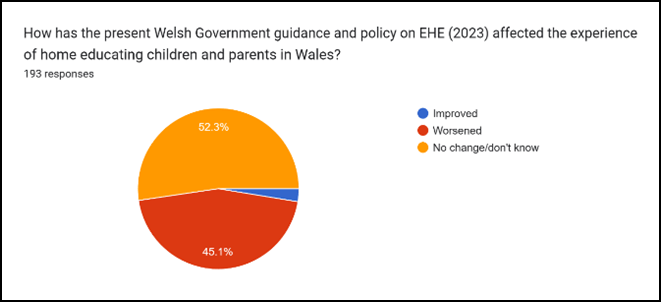
On giving their views of whether the present WG guidance on EHE had improved or worsened the experience of home educating children and parents in Wales, respondents were given the opportunity to comment further on their answer.
Responses tended to fall into categories of
- Those who were aware of the guidance itself
- Those who were judging by recent experience of la conduct rather than the guidance as written
- General comments relating to previous questions and issues rather than directly in relation to the guidance.
These comments highlight that there can be two key issues –
- What guidance (or legislation) may contain
- And the differing ways various LAs may or may not apply this.
———————————————-
Comments relating directly to the content of the WG 2023 guidance
It is so deliberately misleading as to be coercive.
SO many of us tried to engage with the Welsh Government when they were drafting this, but we just, as always, met with stonewalling and gaslighting.
It offers not benefit to children. The previous 2017 guidance was so much better.
I am not great at politics, and I’m not sure if this is due to the 2023 guidance, however I have noticed more issues with LA’s overstepping, pushing boundaries, making the assumption that children “need to be seen”.
No one seems to really understand it
LA staff don’t understand it, and if they do they abuse it.
I don’t think it’s really impacted at all. To me, home ed seems to be something that no one at the LA really wants to deal with. The guidance doesn’t really correlate with legislation in places
It has made home educators more likely to disengage with the LA even when they had good relationships before.
The LA is using the guidance to justify overreach including door stepping people without appointments and sending out correspondence that is frightening to parents as the letters are the same ones used by EWO for children who do not fall in the home ed category.
There was a marked negative shift in our local authority’s attitude toward EHE when the new guidelines were published.
Archaic and controlling.
It has increased uncertainty and anxiety for families, shifting the tone from supportive engagement to monitoring. This erodes trust and makes collaborative relationships harder to sustain.
It is sufficient for all that is needed.
Personally we have had no change but others may have
It reads as if there are mandatory things (eg. face to face meetings) which are not mandatory at all and, in fact, only that parts preceded by “must” are legal requirements. It suggests the Welsh Government have a great support package for home education, which they do not (including some issues with exam centre access). It suggests the LAs duty is proactive and not reactive, to identify those not in receipt of a suitable education. It conflates s437 and s436A of the Education Act 1996. The suggested elements included in reference to how an education can look make it sound like they should be included or followed when the duty of parents is to ensure their child has an education that is suitable to that individual child’s age aptitude and ability, including any ALNs, and if parents did have to follow a list of these elements, then it would be too restrictive to meet children’s specific and individual needs.
Deliberately misleading.
Controlling.
No change at moment but this might happen with the pilot to find unregistered home educators
The guidance is coercive and manipulative, it treats families with contempt and suspicion
The present guidance is deliberately manipulative and coercive. How are we meant to trust a government and their staff when they do that?
Coercion. manipulation, bullying. tries to use intimidation. deliberately tries to confuse people to try to trick them into doing what a few policy makers want. completely unacceptable conduct.
Tries to trick people into compliance with someone else’s political ideas. That is completely unacceptable.
It is deliberately misleading.
it is NOT statutory guidance. there is nothing newly “”statutory”” in this guidance to the previous non-statutory guidance. They use that term “”statutory”” as a further attempt to intimidate, control and manipulate people.
The Welsh Government gaslight and stonewall people who have tried to engage with them and feedback just how bad their policy and guidance is.
It isn’t just their guidance that is poor, it is their policies on EHE – policies based on suspicion, mistrust, state control over families, state knows better than people approaches.
it is deliberately manipulative. It is designed to trick people into changing behaviour by intimidating them. It is dishonest. It is not “statutory”, they just put that to try to increase the intimidation. There are no new “statutory” elements.
Uses bribery to try to get their “eyes” on children. That’s plain creepy as well as manipulative.
It is a tool for coercion in the way they try to manipulate and pressure people into having meetings against their will and better judgement.
The government and local authorities are being deliberately misleading when they repeatedly call it statutory, as there are no new statutory parts to it compared to the previous 2017 non-statutory guidance.
The Government are also being deliberately misleading and openly misusing law when they claim that children who are not known to the local authorities are CME – they are not missing education, they are home educated, they just aren’t on some list at the council. “
Just causes more pressure and stress.
Again, just adds to stress and pressure. Doesn’t help us, just tries to manipulate and control us.
It’s already interfering in family life , values & rights. It’s insulting, as it basically implies that parents are not capable and can’t be trusted to educate and raise their own children
Other comments in response to this question did not necessarily relate directly to the question about the present WG-guidance on EHE, but are retained as these also provide useful additional insight into the experiences of home educators in Wales.
Comments relating to present experience of LAs rather than to the WG guidance.
These responses reflect the mixed and varied experiences of home educators in Wales in relation to LA conduct.
There have been positives and negatives in our area. The worst negatives have been opportunities that, when previously organised by parents, were open to all…
have now become, when taken over by LAs, exclusive to children within each county only. Living on the borders makes this extremely upsetting.
Also, families who do not wish to be on a register have had their opportunities actively reduced by the threat of venues and hosts sharing their data with the LA when they previously didn’t. Positives have been extra funding for children’s educational equipment and opportunities arranged and funded by LAs that otherwise wouldn’t have been available to us as a low-income family.
As explained, we have been “found”. I was told that Anglesey is a “good” LA but my experience demonstrates that their new powers are causing them to behave very differently, moving straight to threats and intimidation tactics.
I don’t know it enough to comment right now but I do know my LA and schools have told me so much misinformation. Threatening fines, shoring up at my house. The stress it’s caused us all is unbelievable. My kids are happier now than in school. No longer suicidal, no more meltdowns depression easing. Just give us space
The present system is sufficient and works well both for families and the LA who are not overburdened with additional workloads.
We manage perfectly fine when overstepping isn’t an issue.
My children were deregistered in 2024. But so far I have had a positive experience with the EHE team and have found the support, information adequate.
Not sure as we have only been home ed less than a year. So far, all good. Extremely unhappy about the proposed changes though. I think they are disgusting. Intrusive, overbearing, and inappropriate.
Home ed officers are turning into bullies and putting g pressure on families that don’t need the extra pressure. Keep them away from us.
The LA trying to enforce policy that bears no relation to the legislation in place feels like the bullying I experienced in school as a child. This is not how good trusting relationships are formed. A lack of trust between parents and the LA makes it difficult for parents to engage and puts barriers in the way of cooperation.
Some councils have a great reputation amongst home ed families where families will approach for help however there’s a postcode lottery and this is not across the board. I am very worried about how things will progress despite being incredibly confident in our own provisions for home education. We should be looking for ways to work together rather than power over. Power over already exists for when it is genuinely required.
We have yearly home visits from the LA & have always had positive experiences. They look at our children’s work but don’t push the children to talk to them & are generally very helpful & we feel that they understand & are ‘for’ home education. They’re always sending out emails with activities that are happening locally that might be of interest to us & are very approachable. We feel very lucky as know that other areas have very different experiences with the LA that have not been good, turning up unannounced for home visits, pushing for evidence of work & generally being threatening & scary. These LAs are the reason that some home educating families try to go under the radar. I feel that if the new proposed laws came in it would become ‘us & them’ & that would be very sad & scary…& scared parents don’t make for happy families
Since we started home educating in 2025, we have had very little involvement from our local authority, and most communication has been agreed in writing. I appreciate the space this has given us, it allows our child to learn without pressure and for our family to focus on wellbeing and individual learning needs.
We have found ***** county council to be quite hands-off and this has worked well for us. I know it’s not the same Wales-wide but I can’t comment on other authorities as I don’t live there.
LA threatened child services involvement. Their purpose is purely for education only. Not welfare checks. My children’s education is beyond satisfactory and they attend multiple home ed groups with dedicated people who are all trained in safeguarding.
Whilst my own family has had no difficulties with our LA, I know of some other families whom have had requirements asked of them which are not currently required. This makes them less likely to have a good working relationship with the LA, which can only be detrimental. A supportive and non-judgemental approach, with good training would be a better path to achieve good outcomes for all.
General insightful comments about home education experiences, but which do not relate to the WG-guidance or LA conduct.
We have been Home Educating after 5 years of Emotional School Based Anxiety and Trauma. Home Education saved my daughter’s life. No other options were offered to us by the local authority. She would have been expected to continue attending a hour a day, with everyone knowing the damaging impact it was having on her. It is a difficult and heart wrenching reality that so many families go through and to be villainised and scrutinised by the proposed Bill, the government and media, it’s nothing short of devastating. My daughter is so much happier, healthier and making wonderful progress BECAUSE she is Home Educated.
Unless there is a genuine cause for concern, as with any child in school, these measures are a complete waste of time and money. They are of no benefit to home educating families, who are feeling targeted. The home educated children will not benefit. The measures will increase parental stress and workload. They are a complete invasion of family privacy. As parents, we know our children better than a complete stranger, who meets them for a short space of time. Children who are shy, anxious or have SEN will find that stressful. The money and time spent on this should be used elsewhere to improve schools or provide home educators with free exams etc, which would actually have a positive effect. Home education alone is not a risk factor for harm.
At the moment parents have freedom to choose how best to educate their children & I think that’s fair. All of the home educating families I know are educating their children in slightly different ways but all of the children are happy & learning. Home education is about tailoring education to your child instead of your child having to fit into a style of education that didn’t/wouldn’t work for them.
The issue isn’t that EHE families need more scrutiny, the issue is our education system is failing children, and is harming many neurodiverse children. The government could/ should focus on improving, updating and in an ideal world transforming our education system. We understand so much more about different learning styles, neurodiversity, the effects of puberty, changes in technology AI, mental health and wellbeing why is this being used to change it, in a real meaningful way.
Non-Home Education people are suspicious and sometimes aggressive on your choice of Home Education. In just a short time, it’s not like how I started out.
.
Just over one-fifth of respondents who had exercised their lawful rights to decline a meeting or visit from the LA cited they they had met difficulties from the LA for doing so.
Free text descriptions of the difficulties and consequences faced for declining what lawfully should be only an “voluntary offer” of a meeting included:
- “Anxiety”, “stress”, “fears”, “worrying”,
- “intimidated”, “scared”, “nervous”
- “Not taking no for answer, trying to influence decision”
- “Unsolicited calls”, “doorstepping”.
- “Pushback and pressure”
- “Threatened”, “threatened with SAO”.
- “Told it would count as a ‘refusal to visit’ which feels like a loaded way to put things”
- Needed to “persist” and “quote the law”
- kept demanding in a rather threatening way more information than is required to confirm my child was not their remit.
- “Took fending off so many intimidating and threatening communications.
- “exhausting having to deal with this, it took so much time. It took time away from being with my child”
Examples of misinformation given and misconduct to try to force actions without lawful remit included respondents who were:
- Told that it was a management decision whether acceptable to not have a meeting
- Told in way that made it “sound like it’s mandatory” that “they are unable to judge education without seeing the home environment, meeting the child and seeing ‘samples’ of work”.
- “(Threatened) that if we don’t send samples or agree to visits, this would be considered a sign that we are not educating appropriately and would probably lead to an SAO.”
- “Threatened with SAO, unlawfully”
- “I was told I must have someone come to my house to complete forms to apply for EHE or I risk getting fined. And was told I need to accept someone coming to home visit once a year and see samples of work”.
- “Threatened child services involvement (for declining a meeting) even though said the education provided was more than satisfactory”
- They issued a SAO letter (for declining a meeting) – (respondent had previously been doorstepped and accepted visits because had been led to believe they were a requirement, until realised they were not and instead expressed a preference for communications in writing by letter).
- The LA person told me she knows we are (providing a great education”) but that she still has to check up on us anyway (by visits that the respondent felt too “scared” to say no to).
Concerningly one of the cold calls was a man wanting to visit the home when did not know the names of the children who lived there and did not know the name of the manager of the department he claimed to work for.
That was for a family where the LA had already been confirmed only months before that the child was not missing education and therefore not under the council’s remit.
A number of responses were from home educators who had “given in” to pressure to demands for things that are not lawful requirements.
Reasons for this included:
- Being given impression home visits were a requirements – and feeling “betrayed by the LA” on finding they were not.
- Feeling “too intimidated and scared to say no to meetings” even though the LA have confirmed there no concerns about educational provision.
- “feel too nervous and worried about repercussions to say no to meetings with the LA. It’s just easier to agree to them than try to fight the battle of saying we don’t need to have them. That isn’t right, we know, but we just have too much on our plate already in caring for children to have to fight the LA too. It’s really wrong that the LA put us in such positions.”
- Felt I would make life more difficult for myself if I didn’t” – in relation to completing forms from the LA when the respondent had already provided the required information in a written response in their own format.
- When cold-called by “doorstepping”, “felt like we had to let her in as didn’t know the rules then
Responses as given include:
Felt such anxiety at how they would react, even though I know am behaving lawfully, because of fears of a negative reaction from them for not doing what they wanted.
I know from others how they have used bullying tactics when declining meetings.
They tried to force a phone call. The thing is the LA had met my son a fortnight earlier when he went to sit a mock exam with them!
Just not immediately taking no for an answer and trying to influence my decision making as a parent.
I had an unsolicited phone call from a mobile number and a caller stating his name and that he was working for the “home school” team and wanted to visit my home for children he didn’t know the names of.
The man did not know the EHE managers name and later stated he was agency staff employed by the council. I ended the call and had to raise a corporate complaint with the local authority to get the matter closed down. The call was within 8th month of my previous written responses supplied to the local authority.
Push back and pressure to allow them a meeting. Stating that written communication was not preferred and would have to be assessed by management to see if it was acceptable, otherwise a meeting would be necessary.
They have written to try to insist (and made it sound like it’s mandatory) and saying that they are unable to judge education without seeing the home environment, meeting the child and seeing ‘samples’ of work.
They have said (threatened) that if we don’t send samples or agree to visits, this would be considered a sign that we are not educating appropriately and would probably lead to an SAO.”
Threatened with SAO, unlawfully. Because they knew it was unlawful they now demand it would be made lawful in the CWS – that is not ok. That is making abuse of power legal.
I was told I must have someone come to my house to complete forms to apply for EHE or I risk getting fined. I declined. And was told I need to accept someone coming to home visit once a year and see samples of work
It was of no benefit to our family. Had to miss a home ed group that day to attend the meeting. It was a waste of our time.
They threatened child services involvement (for declining a meeting) even though said the education provided was more than satisfactory
They issued a SAO letter.
Letter announcing visit came from social services following doorstepping by unknown man. I did not answer the door to the social worker but sent a letter, email and formal complaint. SS acknowledged and apologised, Education Dept sent initial response to complaint which was a combination of lies regarding what had happened and a policy statement so am currently awaiting response to my escalation
It took me emailing 4/5 times in answer to her texts and a complaint to her supervisor to get her to stop and understand I was FULLY aware of all my rights.
Awaiting response
Told it would count as a ‘refusal to visit’ which feels like a loaded way to put things. I actually created a lengthy report as a result of feeling it would reflect better and have a more positive outcome for all involved. I also wanted to protect my children’s safety in the home and not cause them distress by a stranger coming with pressures and questions.
They were confused by my rights and the law until I persisted and insisted and quoted the law
increased anxiety and stress of worrying if and how if would be held against us.
LA person was really pushing and intimidating. Then kept demanding in a rather threatening way more information than is required to confirm my child was not their remit. I stood my ground, and simply gave sufficient info to confirm my child is not CME. Eventually they accepted that this was indeed sufficient to confirm that, but it took fending off so many intimidating and threatening communications. It was exhausting having to deal with this, it took so much time. It took time away from being with my child.
A selection of responses to the question were from those who had met such difficulty in declining demands from LAs that did not have a lawful basis that they had “given in” to LA demands against their will and choice, or had agreed because of being led to believe these were a requirement.
I thought I had to have these meetings, that is was a requirement of home educating that I had to have them, so it wasn’t so much me agreeing to them as thinking I couldn’t really not agree if I wanted to continue home educating. So I just got used to having them.
When I found out that I didn’t have to (from others) I felt betrayed and used by the LA.
I feel too intimidated and scared to say no to meetings, even though I know and they know we’re providing a great education. The LA person told me she knows we are but that she still has to check up on us anyway.
We feel too nervous and worried about repercussions to say no to meetings with the LA.
It’s just easier to agree to them than try to fight the battle of saying we don’t need to have them. That isn’t right, we know, but we just have too much on our plate already in caring for children to have to fight the LA too. It’s really wrong that the LA put us in such positions.
Did have difficulty with responding in writing as la bod wanted the info in the form format and I felt I would make life more difficult for myself if I didn’t put the info I had already submitted but was ignored, into the form
I was doorstepped as my information was shared with the LA due to my work …. felt like we had to let her in as didn’t know the rules then
As Questions B.3.5.1, B.3.5.2, B.3.5.3, B.3.5.4 relate to quantitative rather than qualitative data, the responses to these, and the evaluation of them, can be found in the main survey report.
Section B.3.6
Respondents were given the opportunity to comment on the following question.
“Have you ever experienced overstepping or inappropriate conduct by your LA in some other ways?
If so, could you kindly share below:
Responses demonstrated a spectrum of ways where council staff had overstepped respectful or lawful remits and/or acted in ways that were not in the “best interests” of the wellbeing of the child.
One time someone from the council turned up unannounced, when we were not in. Our builder answered the door, and she said she was from the local authority and had had to come out to check up on us because we home educate. This made the builder really suspicious of us, even though he knew us quite well, he thought we must have done something wrong.
I accepted a home visit because I thought we had to. Whilst the lady seemed “”nice”” I showed her all sorts of things I didn’t know I had to, even showed her round every room in the house including the children’s bedrooms, all sorts of personal information. She didn’t once indicate that this wasn’t necessary. When I later found out that she did not have a right to this, that she didn’t need this, I felt so betrayed and tricked. I would never trust them in my home again.
I was under the radar, and was found when I met a member of the LA from a completely different team, to have my documents signed for a DBS form, decided to question me about home education as I had my children with me. I gave no impression that I was under the radar, however she chose to go straight to the EHE officer and give my details and ask if my children were registered. By the time I got home (20 minutes journey) I had an email. This just proves the mistrust that they have in us. “
After I refused a visit, I was told to write a report, the deadline was 10 days after the email requesting a report was sent. (for reference, even formal process under s437 of the Education Act allows 15 working days for families to respond, however there have been increasing complaints of unworkable or inappropriately timeframes being given by LAs for initial informal enquiries as if these are mandatory deadlines).
Phoning me at lunchtime because I hadn’t replied to an email she had sent that morning, very impatient.
Door stepping when unexpected. Inappropriate suggestion of using SPOC referral for ND pathway assessment.
“Yes, we were doorstepped.
Yes, one of the EHE staff members told me private information about another EHE child from a different family which made me uncomfortable and I was concerned that they might disclose things about my family to others too. I told them that this was not appropriate and she stopped.
One of our LA EHE staff members is very unreliable and has a few times not done what was promised and arranged, e.g. they forgot to book a hall for a GCSE exam, didn’t turn up for various appointments without letting us in advance or even at the time, “
Turning up in-person unannounced and giving inaccurate information.
pushy emails.
Door stepping initially.
A phone-call to try and bribe us to go on the home-education register by offering vouchers. Not making it clear that we could decline to be put on the register, at the time.
The initial phone call from the LA was not in line with practices but the email communication has been.
They have also taken the step of asking a school to prepare a place to my child after just one letter requesting info …. we agreed a date to submit the written report with a colleague of the person sending the letters; and that date had not yet been reached but the 2 colleagues had not shared information, so one had agreed we were not yet due to submit the annual report and the other was already escalating to SAO.
The head teacher of our local school shared their letter to him, with me, so I have written proof that they were proceeding with the SAO without following the due process.
In hindsight the doorstepping of school staff was excessive and intrusive but I didn’t realise that at the time. This serves only to highlight that even well meaning /apparently well meaning home visits can traumatise children and actually serve to break trust.
Yes. Once even claimed I had ignored responses for years and threatened with instance SAO. I showed proof and complained, to which she was then promoted!
Yes, in many ways over the years by many departments.
Yes, prior to deregistration, an EWO visited us at home and questioned my 8-year-old Autistic child on why she didn’t want to go to school and told her that I would get into trouble. It resulted in my child becoming exceptionally distressed and the EWO left. She fed this back in a meeting as ‘evidence of ESBA’, but didn’t feedback that it was caused by her presence or questioning.
Talking over me on the phone, not letting me speak, making me feel like I was a child
The ‘home’ education officer tried to negotiate my child into school and barter a deal between myself and other parent. Intrusive and unprofessional at least, with no interest or understanding of background and putting both my child and myself at risk.
Threatened child services
Yes, unarranged visit, threatened with SAO when I tried to stand up for my child.
Yes, as above. I was located via the pilot scheme, received and responded to one letter, was subsequently doorstepped and reported to social services because I refused to give personal details about my child to a strange man on my doorstep.
Yes
Giving me a date and time to meet when they have not consented with me first that the date and time suited us. Asking for actual proof of work and asking us to date it
Yes very much so. As discussed above in my last comment section.
yes in relation to IDPs
yes
How intimidating and pushy they are.
The LA person tells me things she thinks I should be doing in terms of the children’s education. My children are thriving and learning so much more than they would in school using the approaches we take, which are very different to those taken in school. I try to ignore what she says and hope that she’s forgotten by the time she next makes contact, but it induces significant anxiety in me. I find myself so dreading every contact, not because I’m worried about my children’s education, I’m not at all, they are really flourishing, but because of whether she’ll try to make me do things differently when I know they are not the right thing for my children. She has such a school-like view of what education should be. So, she can seem so nice and pleasant, but really it’s very unhelpful and manipulative. It’s pressure I really could do without. It would be so much easier if the LA would just leave us alone.
I feel too intimidated and scared to say no to meetings, even though I know and they know we’re providing a great education. The LA person told me she knows we are but that she still has to check up on us anyway.
They try to tell us how we should home educate our children. That’s wrong. They keep trying to suggest school like ways that we know would switch off our children’s love of learning. We just nod and pretend we’re interested because we’re too worried about how they’d react if we stood up for ourselves.
Trying to enforce visits and asking for a 12 month plan ahead on home education
Asking for reports more often than necessary
“Are you aware of issues or problems with LA conduct towards EHE families where home educators have tried to engage with the LA but either where there are still persistent problems and issues, or where LAs have refused meaningful engagement on these?
Yes, so many. Letters being sent out claiming people haven’t sent info when they have.
Yes. They could go back to the office and produce a false report
Plenty of times. Parents explaining what they’ve been doing, but the LA just refusing to accept or place unreasonable expectations of hours working or social engagement.
Yes I often see in groups that parents have not been given time or a fair chance to reply to reply to enquiries or they have replied and the LA has been unfairly unsatisfied with the parents answers.
Yes I’ve heard of other officers being invasive, rude and threatening.
Yes, I am aware of issues with communication between the LA and home educators generally from forums I am involved in. Mostly because the LA are overstepping on their lawful remit
I have on several occasions emailed the EHE line manager, and he simply does not respond. To get any sort of response I have had to escalate my query to the head of department.
I am aware that our LA tends to ask newcomers to EHE information that EHE families are not required by law to provide.
Our LA sometimes sends out generic threatening letters to EHE families even when they have recently sent out reports to EHE LA staff, particularly to families new to home education.
Asking for help with Autism/ADHD assessments. Requesting an EHCP, before removing our child from school, given advice to contact SNAP Cymru by the LA, who were not helpful in the slightest.
Yes
They do not answer emails when families send ideas
When my child was in school, the report was 2 lines for each subject and gave no real reflection of my child’s development academically. The meeting school provide, aka parents evening, was a disorganized chaotic event, that was brief and impersonal. I cannot imagine if I delivered a meeting with such indifference, that the LA would deem it ‘acceptable’.
Yes – where I’ve engaged with one person and believed we understood each other then they haven’t shared information and another person has issued an SAO when we hadn’t even reached the report due date.
Yes. Constantly can only be the national curriculum too, which belittles child’s education, she can and does do more.
Yes I’m aware of other families problems with the way the LA approach their remit and overstep causing distress and harm to families.
Yes, it’s widespread
I have heard in groups we attended that some can be problematic
Threatened child services
I engaged in writing, they doorstepped me and reported me to social services.
I know of other families where the LA has doorstepped them, knocked on neighbours houses, issues SAO’s because the parents wouldn’t provide work, LAs that have barged in when only the teen child was home, LAs that have grilled the kids in their knowledge and scared the children.
“Yes – and the LA just aren’t interested in hearing from families, or in genuinely improving.
Staff are more interested in protecting their own jobs and working up the career ladder. “
yes aware of various issues
know how they have tried to trick, manipulate and bully other home educators in my area.
yes, aware how they try to trick people into providing information about their families that is not necessary
“Yes, and LAs don’t want to hear.
I know Home Ed Cymru and other groups have tried to regularly send communications to LAs to try to engage, to help ensure conduct is respectful and within lawful remits, to try to reduce how we find ourselves having to mistrust LAs. But LAs just don’t care about what families experience and think, they just want to try to enforce power and control, they are determined to not trust normal families. They think they are better than families.
Yes. We’ve tried to in our area. They just don’t want to listen to anything, unless it were us saying we’d do whatever they wanted.
Home Ed Cymru have sent out regular communications to try to encourage LAs to listen to home educators in their area, to help encourage LAs to keep within lawful remits .But LAs don’t seem interested in keeping to lawful remits, only in pushing for power and control over people, only to tick their boxes rather than act in ways that benefit families.
I know other great families who have.
Yes, I know some home educators try to explain to LAs when they overstep that they shouldn’t really be doing that, that what they are doing is misleading or wrong, but that puts those home educators in the firing line. So most home educators are too scared to try to stand up to councils when they overstep and misuse their powers. How much worse will that be if even more powers were given.
Yes i know other families who are too scared to say no to meetings even though they are great home educators.
Yes I know of others who have real fights on their hands to stand up for our rights as home educators, only to meet gaslighting and stonewalling.
Yes only from witnessing on EHE groups on people’s bad experiences
Yes, parents where treated like child abusers
Questions B.3.7.1 , B.3.7.2 and B.3.7.3 relate to quantitative data, so the results for these are found in Section B of the main survey report.
Please see the Conclusions as given at the end of Sections A and B for a summary of the findings of this survey
 Wellbeing in Education Wales